 Famous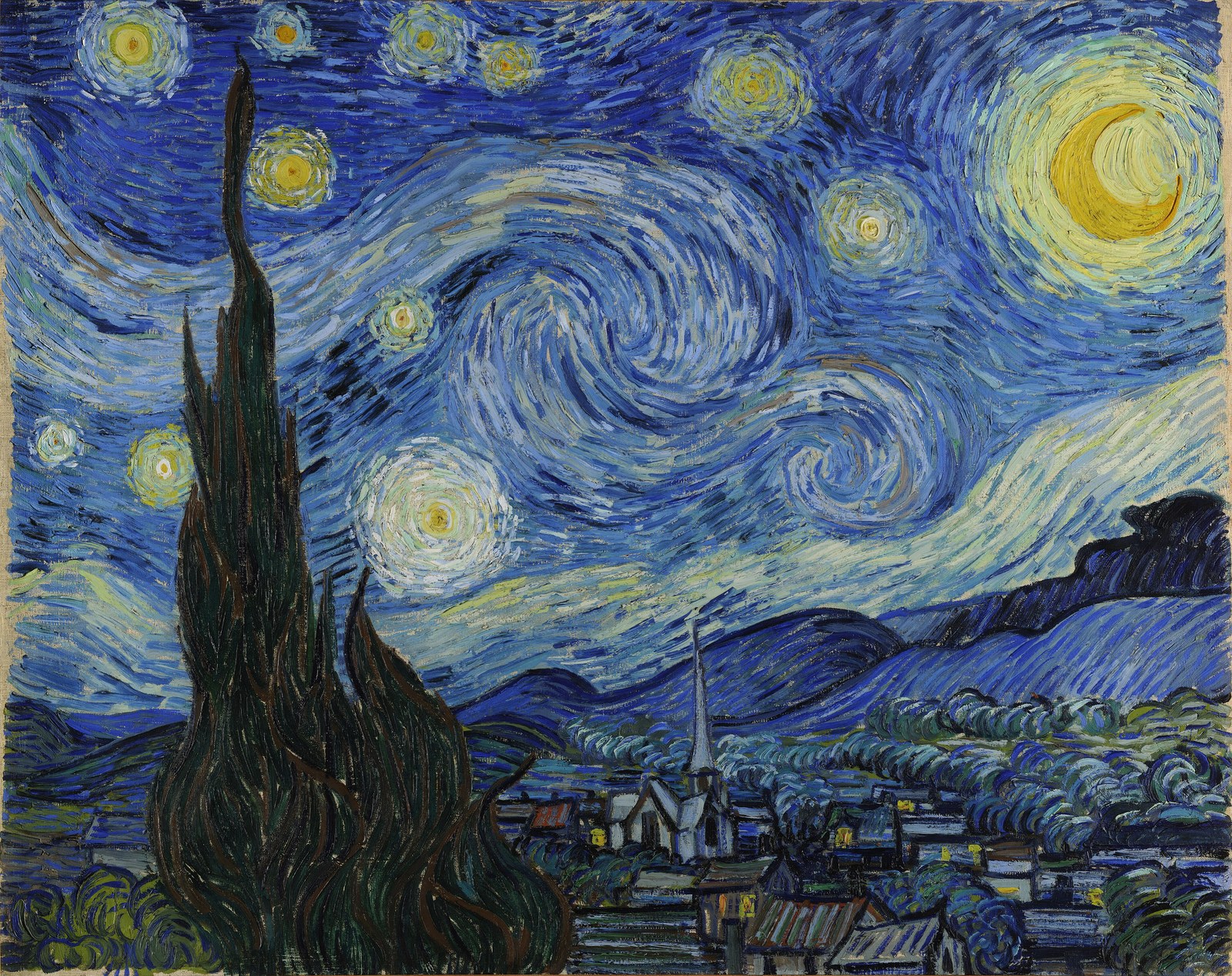
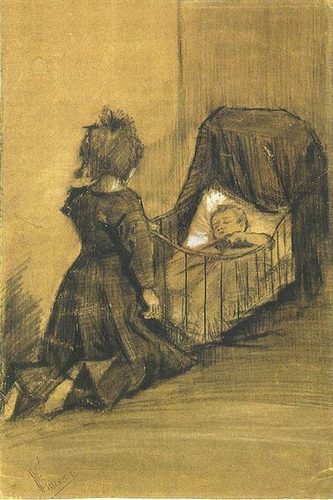
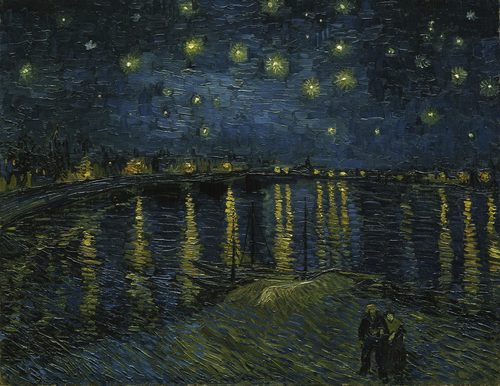
Vincent van Gogh (1853–1890) was a Dutch Post-Impressionist painter whose brief, intense career produced some of the most recognized images in Western art, including The Starry Night and his sunflower series, painted through emotionally turbulent final years in France.
Van Gogh came to painting late, in his late twenties, after failed careers as an art dealer, teacher, and evangelical preacher among coal miners in Belgium. Self-taught and voracious, he absorbed Dutch masters, Japanese prints, and then, after moving to Paris in 1886, the color theory of the Impressionists and Neo-Impressionists. His own style crystallized after he moved south to Arles in 1888, where intense sunlight and his own restless energy produced thick, directional brushwork and saturated color applied with startling speed.
He suffered severe mental health crises from late 1888 onward, including the episode in which he injured his own ear, and spent periods in psychiatric care at Saint-Rémy. He continued painting prolifically throughout, completing some of his best-known canvases in the asylum garden and the wheat fields near Auvers-sur-Oise, where he died in 1890 from a self-inflicted gunshot wound, two days after being shot.
How to recognize a Gogh
Thick impasto brushwork
Van Gogh applied paint straight from the tube in raised, visible ridges, sometimes with the brush handle or a palette knife, so the surface itself has texture you can trace with your eyes.
Directional, rhythmic strokes
Skies swirl, wheat fields ripple, and cypress trees twist upward in curling, repeated strokes that follow the form of the subject, turning brushwork into a kind of visible motion and energy.
High-key complementary color
He paired colors directly opposite each other—blue against orange, yellow against violet—at full intensity, creating vibration and heat between hues rather than blending them into a single, quiet muted harmony.
Everyday, humble subjects
Worn boots, a simple chair, a bedroom, wheat fields, and village postmen appear again and again—ordinary subjects Van Gogh treated with the same intensity most painters reserved for grand or heroic scenes.
Expressive, unmixed color fields
Rather than optically blending tones, he laid pure color beside pure color and let the eye do the mixing, favoring emotional truth over the muted, naturalistic palette of academic painting.
Urgent, rapid mark-making
Letters describe him painting fast, sometimes finishing a canvas in a single sitting, and the resulting brushwork keeps a visible sense of speed and pressure, as if the paint were still moving.
The life
Vincent van Gogh was born in Zundert, the Netherlands, in 1853, the son of a Protestant pastor. He worked as an art dealer's assistant and briefly as a teacher and lay preacher, ministering to impoverished miners in the Borinage region of Belgium, before deciding around age 27 to become a painter, largely self-taught with guidance from his brother Theo.
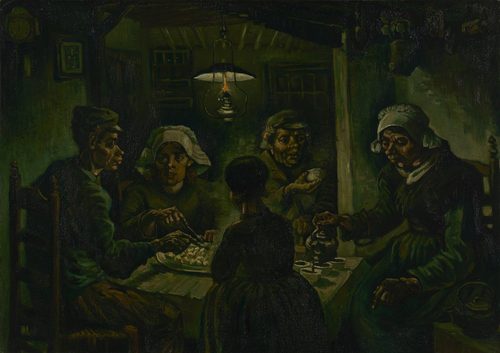
His early work, made in the Netherlands, was somber and heavy, built around peasant life; The Potato Eaters (1885) marks its high point. Moving to Paris in 1886 to live with Theo, an art dealer, exposed him to Impressionism and Japanese prints, and his palette lightened dramatically.
Seeking stronger light and hoping to found an artists' colony, Van Gogh moved to Arles in the south of France in 1888. Paul Gauguin joined him briefly that winter, but the collaboration collapsed in crisis, and Van Gogh suffered the first of several severe breakdowns. He voluntarily entered the asylum at Saint-Rémy-de-Provence in 1889, painting steadily between episodes, then moved to Auvers-sur-Oise near Paris in 1890 under a sympathetic doctor's care. He died there on July 29, 1890, two days after shooting himself in a wheat field, at age 37.
Timeline
- 1853Born in Zundert, the Netherlands
- 1869Begins work at art dealer Goupil & Cie
- 1880Decides to become a painter
- 1885Paints "The Potato Eaters" in Nuenen
- 1886Moves to Paris, discovers Impressionism
- 1888Moves to Arles; Gauguin visits and leaves
- 1889Enters the asylum at Saint-Rémy-de-Provence
- 1890Moves to Auvers-sur-Oise
- 1890Dies near Auvers of a gunshot wound
Most famous works
| Work | Date | Why it matters |
|---|---|---|
| The Starry Night | 1889 | A swirling night sky over a sleeping village, painted from memory and imagination at the Saint-Rémy asylum. |
| Sunflowers (series) | 1888 | Bright yellow still lifes made to decorate Gauguin's room in Arles, now among the most reproduced images in art. |
| The Potato Eaters | 1885 | A somber early masterpiece of peasant life in dark earth tones, Van Gogh's first major statement as a painter. |
| Café Terrace at Night | 1888 | A gas-lit Arles café rendered in glowing yellow against deep blue, painted directly outdoors at night. |
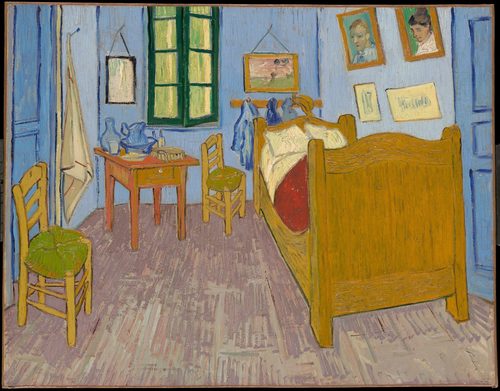
| Bedroom in Arles | 1888 | A simple, tilted view of his own bedroom, painted in flat planes of color meant to suggest rest. |
| Wheatfield with Crows | 1890 | A turbulent late landscape often, if not certainly, linked to his final weeks near Auvers-sur-Oise. |
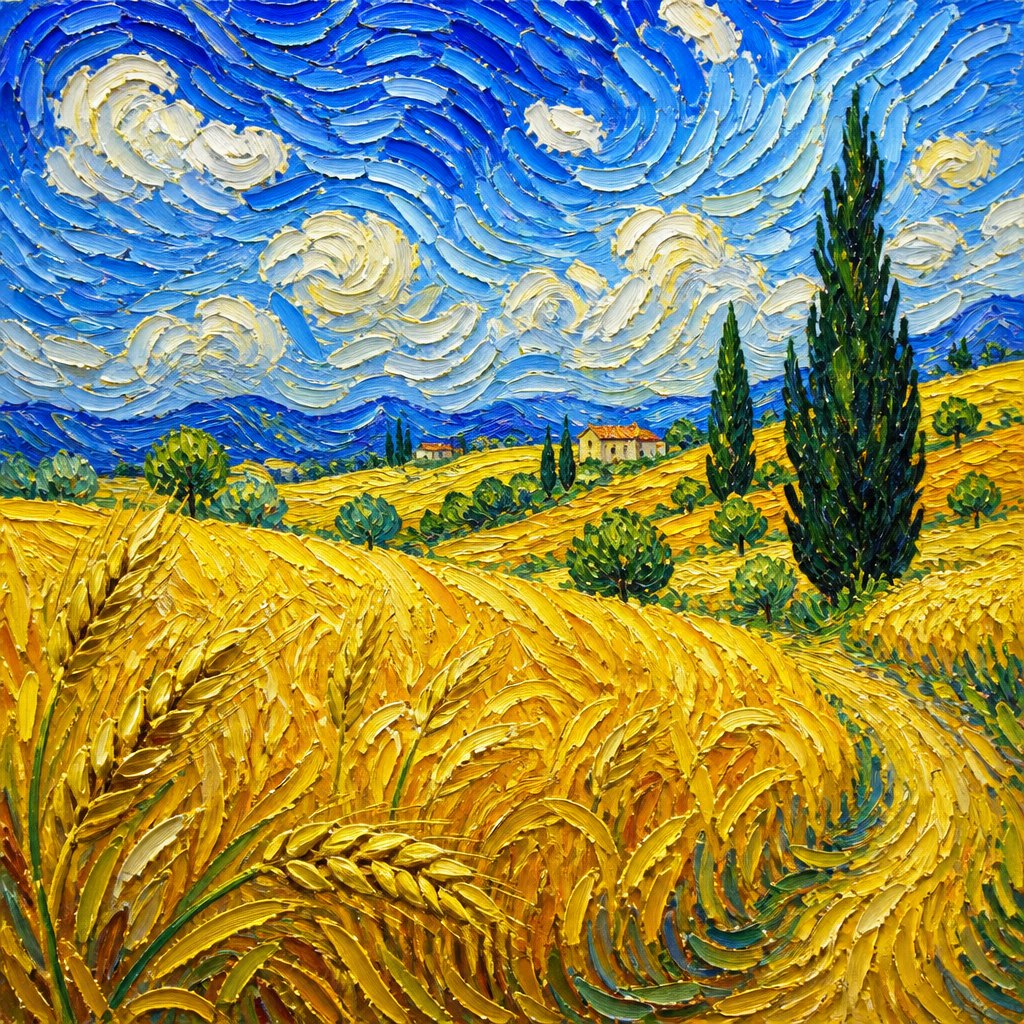 AI-generated
Create in the same spirit
Make Post Impressionism art of your own
This AI interpretation echoes the aesthetic world Vincent van Gogh worked in — it depicts no real artwork. Generate your own with the Post-Impressionism Art Style generator.
Open the Post-Impressionism Art Style generator →Legacy
Van Gogh's willingness to distort color and form for emotional truth became a founding gesture of Expressionism, influencing painters from the Fauves to the German Expressionists and beyond. His nearly unknown lifetime, supported almost entirely by his brother Theo, gave way to posthumous fame built through Theo's widow Johanna, who preserved and promoted his letters and paintings. Today he is among the most visited and reproduced artists in the world; the Van Gogh Museum in Amsterdam and the Kröller-Müller Museum hold the largest collections. His example—paint as urgent, personal feeling rather than polished description—still shapes how art students learn to trust their own eye.
Frequently asked questions
What is Vincent van Gogh famous for?
Van Gogh is famous for emotionally intense paintings built from thick, visible brushwork and bold color, especially The Starry Night and his sunflower series, made mostly in the last two years of his life in France.
Where can I see Van Gogh's paintings?
The largest collections are at the Van Gogh Museum and the Kröller-Müller Museum, both in the Netherlands. The Museum of Modern Art in New York and the Musée d'Orsay in Paris also hold major works.
What art movement was Van Gogh part of?
Van Gogh is classified as a Post-Impressionist. He absorbed Impressionist color in Paris, then pushed it toward emotional expression and symbolic color, work later seen as a direct ancestor of Expressionism.
How did Vincent van Gogh die?
Van Gogh died on July 29, 1890, in Auvers-sur-Oise, France, two days after shooting himself in a wheat field, following years of documented mental health crises. He was 37.