 Famous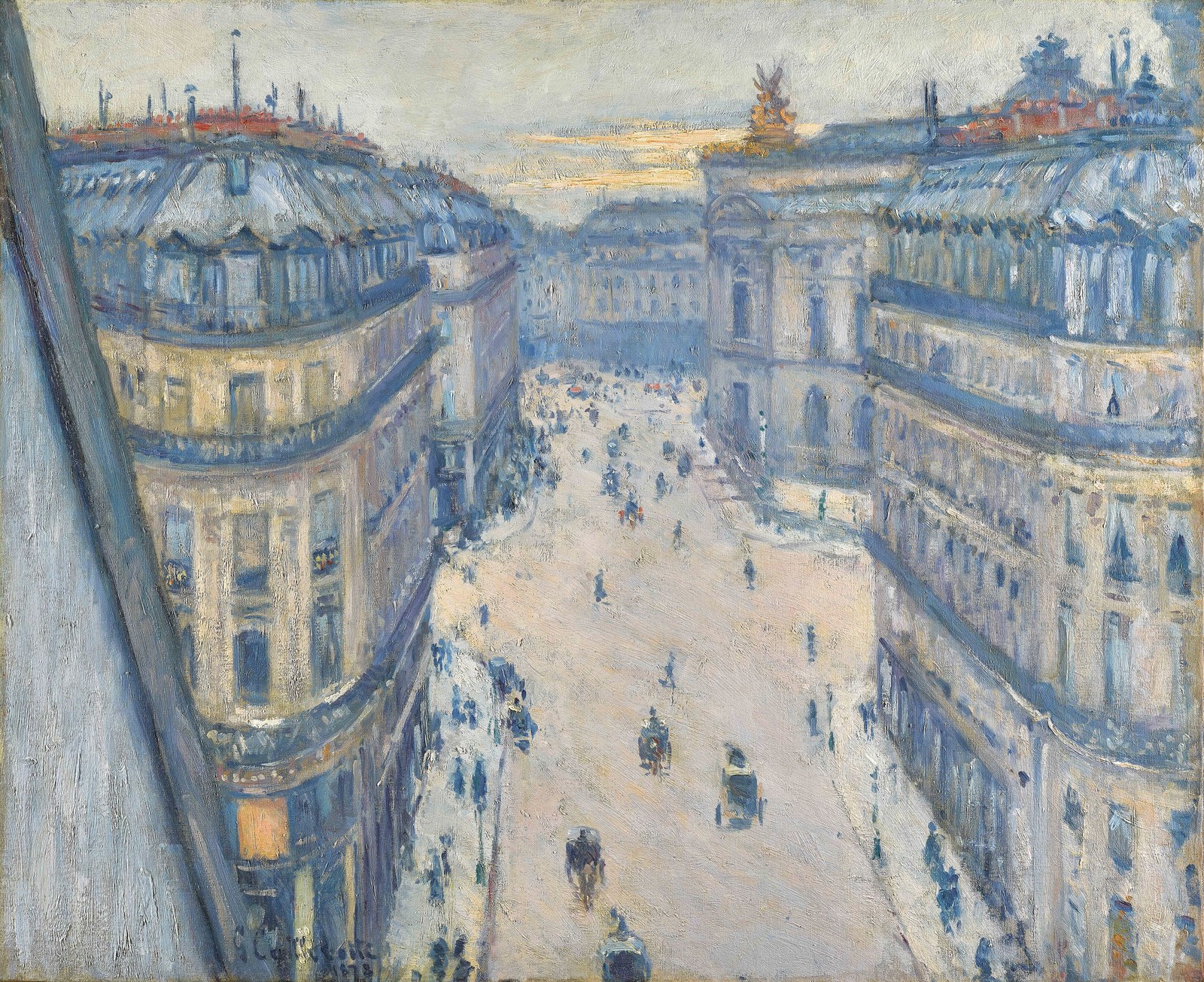
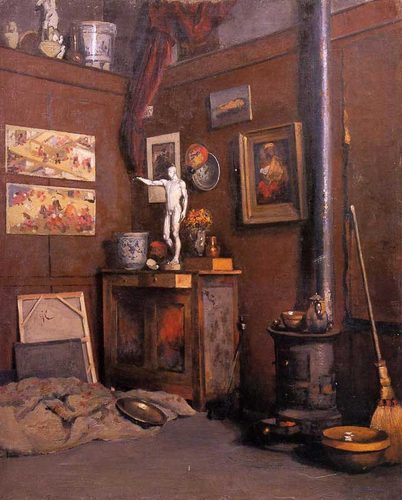
Gustave Caillebotte (1848–1894) was a French painter and patron whose sharply angled, near-photographic street scenes and rowing pictures brought a distinctive urban eye to Impressionism, and whose personal fortune quietly kept the movement financially afloat. Born into a wealthy Paris family, he trained under the academic painter Léon Bonnat and briefly studied at the École des Beaux-Arts before inheriting substantial wealth that freed him from ever needing to sell his work.
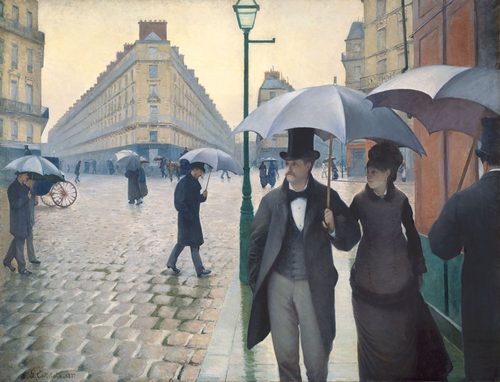
His 1875 painting The Floor Scrapers, showing laborers stripping a wooden floor, was rejected by the official Salon for its plain, working-class subject, so he showed it instead at the second Impressionist exhibition in 1876, joining the group he would go on to help organize and fund. Paintings like Paris Street; Rainy Day and Le Pont de l'Europe applied bold, cropped compositions and steep perspective to modern Parisian life.
An avid sailor, he also painted rowers and boats on the Yerres and Seine rivers with the same structural precision. He used his money to buy Impressionist paintings from struggling friends including Monet, Renoir, Pissarro, and Sisley, building a major collection. He died suddenly in 1894, and his bequest of that collection to the French state later formed a core of national Impressionist holdings.
How to recognize a Caillebotte
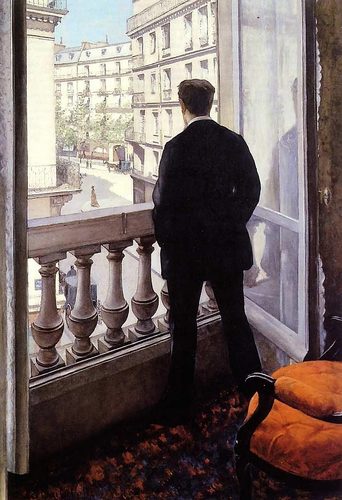
Steep, photographic perspective
Caillebotte often placed his viewpoint high above a street or tilted sharply down a floor, a cropped, foreshortened framing that owed as much to early photography as to painting tradition.
Modern Paris streetscapes
Wide new boulevards, iron bridges, and rain-slicked cobblestones recur throughout his city scenes, capturing the freshly rebuilt Paris of Baron Haussmann's renovations rather than the older, narrower, picturesque quarters painters preferred.
Working bodies at labor
Unlike many of his peers, he painted manual work directly — floor scrapers bent over bare wood, house painters balanced on ladders — treating ordinary labor as a serious, unsentimental subject worth close study.
Precise, controlled brushwork
His paint handling is tighter and smoother than most other Impressionists', closer to academic realism, giving his scenes a crisp, almost architectural clarity of form, edge, and structural line rarely seen in the group.
Rowers and river life
An avid sailor and boat designer himself, he painted skiffs, oarsmen, and riverbanks along the Yerres and Seine with close technical attention to boats, currents, and water caught in motion.
Isolated, solitary figures
Even in his most crowded scenes, individual figures often stand apart, faces turned away or half-hidden beneath umbrellas and hats, giving his busy modern Paris an undercurrent of quiet detachment and isolation.
The life
Gustave Caillebotte was born in Paris in 1848 to a family that had made its fortune supplying textiles to the French military. He trained in law and briefly served in the Franco-Prussian War before turning seriously to painting, studying under the academic Léon Bonnat and enrolling at the École des Beaux-Arts. An inheritance from his father in 1874 left him independently wealthy for the rest of his life.
His 1875 painting The Floor Scrapers was rejected by the official Salon for depicting laborers at plain manual work, a subject the jury considered too vulgar for serious art. He instead joined the Impressionist circle, exhibiting at their second show in 1876 and quickly becoming one of the group's key organizers, helping select works and secure exhibition spaces for shows through the early 1880s.
Because he did not need to sell paintings to live, Caillebotte used his money to buy work directly from struggling friends, including Monet, Renoir, Pissarro, and Sisley, assembling a significant private collection. In his later years he spent increasing time at his garden and boatyard in Petit Gennevilliers, painting rowers and flowers with the same structural precision as his city scenes. He died there suddenly in 1894 at age forty-five, leaving his art collection to the French state.
Timeline
- 1848Born in Paris
- 1870Serves in the Franco-Prussian War
- 1873Enrolls at the École des Beaux-Arts
- 1874Inherits his father's fortune
- 1875Paints The Floor Scrapers; rejected by the Salon
- 1876Joins the second Impressionist exhibition
- 1877Paints Paris Street; Rainy Day
- 1888Moves to Petit Gennevilliers
- 1894Dies suddenly; bequeaths his art collection to France
Most famous works
| Work | Date | Why it matters |
|---|---|---|
| The Floor Scrapers | 1875 | A frank depiction of laborers stripping a wooden floor, rejected by the Salon and later hailed as strikingly modern. |
| Paris Street; Rainy Day | 1877 | A large, sharply perspectival street scene of Parisians under umbrellas that remains his best-known painting. |
| Le Pont de l'Europe | 1876 | A steel bridge scene using bold cropping and steep perspective to capture Paris's newly modernized cityscape. |
| Skiffs (Périssoires) | 1877 | A river scene of rowers seen from a low, close vantage point, reflecting his lifelong passion for sailing. |
| The Yerres, Rain | 1875 | A quiet study of rainfall dimpling a river's surface, painted at his family's country estate. |
 AI-generated
Create in the same spirit
Make Impressionism art of your own
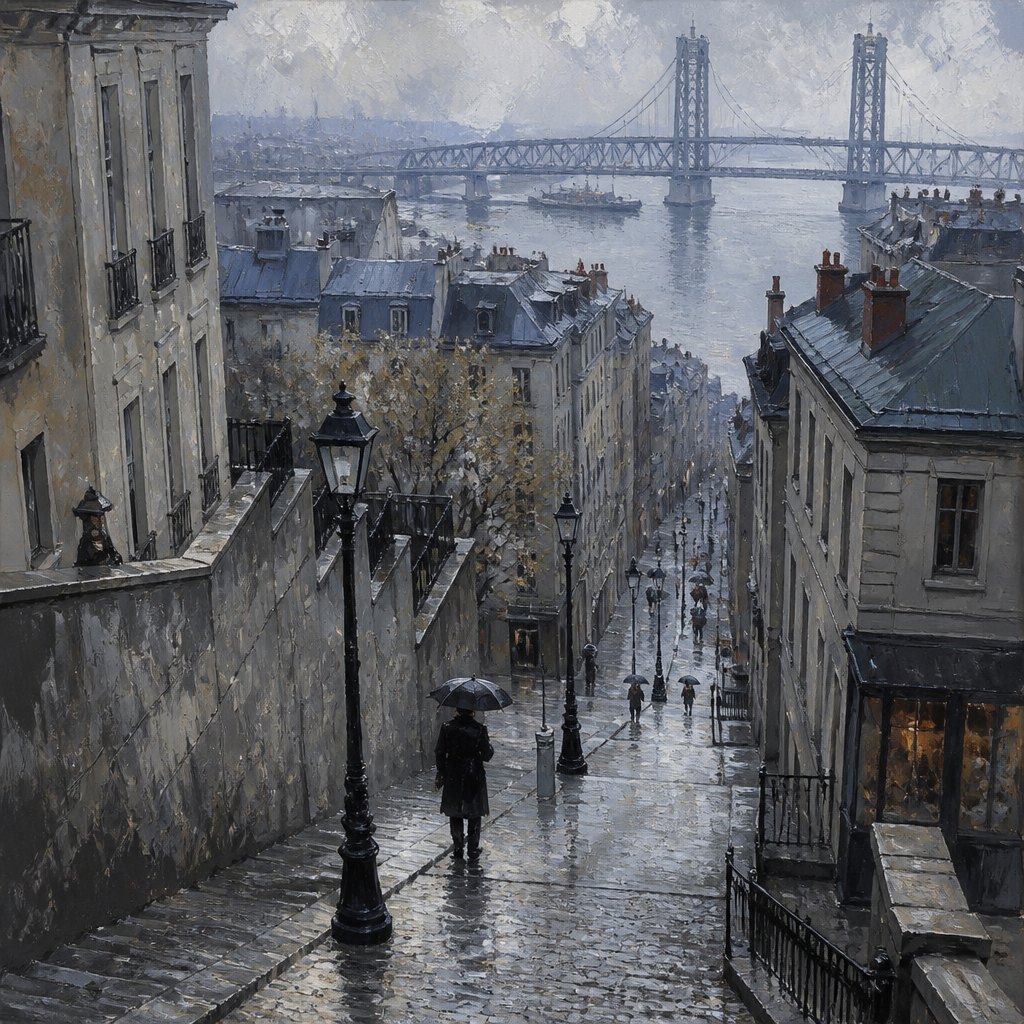
This AI interpretation echoes the aesthetic world Gustave Caillebotte worked in — it depicts no real artwork. Generate your own with the Impressionism Art Style generator.
Open the Impressionism Art Style generator →Legacy
Caillebotte was dismissed for decades as a wealthy amateur, overshadowed by the friends he supported, and it took until the later twentieth century for his own paintings to be seriously reassessed as some of Impressionism's boldest experiments in perspective and framing. His crisp, cropped, almost cinematic viewpoints anticipated ways of seeing that photography and film would later make familiar. Just as important was his patronage: without his purchases and organizing energy, several core Impressionist exhibitions might not have happened, and his bequeathed collection gave France's national museums their first serious holdings of the movement. His street scenes remain touchstones for painting modern urban space.
Frequently asked questions
What is Gustave Caillebotte famous for?
Caillebotte is famous for Paris Street; Rainy Day and other sharply perspectival paintings of modern Paris, and for using his personal fortune to buy and organize exhibitions for struggling Impressionist friends.
Where can I see Caillebotte's paintings?
His major works hang at the Art Institute of Chicago, which holds Paris Street; Rainy Day, as well as the Musée d'Orsay in Paris and other collections that received works from his bequest.
What art movement was Caillebotte part of?
He was a key organizer and financial backer of the Impressionist movement, exhibiting with Monet, Renoir, Degas, and Pissarro at several of the group's independent Paris shows starting in 1876.
Why was Caillebotte overlooked for so long?
Because inherited wealth meant he never needed to sell his art, critics for decades treated him as an amateur patron rather than a serious painter; his reputation was only fully restored in the later twentieth century.