 Famous


Georges Seurat (1859–1891) was a French painter who invented Pointillism, a technique of applying paint in small, distinct dots of pure color that the eye blends at a distance, most famously in A Sunday Afternoon on the Island of La Grande Jatte.
Trained at the École des Beaux-Arts in Paris, Seurat studied color theory closely, reading contemporary scientific writing on optics and perception by Michel-Eugène Chevreul and Ogden Rood. Rather than mix pigments on the palette, he set complementary and analogous colors side by side as tiny, uniform dots, trusting the viewer's eye to fuse them into more luminous, vibrating color than paint mixing alone could achieve.
He worked with methodical patience, producing numerous studies and drawings before a large finished canvas, a process closer to engineering than to the quick, spontaneous handling of the Impressionists he had grown out of. His paintings of Parisian leisure—bathers, promenaders, circus performers—combine this rigor with calm, almost frozen compositions. Seurat died suddenly in Paris in 1891, likely of meningitis, at only 31, having produced a small body of work in barely a decade of mature practice.
How to recognize a Seurat
Pointillist dot technique
Seurat applied paint in small, distinct, roughly uniform dots of pure color rather than blended brushstrokes, relying on the viewer's eye and distance to fuse them into a single luminous surface.
Scientific color theory
He placed complementary colors—orange beside blue, red beside green—directly next to each other in tiny dots, following contemporary optical science to maximize brightness and vibration on the canvas without ever mixing pigment on a palette.
Frozen, monumental figures
Figures in his paintings stand or sit in stiff profile, almost like statues, drained of casual gesture, giving scenes of everyday leisure an oddly formal, timeless calm rarely seen in ordinary recreation.
Painted borders and frames
Seurat extended his dot technique onto the frame itself, painting borders in complementary dots so the artwork's edge continued the optical logic of the picture rather than abruptly breaking it.
Parisian leisure subjects
He painted the modern city at rest—riverside bathers, Sunday strollers in a park, café-concert performers, circus acts—capturing a new middle-class culture of organized public leisure rather than the working life around it.
Meticulous preparatory method
Before a major canvas, Seurat produced dozens of small oil studies and conté-crayon drawings, working out composition and tone with the deliberate patience of an engineer rather than an improviser.
The life
Georges Seurat was born in Paris in 1859 to a well-off family, which gave him financial freedom to pursue painting without needing to sell his work to survive. He trained formally at the École des Beaux-Arts, studying drawing and classical composition before drifting toward Impressionism and, more decisively, toward the emerging science of color and optics.
He spent roughly two years, from 1884 to 1886, on his breakthrough canvas, A Sunday Afternoon on the Island of La Grande Jatte, developing his pointillist technique through hundreds of preparatory drawings and oil sketches. Shown at the final Impressionist exhibition in 1886, it announced a new movement that critics soon called Neo-Impressionism, with Seurat as its founder and Paul Signac as his closest collaborator and champion.
Seurat worked slowly and secretively, producing only a handful of major finished paintings in his short career, alongside luminous smaller studies of the Seine, the circus, and Parisian nightlife. He guarded his working methods closely and remained reserved even among fellow artists. In March 1891, he fell suddenly ill, probably from meningitis or diphtheria, and died within days in Paris at age 31, cutting short a body of work that had only begun to mature.
Timeline
- 1859Born in Paris, France
- 1878Enters the École des Beaux-Arts
- 1883Exhibits his first major drawing at the Salon
- 1884Begins "A Sunday Afternoon on La Grande Jatte"
- 1886Shows the finished painting; Neo-Impressionism named
- 1888Paints "Parade de Cirque"
- 1891Dies suddenly in Paris, likely of meningitis
Most famous works
| Work | Date | Why it matters |
|---|---|---|
| A Sunday Afternoon on the Island of La Grande Jatte | 1884–1886 | Seurat's monumental pointillist masterpiece of Parisians at leisure, built from thousands of individual dots of color. |
| Bathers at Asnières | 1884 | A large riverside scene of working-class men at rest, painted just before Seurat adopted full pointillist technique. |
| The Circus | 1891 | An unfinished late canvas of circus performers in motion, left incomplete at Seurat's sudden death. |
| Parade de Cirque | 1887–1888 | A nocturnal sideshow scene rendered in cool dotted color, exploring gaslight and the geometry of entertainment. |
| The Eiffel Tower | 1889 | A small, glowing study of the newly built tower, painted while it was still under construction. |
| Young Woman Powdering Herself | 1889–1890 | An intimate pointillist portrait, reportedly of Seurat's companion Madeleine Knobloch, blending domestic scene with optical rigor. |
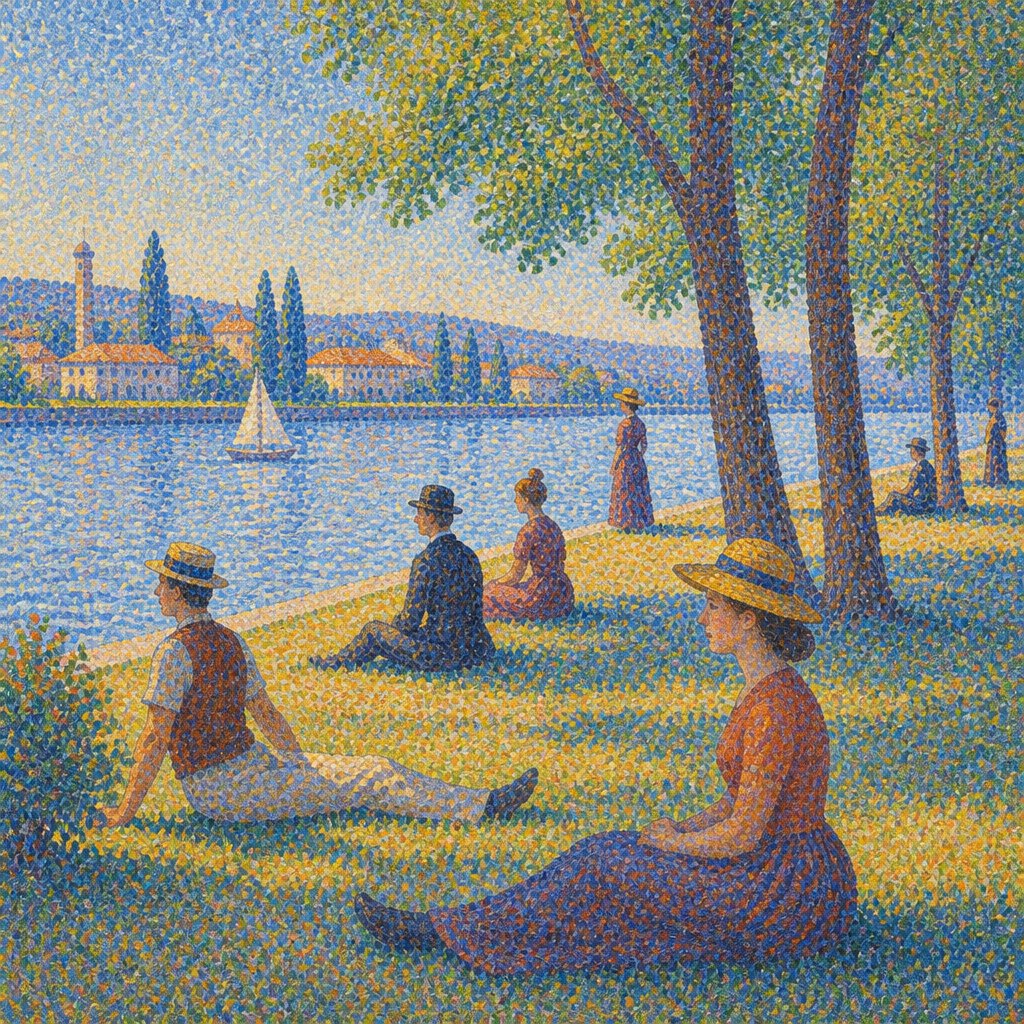 AI-generated
Create in the same spirit
Make Neo Impressionism art of your own
This AI interpretation echoes the aesthetic world Georges Seurat worked in — it depicts no real artwork. Generate your own with the Pointillist Impressionism Art Style generator.
Open the Pointillist Impressionism Art Style generator →Legacy
Seurat's pointillist method gave Neo-Impressionism its founding logic and pushed color theory from the studio into a near-scientific discipline that painters like Paul Signac carried forward for decades. His patient, structured approach to composition also fed forward into twentieth-century movements interested in order and geometry, from Cubism to hard-edged abstraction. Though he completed only a handful of major canvases before his early death, each remains a landmark; La Grande Jatte is one of the most recognized paintings in the world, permanently installed at the Art Institute of Chicago. Seurat proved that rigor and feeling were not opposites.
Frequently asked questions
What is Georges Seurat famous for?
Seurat is famous for inventing Pointillism, painting with small, distinct dots of pure color that blend optically when viewed from a distance. His best-known work is A Sunday Afternoon on the Island of La Grande Jatte.
Where can I see Georges Seurat's paintings?
His masterpiece La Grande Jatte hangs at the Art Institute of Chicago. Other major works are held by the Musée d'Orsay in Paris, the National Gallery in London, and the Museum of Modern Art in New York.
What art movement did Seurat found?
Seurat founded Neo-Impressionism, also known as Pointillism or Divisionism, which applied color in small, separate dots based on contemporary optical science, rather than blending pigment on the palette.
How many paintings did Seurat complete?
Seurat completed only around seven major large-scale paintings in his short career, alongside numerous smaller oil studies and drawings, because his method demanded months or years of careful preparation for each finished canvas.