 Famous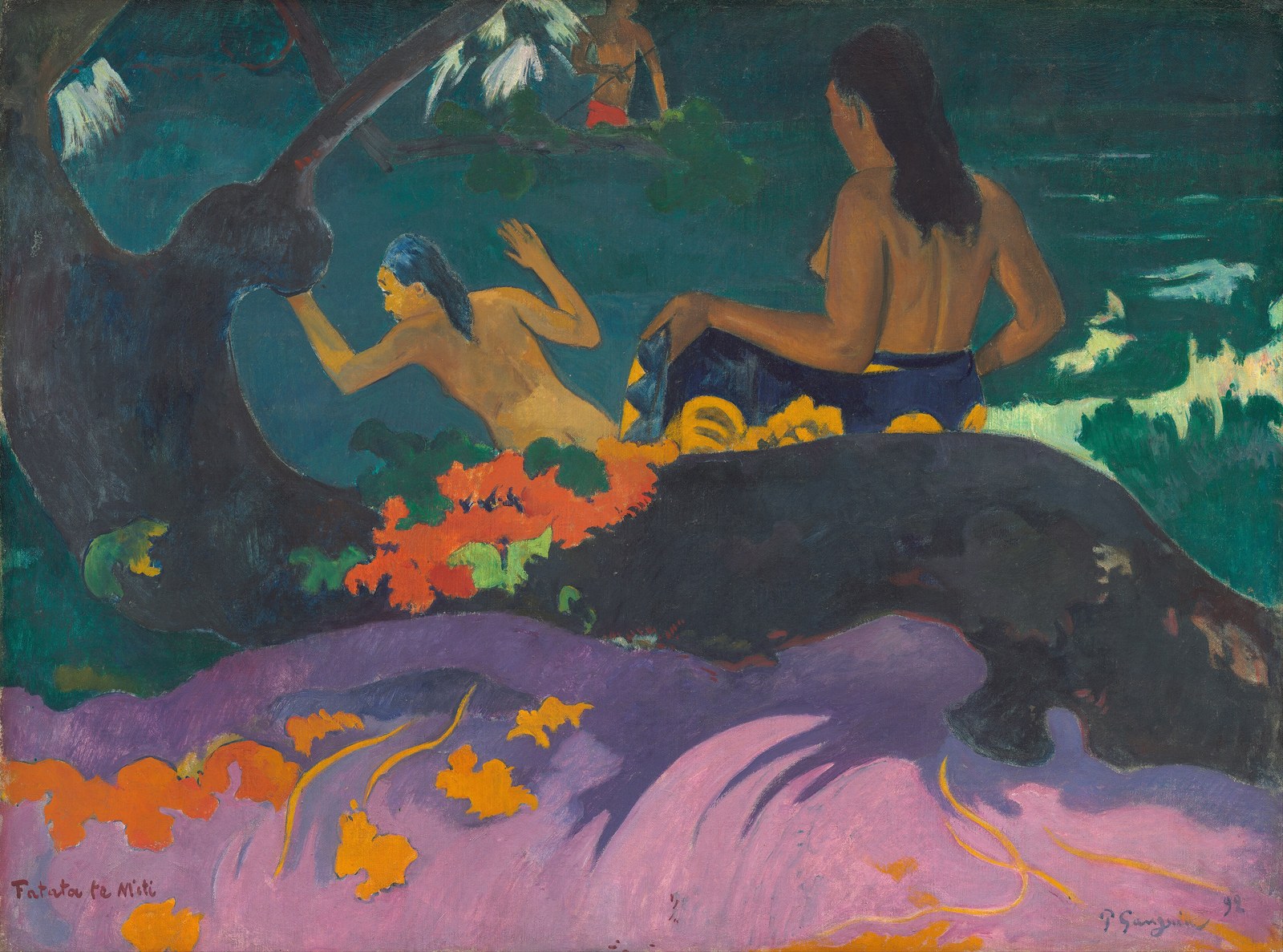
Paul Gauguin (1848–1903) was a French painter who abandoned a stockbroker's career in his mid-thirties to pursue art full-time, eventually settling in Tahiti and the Marquesas Islands, where he developed a bold, flattened style built from pure color and symbolic subjects rather than optical realism.
Gauguin began as a Sunday painter and Impressionist collector before quitting finance in 1883 to paint. Restless in Paris, he moved to the Breton village of Pont-Aven, where he and Émile Bernard developed Synthetism: simplified forms, heavy outlines, and color chosen for emotional and symbolic weight rather than observed truth. A brief, disastrous stay with Van Gogh in Arles in 1888 ended in crisis for both men.
Seeking what he imagined as an unspoiled world, Gauguin sailed to Tahiti in 1891 and, apart from one return to France, spent his remaining years in French Polynesia, painting Tahitian women, myth, and daily life in saturated color. Poverty, illness, and conflict with colonial authorities shadowed these years. He died in the Marquesas in 1903, largely unrecognized in his lifetime but soon claimed as a founder of modern painting's break from realism.
How to recognize a Gauguin
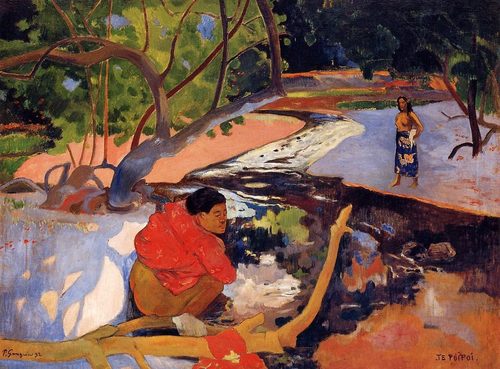
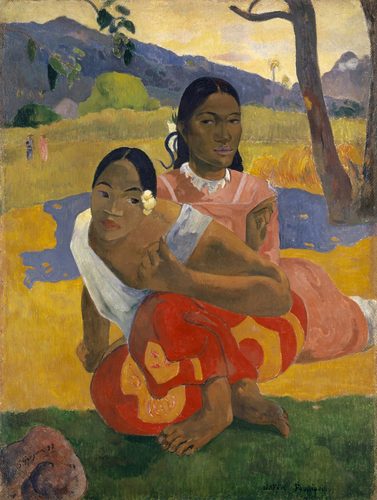
Flat planes of color
Gauguin filled shapes with single, unmodulated color rather than blending tones or modeling light and shadow, so figures and landscapes read as flat, poster-like fields bordered by dark, deliberate outlines.
Bold cloisonnist outlines
Borrowing from stained glass and enamel work, Gauguin bounded areas of flat color with thick dark contours, a technique called cloisonnism that gave his paintings a stylized, almost decorative clarity.
Saturated, non-naturalistic hues
Skies turn orange, sand turns pink, and grass turns red in his work—color chosen for symbolic or emotional charge rather than what the eye actually saw, a rejection of Impressionist observation.
Tahitian and Breton subjects
His mature subjects center on Tahitian women in daily and ceremonial life, and earlier, Breton peasants at prayer or labor, treated less as individuals than as figures within a symbolic, almost mythic scene.
Decorative, flattened composition
Gauguin compressed depth, tilting ground planes upward and stacking figures across the canvas like a woven frieze rather than a window onto space, favoring pattern and rhythm over illusionistic recession.
Carved, sculptural presence
Figures often stand monumental and still, weighted like carved wooden idols rather than captured mid-gesture, echoing Gauguin's own interest in Polynesian and Breton religious carving traditions and the totemic sculpture he collected.
The life
Paul Gauguin was born in Paris in 1848 and spent part of his childhood in Peru, an early exposure to a world outside bourgeois France that stayed with him. He worked as a merchant sailor and then a successful stockbroker in Paris, collecting Impressionist paintings and painting as a hobby before the 1882 stock market crash and his own restlessness pushed him toward art full-time.
He exhibited with the Impressionists in the early 1880s but soon broke from their focus on optical observation. In Brittany's Pont-Aven art colony, he developed Synthetism with Émile Bernard, simplifying form and using color symbolically. His 1888 visit to Vincent van Gogh in Arles ended after weeks of mounting tension, culminating in the crisis on the night Van Gogh injured his own ear.
Convinced that Europe was creatively exhausted, Gauguin sailed for Tahiti in 1891, seeking subjects and a way of life he considered more authentic. Aside from one difficult return to France in 1893–95, he spent the rest of his life in French Polynesia, first in Tahiti and later the Marquesas, producing his best-known paintings, woodcuts, and prints amid worsening health and financial hardship. He died in the Marquesas in 1903.
Timeline
- 1848Born in Paris, France
- 1865Joins the merchant marine
- 1883Leaves stockbroking to paint full-time
- 1886Works in the Pont-Aven artists' colony
- 1888Stays with Van Gogh in Arles
- 1891Sails to Tahiti for the first time
- 1897Paints "Where Do We Come From?"
- 1901Moves to the Marquesas Islands
- 1903Dies in Atuona, Marquesas Islands
Most famous works
| Work | Date | Why it matters |
|---|---|---|
| Where Do We Come From? What Are We? Where Are We Going? | 1897 | A monumental frieze painted as Gauguin's summation of life, death, and meaning, made during a period of despair. |
| Vision After the Sermon | 1888 | Breton women envisioning Jacob wrestling the angel against a flat red field, a landmark of Synthetist symbolism. |
| Tahitian Women on the Beach | 1891 | An early Tahiti painting pairing two women in contrasting poses and dress, setting the tone for his Polynesian period. |
| The Yellow Christ | 1889 | A Breton crucifixion scene rendered in flat yellow, fusing folk piety with Gauguin's Synthetist color theory. |
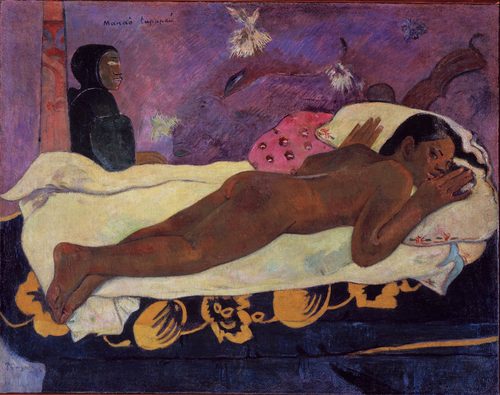
| Spirit of the Dead Watching | 1892 | A reclining Tahitian figure and a watching spirit, painted in somber purples and greens charged with local belief. |
| Woodcuts of the Noa Noa suite | 1893–1894 | Rough-carved prints that translated Gauguin's Tahitian imagery into a stark graphic language later prized by Expressionist printmakers. |
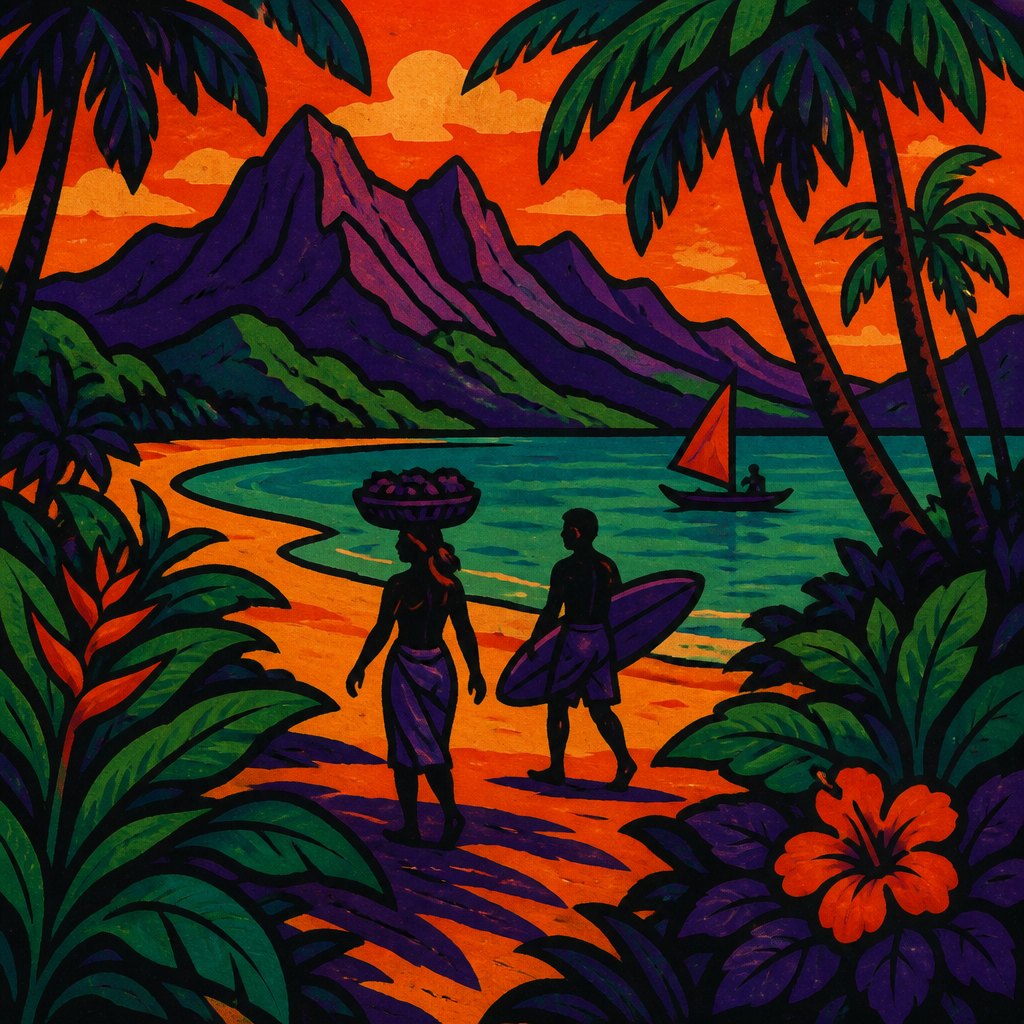 AI-generated
Create in the same spirit
Make Post Impressionism art of your own
This AI interpretation echoes the aesthetic world Paul Gauguin worked in — it depicts no real artwork. Generate your own with the Post-Impressionism Art Style generator.
Open the Post-Impressionism Art Style generator →Legacy
Gauguin's flattened color and symbolic subject matter gave the Fauves and German Expressionists permission to paint feeling instead of appearance, and his woodcuts helped revive printmaking as a serious modern medium. His pursuit of the "primitive" as a source of artistic renewal shaped decades of Western modernism, even as that same posture toward Polynesian culture and its people remains sharply debated today. Museums now present his Tahitian years alongside that scrutiny rather than around it. Walk through the Musée d'Orsay or MoMA and his color still startles—flat, decisive, unapologetically symbolic, a permission slip every later colorist quietly carries.
Frequently asked questions
What is Paul Gauguin famous for?
Gauguin is famous for bold, flat areas of non-naturalistic color and symbolic scenes, especially paintings made in Tahiti and French Polynesia depicting local women, myth, and daily life, alongside his earlier Synthetist work in Brittany.
Where can I see Paul Gauguin's paintings?
Notable collections are at the Musée d'Orsay in Paris, the Art Institute of Chicago, the Museum of Modern Art in New York, and the Ny Carlsberg Glyptotek in Copenhagen.
What art movement was Gauguin part of?
Gauguin is grouped with Post-Impressionism and is a founder of Synthetism, developed with Émile Bernard in Pont-Aven, which favored simplified form and symbolic color over direct observation of nature.
Why did Gauguin move to Tahiti?
Gauguin believed European art and society had grown artificial, and he sought what he saw as a simpler, more authentic way of life and subject matter in French Polynesia, settling there from 1891 until his death.