 Famous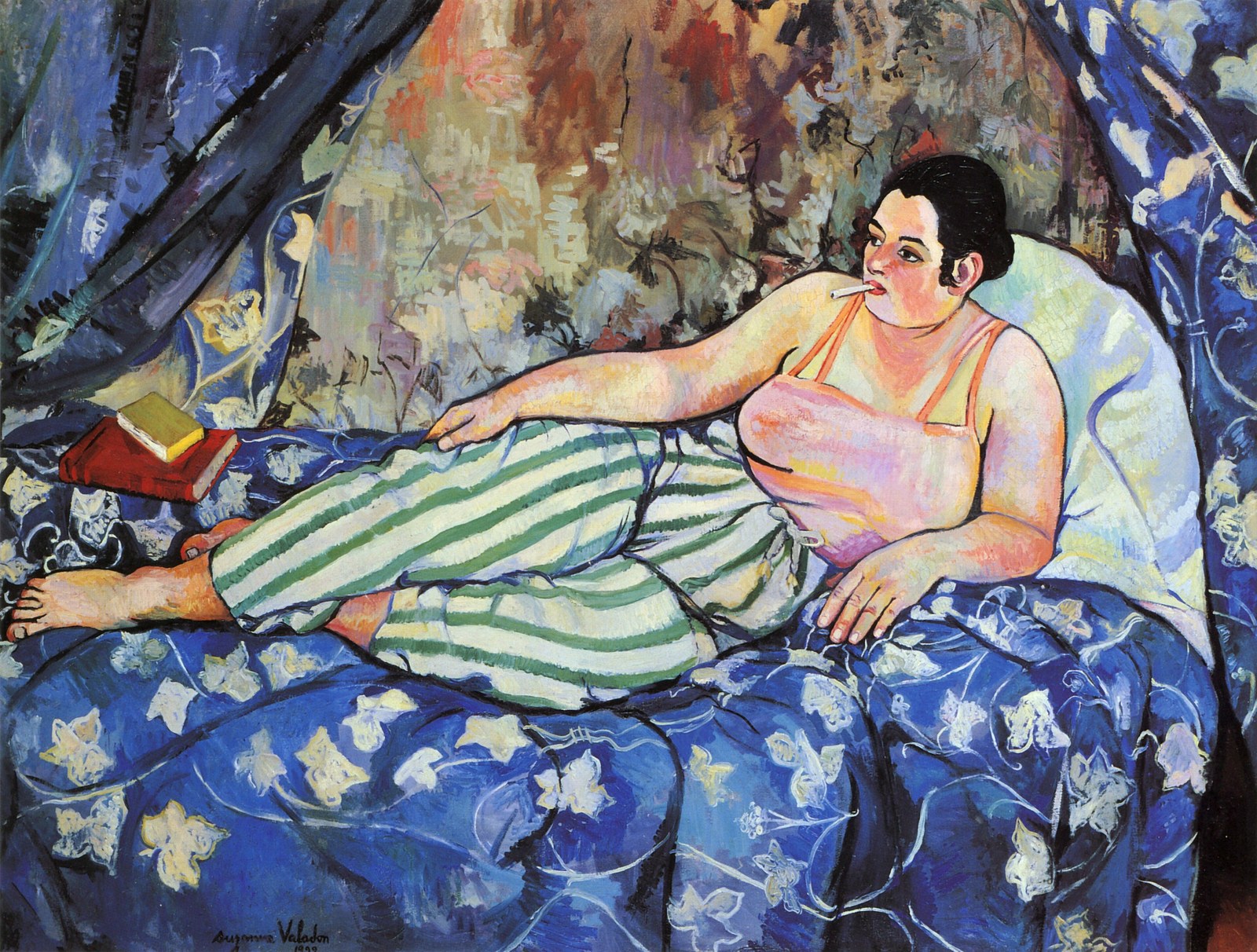
Suzanne Valadon (1865–1938) was a self-taught French painter who began as a circus acrobat and then an artist's model for Renoir, Puvis de Chavannes, and Toulouse-Lautrec before becoming a formidable painter in her own right, known for direct, unromanticized depictions of women's bodies.
Working without academic training, she learned by watching the painters who hired her, particularly absorbing Degas's confidence in line, and began drawing seriously in her twenties. Degas himself encouraged her and helped her sell her first prints. She exhibited at the Societe Nationale des Beaux-Arts starting in 1894, becoming the first woman admitted to that society.
Valadon painted female nudes, portraits, still lifes, and flowers with a bluntness unusual for the period, refusing the softened, idealized poses common in nudes painted by men. She was also the mother of painter Maurice Utrillo, whom she encouraged to paint during a troubled adolescence, and later married the much younger painter Andre Utter.
She continued painting into her seventies, remaining a working artist to the end of her life in Paris in 1938.
How to recognize a Valadon
Bold, unposed nudes
She painted female bodies frankly, without the softened idealization typical of male painters, choosing frank stances, visible weight, and direct gazes that treat the model as a person rather than an object of desire.
Strong, confident contour lines
Trained partly by watching Degas draw, she built her figures around firm, continuous outlines, giving even quick studies a sculptural solidity and clarity rare in painters without formal academic training.
Saturated, unmixed color
She favored bold, near-flat areas of strong color — deep blues, oranges, and greens — applied with little blending, giving her canvases a decorative punch closer to the Fauves than to Impressionism.
Working-class and family subjects
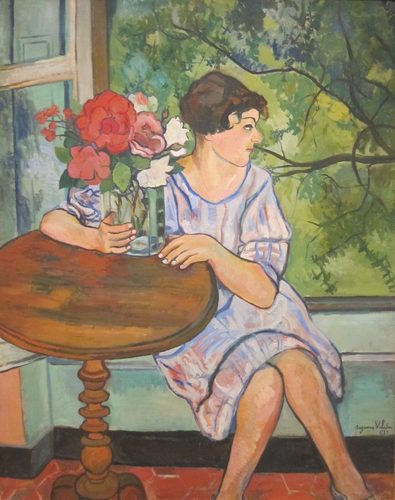
She painted her own family, neighbors, and herself repeatedly, favoring ordinary Montmartre life over fashionable society portraiture, and treated these everyday domestic subjects with the same seriousness she brought to her grand nudes.
Flowers and still life density
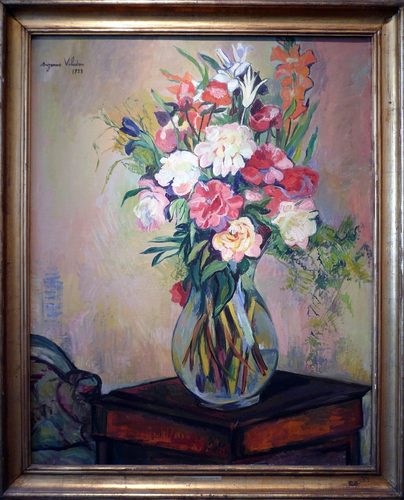
Her still lifes crowd the canvas with tightly arranged flowers and objects, using pattern and color contrast rather than soft atmosphere, echoing the decorative flatness she also brought to her figure paintings.
Frank, unsentimental self-portraits
She painted herself at various ages without flattery, including in old age, recording her own aging body with the same unflinching directness she applied to every other body and face she painted throughout her long career.
The life
Marie-Clementine Valadon was born in 1865 in Bessines-sur-Gartempe, France, the illegitimate daughter of a laundress, and grew up poor in Montmartre. As a teenager she worked briefly as a circus acrobat until a fall ended that career, after which she began modeling for painters including Puvis de Chavannes, Renoir, and Toulouse-Lautrec, who gave her the name Suzanne.
Watching these artists work, she taught herself to draw and paint, developing a confident, unschooled line. Edgar Degas recognized her talent, bought her drawings, taught her printmaking, and championed her career. In 1894 she became the first woman admitted to exhibit with the Societe Nationale des Beaux-Arts.
She raised her son, Maurice Utrillo, largely alone, encouraging him to paint during a difficult adolescence; he became a noted painter of Parisian streets. In 1909 she began a relationship with the much younger painter Andre Utter, whom she later married, and the two lived and worked together in Montmartre.
Valadon continued painting nudes, portraits, and still lifes with unflagging confidence through the 1920s and into the 1930s, gaining wide recognition before her death in Paris in 1938.
Timeline
- 1865Born in Bessines-sur-Gartempe, France
- 1880Works briefly as a circus acrobat in Paris
- 1883Son Maurice Utrillo is born
- 1890Degas discovers her drawings and encourages her
- 1894First woman admitted to the Societe Nationale des Beaux-Arts
- 1909Begins relationship with painter Andre Utter
- 1923Paints The Blue Room, one of her best-known works
- 1938Dies in Paris
Most famous works
| Work | Date | Why it matters |
|---|---|---|
| The Blue Room | 1923 | A reclining woman in striped pajamas, smoking, replacing the traditional nude odalisque with a relaxed, self-possessed modern figure. |
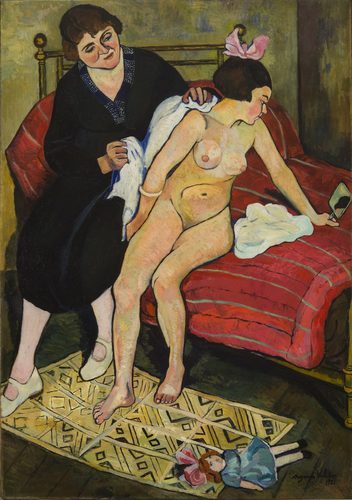
| The Abandoned Doll | 1921 | A mother helping a young girl dress after bathing, a rare tender domestic scene painted with Valadon's usual physical directness. |
| Joy of Life | 1911 | A large composition of nude figures in a landscape, showing her ambition to work at the scale of history painting. |
| Self-Portrait | 1927 | A late, unflattering self-portrait showing her aged face without vanity, consistent with her lifelong refusal to idealize any body, including her own. |
| Bouquet of Flowers | c. 1920 | A densely packed still life demonstrating her bold, saturated color and flattened decorative sense outside of figure painting. |
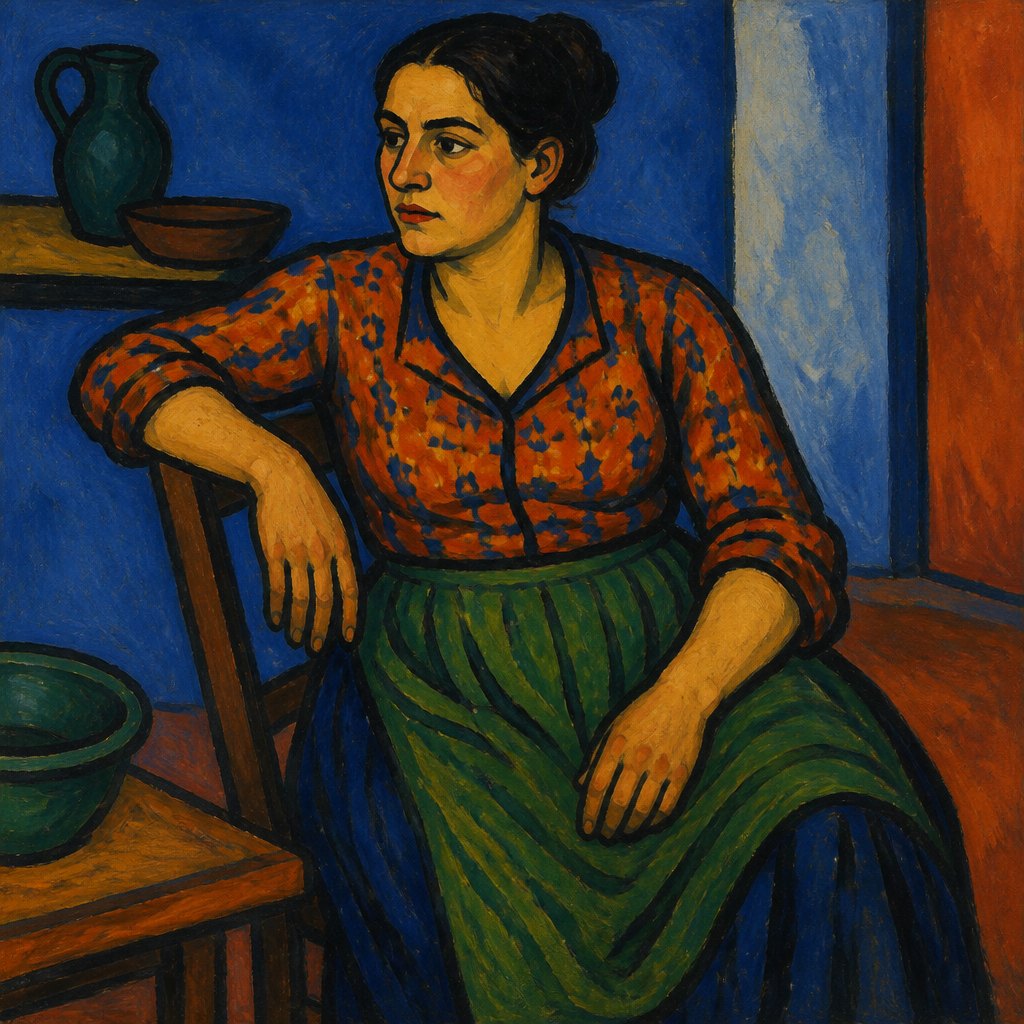 AI-generated
Create in the same spirit
Make Post Impressionism art of your own
This AI interpretation echoes the aesthetic world Suzanne Valadon worked in — it depicts no real artwork. Generate your own with the Post-Impressionism Art Style generator.
Open the Post-Impressionism Art Style generator →Legacy
Valadon opened a path for women to paint the nude on their own terms, refusing the soft idealization that defined most nudes made by men of her generation. Her frank, sturdy figures influenced later painters interested in unromanticized depictions of the body, and her career — self-taught, working-class, unapologetic — stood apart from the academic route most recognized painters followed. She is also remembered as the mother and first champion of Maurice Utrillo. Museums in Paris and beyond now hold her nudes, portraits, and still lifes as key documents of how a woman painter reimagined a genre long defined by the male gaze.
Frequently asked questions
What is Suzanne Valadon famous for?
She is known for frank, unidealized paintings of the female nude, painted from a woman's perspective at a time when the genre was defined almost entirely by male painters.
Where can you see Suzanne Valadon's paintings?
Her work is held at the Centre Pompidou and Musee de Montmartre in Paris, as well as museums across France and in international collections including several U.S. museums.
Was Suzanne Valadon self-taught?
Yes. She had no formal art training, learning instead by observing the painters who hired her as a model, including Renoir and Toulouse-Lautrec, with Edgar Degas later mentoring her directly.
What art movement was Suzanne Valadon part of?
She is generally classified with Post-Impressionism, though her bold outlines and flat color also connect her to early modernist tendencies that fed into Fauvism and Expressionism.