 Famous

Gustav Klimt (1862–1918) was an Austrian painter whose gold-encrusted, pattern-saturated portraits and allegories made him the leading figure of the Vienna Secession and one of the defining artists of European fin-de-siècle culture, best known today for 'The Kiss.'
Trained at Vienna's School of Applied Arts, Klimt began as a successful decorative muralist, working on public commissions in a polished academic style. In 1897 he co-founded the Vienna Secession, breaking from the conservative art establishment to champion a freer, more ornamental modernism drawing on Byzantine mosaics, Japanese prints, and Symbolist ideas.
His mature 'Golden Phase,' beginning around 1899, fused flattened, richly patterned surfaces with real gold and silver leaf, most famously in portraits of Viennese society women and in 'The Kiss.' Klimt's frank eroticism and psychological intensity scandalized official Vienna even as private patrons embraced him. He remained prolific until his death from a stroke and pneumonia in 1918, leaving behind an unfinished body of work and a visual language that still defines popular ideas of turn-of-the-century Vienna.
How to recognize a Klimt
Gold and silver leaf
Klimt applied real gold and silver leaf directly to canvas, most famously in his 'Golden Phase' portraits, fusing painted flesh with flat, glinting metal surfaces borrowed from Byzantine mosaics and religious icons.
Ornamental pattern fields
Bodies and backgrounds dissolve into dense fields of spirals, rectangles, eyes, and floral motifs, so that figure and decoration blur — a hallmark borrowed from mosaics, textiles, and Japanese prints he collected.
Realistic faces, flat bodies
Klimt painted faces and hands with careful naturalism while flattening the rest of the figure into pattern and gold, creating a striking tension between intimate, lifelike portraiture and abstract, purely decorative surface design.
Embracing, entwined couples
Klimt returned repeatedly to couples locked in embrace, their bodies merged into a single ornamental mass at the edge of a cliff or meadow, tenderness rendered as much through pattern as through pose.
Viennese society portraits
Klimt made his living painting the wives and daughters of Vienna's wealthy elite, framing them in luxurious, patterned dress that turned each sitting into a study of status and shimmering surface as much as likeness.
Landscape as woven texture
In his later landscapes, fields, gardens, and orchards are compressed into flat, dense mosaic-like surfaces viewed from above, treating nature with the same ornamental patterning and jewel-toned color he gave his figures.
The life
Gustav Klimt was born near Vienna in 1862, one of seven children of a gold engraver, and trained at the city's School of Applied Arts. He began his career as part of a successful decorative painting partnership, completing grand mural commissions for Vienna's public buildings and theaters in a polished, classically inspired style that brought him early acclaim and official honors.
In 1897, frustrated with the conservative Vienna Künstlerhaus, Klimt helped found the Vienna Secession and became its first president, championing a more modern, internationally engaged art scene. His 1900 murals for the University of Vienna, featuring nude allegorical figures, provoked public outrage over their frankness and were never installed as intended, pushing Klimt away from public commissions toward private patronage.
From around 1899 to 1909, Klimt entered his celebrated 'Golden Phase,' producing gold-leaf portraits and works including 'The Kiss,' commissioned largely by wealthy Viennese patrons. He later loosened this style into broader, more colorful landscapes and figure paintings influenced by contemporaries abroad. Klimt continued working prolifically, mentoring younger artists including Egon Schiele, until his death in Vienna in 1918, following a stroke and the influenza pandemic, leaving several works unfinished.
Timeline
- 1862Born near Vienna, Austria
- 1883Opens a decorative painting studio with his brother
- 1897Co-founds and becomes first president of the Vienna Secession
- 1900University of Vienna ceiling paintings spark public scandal
- 1907Completes 'The Kiss' during his Golden Phase
- 1908Major retrospective at the Kunstschau Wien
- 1918Dies in Vienna after a stroke and influenza
Most famous works
| Work | Date | Why it matters |
|---|---|---|
| The Kiss | 1907-08 | A gold-leaf embrace on a flowered cliff edge, Klimt's best-known work and an emblem of his Golden Phase. |
| Portrait of Adele Bloch-Bauer I | 1907 | A gold-encrusted society portrait once nicknamed 'The Woman in Gold,' among the era's most celebrated commissions. |
| Judith and the Head of Holofernes | 1901 | A gilded, unsettling femme fatale that scandalized Viennese audiences with its frank sensuality. |
| The Tree of Life | 1909 | A sweeping spiraled mural design created for the Stoclet Palace in Brussels, his most ambitious decorative scheme. |
| Danaë | 1907-08 | A curled, sleeping figure bathed in a shower of gold, among his most sensuous Golden Phase paintings. |
| Death and Life | 1910-15 | A late allegorical painting contrasting a grinning skeletal figure with a huddled mass of the living. |
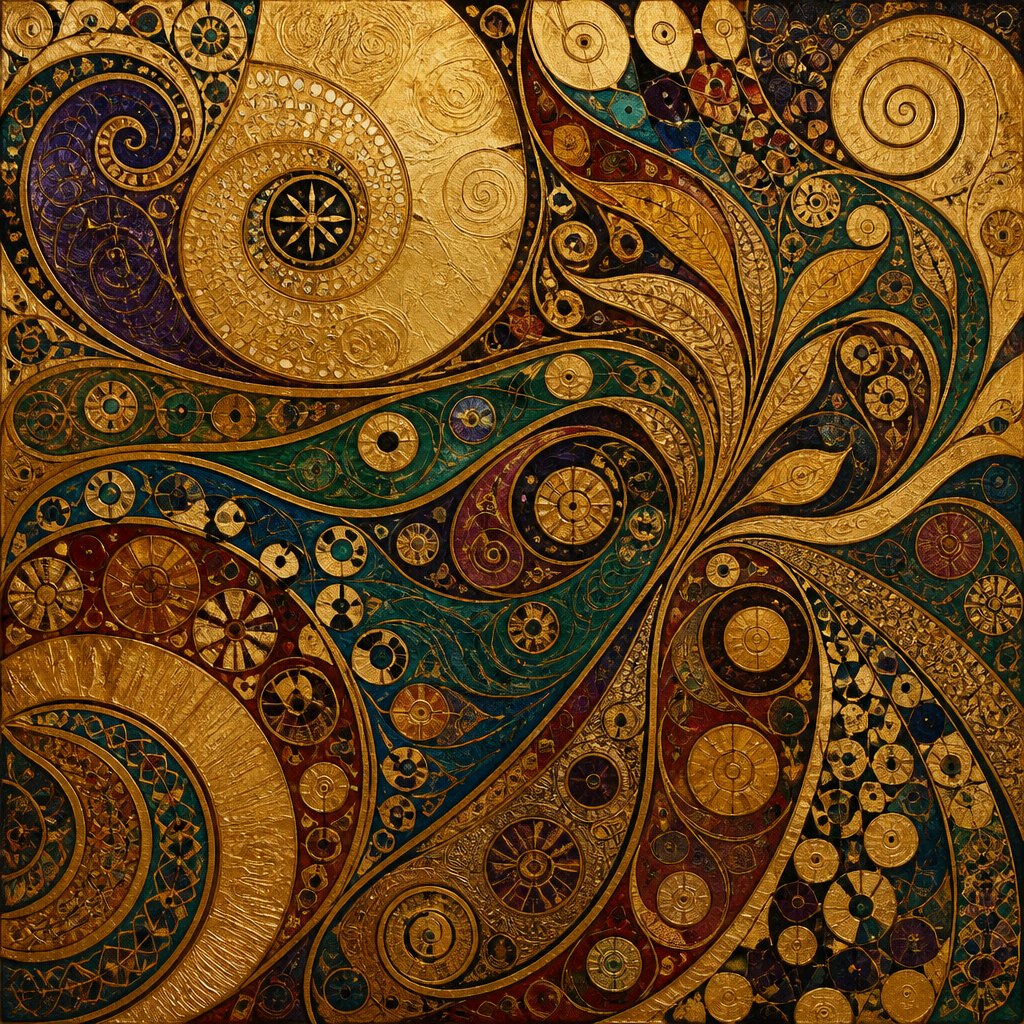 AI-generated
Create in the same spirit
Make Vienna Secession art of your own
This AI interpretation echoes the aesthetic world Gustav Klimt worked in — it depicts no real artwork. Generate your own with the Vienna Secession Art Style generator.
Open the Vienna Secession Art Style generator →Legacy
Klimt's fusion of gold-leaf ornament with frank, psychologically charged portraiture gave Vienna Secession art its defining image and helped legitimize a decorative, pattern-driven modernism outside the academic mainstream. He mentored Egon Schiele and influenced a generation of Austrian Expressionists who pushed his emotional intensity further while dropping his gilded surfaces. 'The Kiss' remains one of the most reproduced images in Western art, appearing on everything from museum posters to jewelry — proof of how completely Klimt fused beauty, unease, and desire into a single, unmistakable visual language.
Frequently asked questions
What is Gustav Klimt famous for?
Klimt is famous for gold-leaf paintings from his 'Golden Phase,' especially 'The Kiss,' and for leading the Vienna Secession's break from academic art toward a more decorative, symbol-laden modernism.
Where can you see Gustav Klimt's paintings?
'The Kiss' hangs at the Belvedere in Vienna, which holds his largest collection; other major works are at the Neue Galerie in New York and museums across Austria and Germany.
What is Klimt's 'Golden Phase'?
It refers to roughly 1899-1909, when Klimt incorporated real gold and silver leaf into his paintings, producing his most opulent and celebrated portraits and allegorical works, including 'The Kiss.'
What art movement is Gustav Klimt associated with?
Klimt led the Vienna Secession, an offshoot of Art Nouveau, and his work is also closely tied to European Symbolism for its allegorical, dreamlike subject matter.