 Famous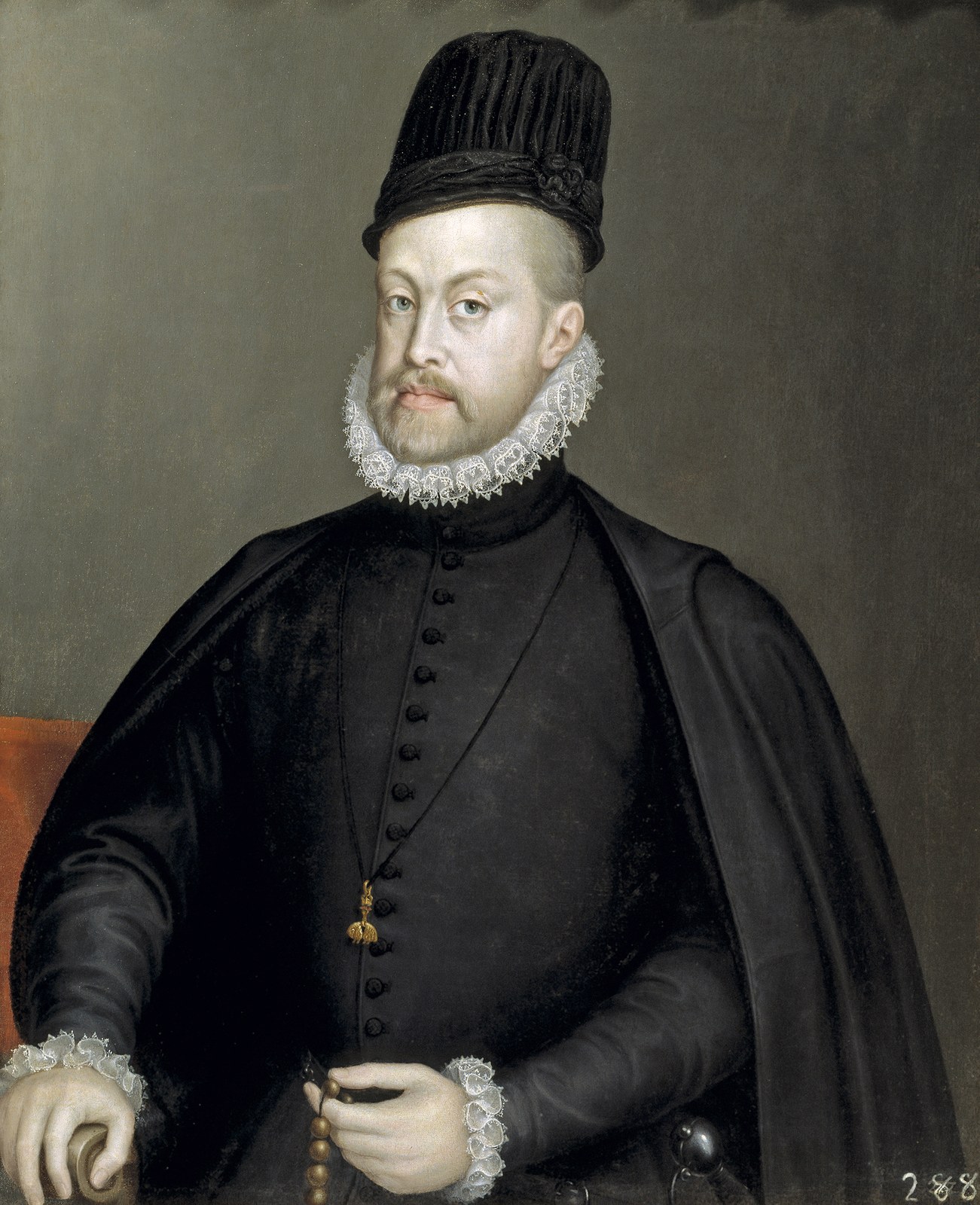
Sofonisba Anguissola (1532–1625) was an Italian noblewoman who became the first woman painter to achieve international fame, opening a path that later artists such as Artemisia Gentileschi would follow. Born in Cremona, she was one of six sisters whose father, unusually for the period, arranged formal art training for his daughters, sending Sofonisba to study under the painter Bernardino Campi.
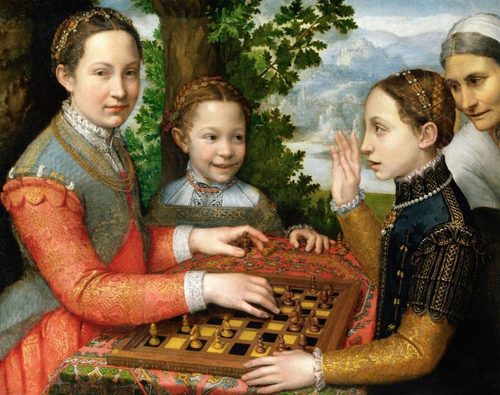
She built her reputation on portraits, above all self-portraits and intimate family scenes such as The Chess Game, which showed her sisters at play with an informality rare in the period's stiffer court portraiture. Her talent reached Michelangelo, who is recorded as informally reviewing her drawings and offering guidance.
In 1559, Sofonisba was invited to the Spanish court of Philip II, where she served for years as lady-in-waiting and painter to the young queen, Elisabeth of Valois, producing portraits of the royal family. She later married twice, eventually settling in Palermo, where in 1624 the young Anthony van Dyck sought her out and sketched her, recording her as a sharp, generous conversationalist even in old age. She died in Palermo in 1625, in her nineties.
How to recognize a Anguissola
Quiet psychological intimacy
Sitters meet the viewer's eye directly, caught in unguarded half-smiles rather than formal stillness. Anguissola favored domestic settings and informal gestures — a hand resting on a shoulder, a sideways glance — over the rigid poses of court portraiture.
Recurring self-portraiture
She painted herself repeatedly across five decades, at the easel, at the keyboard, holding a book, aging visibly from picture to picture. Few artists before her left such a sustained visual record of their own changing face.
Domestic genre scenes
Beyond formal commissions, she painted her own family at everyday moments — playing chess, reading, making music — treating relatives with the same seriousness reserved for nobility, a quietly unusual shift in subject matter for the period.
Restrained Lombard palette
Colors stay muted and warm: soft blacks, ivory linen, dull gold, without the saturated drama of Venetian painting. The restraint keeps attention on faces and hands rather than costume or setting.
Precise rendering of hands
Hands appear constantly and deliberately — folded, gesturing, holding an object — often doing as much expressive work as the face. It became a kind of signature within her otherwise understated compositions.
Modest court-dress detail
Fabrics are rendered plainly but accurately: a starched ruff, a plain bodice, a single ring, never overwhelmed by ornament. The sobriety reads as dignity rather than plainness, in keeping with Spanish court fashion of her later years.
The life
Sofonisba Anguissola was born in Cremona in 1532, the eldest of seven children in a noble but modestly resourced family. Her father Amilcare, unusually for his time, believed his daughters deserved a humanist education that included painting, and arranged for Sofonisba and her sister Elena to study under the Cremonese painter Bernardino Campi, and later Bernardino Gatti.
Her early portraits and self-portraits circulated among Italian courts and reached Rome, where Michelangelo is said to have reviewed her drawings and offered informal criticism. Her 1555 group portrait of her sisters playing chess showed an ease and naturalism that set her apart from the formal court portraiture of the day, and her reputation grew quickly across Italy.
In 1559, King Philip II of Spain invited her to Madrid, where she spent roughly a decade as lady-in-waiting to Queen Elisabeth of Valois, teaching her painting and producing portraits of the royal family, though rigid court protocol meant much of her royal-period work went unsigned. She married a Sicilian nobleman in the 1570s and, after his death, a Genoese sea captain, eventually settling in Palermo.
She continued painting into extreme old age. In 1624 the young Anthony van Dyck visited her in Palermo and sketched her, recording in his notebook her sharp memory and generous advice on painting despite near blindness. She died in Palermo in 1625, around ninety-three years old.
Timeline
- 1532Born in Cremona, Italy
- 1546Begins training under painter Bernardino Campi
- 1555Paints The Chess Game, a portrait of her sisters
- 1559Joins the Spanish court as painter to Queen Elisabeth of Valois
- 1573Marries Sicilian nobleman Fabrizio de Moncada
- 1584Remarries Genoese captain Orazio Lomellino
- 1624Visited and sketched by the young Anthony van Dyck
- 1625Dies in Palermo, in her nineties
Most famous works
| Work | Date | Why it matters |
|---|---|---|
| The Chess Game | 1555 | An informal portrait of her three sisters at play, praised in its own time for its naturalism. |
| Self-Portrait at the Easel | c. 1556 | One of her earliest self-portraits, showing herself in the act of painting. |
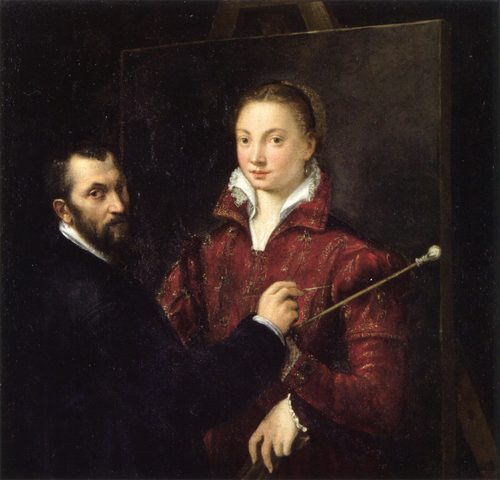
| Bernardino Campi Painting Sofonisba Anguissola | c. 1550 | A clever double self-portrait crediting her teacher while asserting her own presence. |
| Portrait of Elisabeth of Valois | c. 1560s | A court portrait of the young Spanish queen she served and taught. |
| Self-Portrait | 1610 | A late self-portrait showing the artist candidly aged, decades after her court career. |
 AI-generated
Create in the same spirit
Make Mannerism art of your own
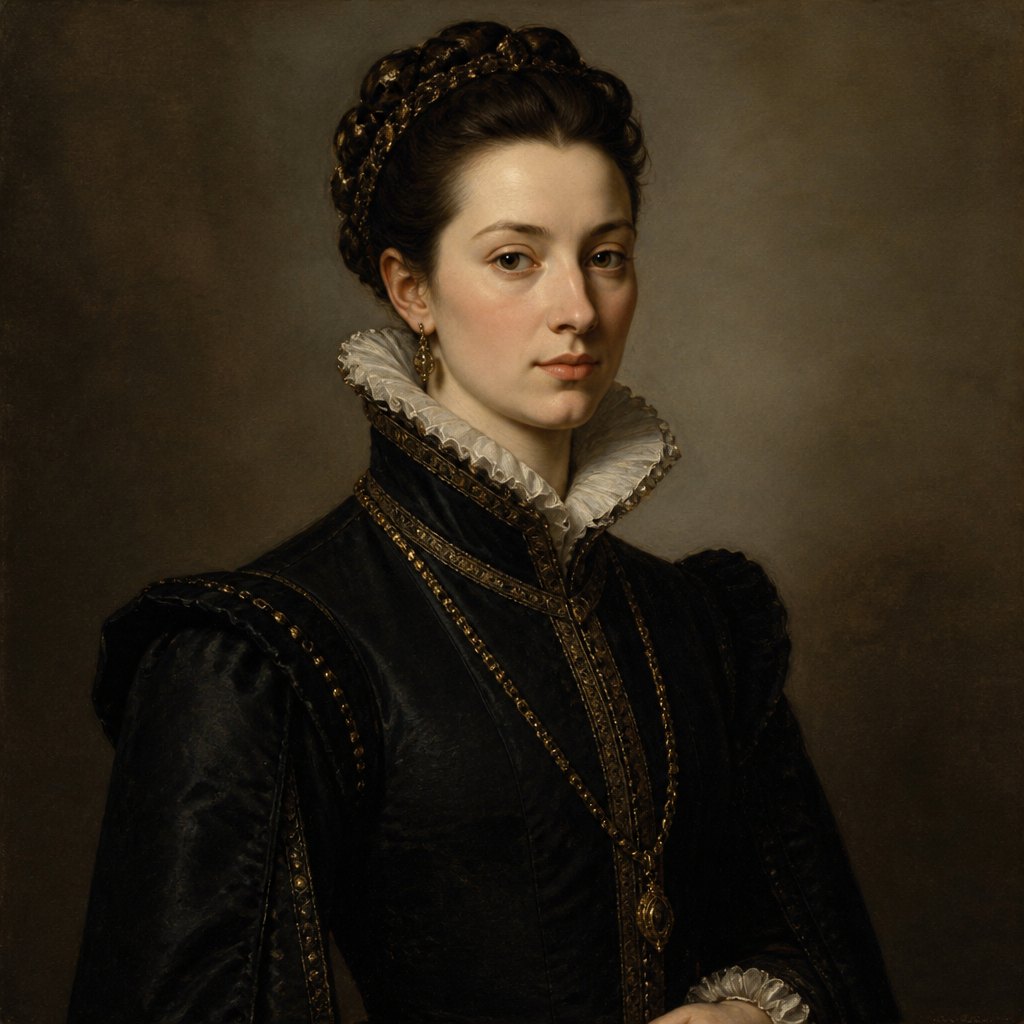
This AI interpretation echoes the aesthetic world Sofonisba Anguissola worked in — it depicts no real artwork. Generate your own with the Mannerism Art Style generator.
Open the Mannerism Art Style generator →Legacy
Anguissola proved, publicly and durably, that a woman could sustain a serious painting career — not as a private accomplishment but as a profession recognized by kings and popes. Giorgio Vasari traveled to see her work and praised it in his Lives of the Artists, a rare inclusion for a living woman. Her example encouraged later women painters, including Lavinia Fontana and, a generation on, Artemisia Gentileschi, who worked in a world slightly more open because Anguissola had already proven the market and the talent existed. Her sustained series of self-portraits also anticipated a genre — the artist studying her own face over a lifetime — that painters would return to for centuries after her.
Frequently asked questions
What is Sofonisba Anguissola famous for?
Anguissola is famous as the first woman painter to achieve international fame, breaking into a profession largely closed to women. She is known for intimate, psychologically alert portraits, including The Chess Game and a long series of self-portraits made across her lifetime.
Where can you see Sofonisba Anguissola's paintings today?
Her work hangs in Italy's Uffizi and Madrid's Museo del Prado, which holds several of her Spanish-court portraits. The Chess Game is in the National Museum in Poznań, Poland, and self-portraits are held in museums across Europe and the United States.
What artistic movement did Sofonisba Anguissola belong to?
She worked within Mannerism, the sixteenth-century style that favored elegant composition and psychological nuance over strict naturalism. Her portraiture, however, is often prized precisely for its directness and informality, qualities that set her apart from more theatrical Mannerist painters.
Did Sofonisba Anguissola paint many self-portraits?
Yes. She painted herself repeatedly across roughly five decades, more often than almost any artist before her. These self-portraits, made at the easel, at a keyboard, and in old age, form an unusually continuous visual record of one artist's changing face and status.