 Famous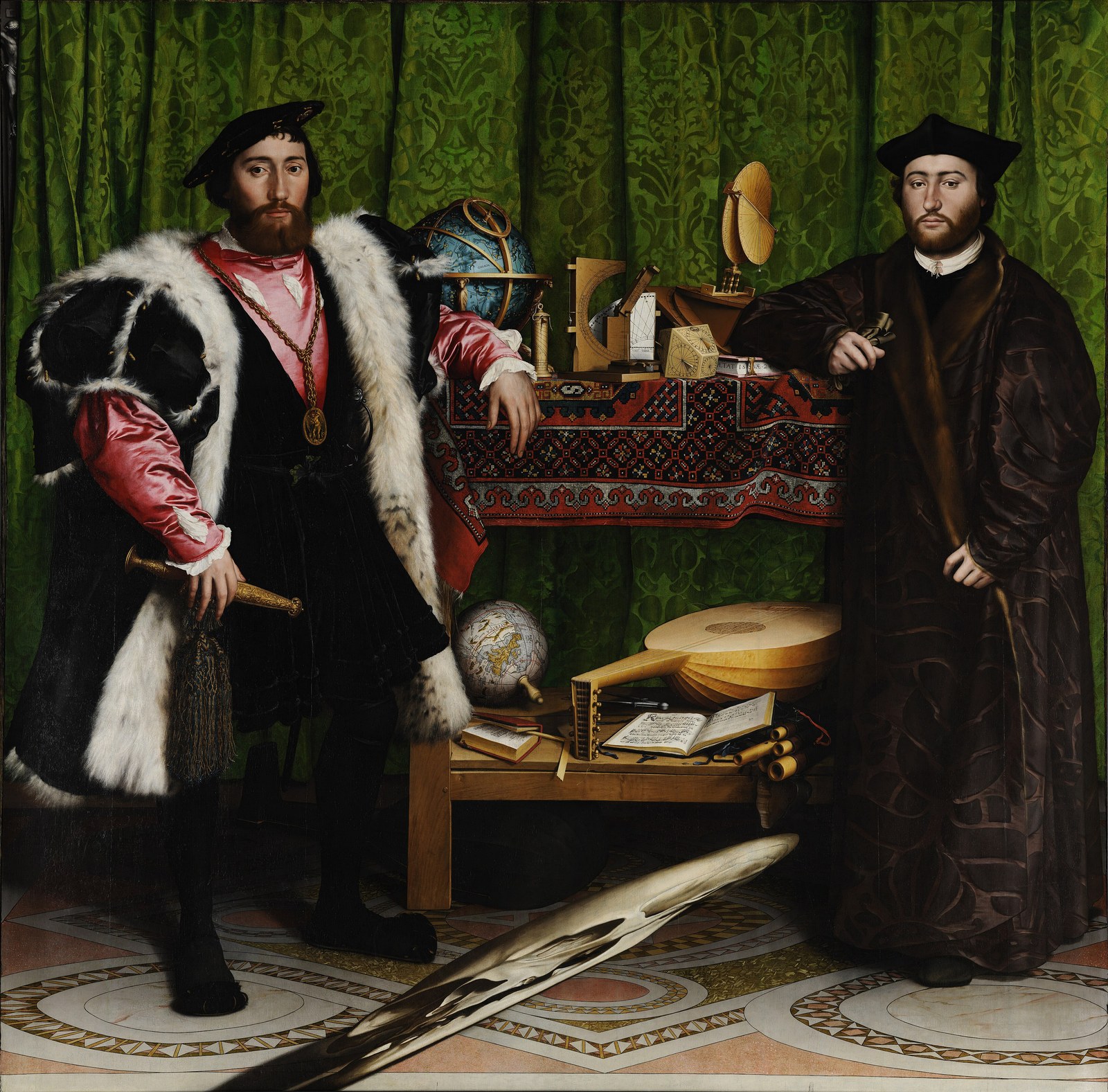
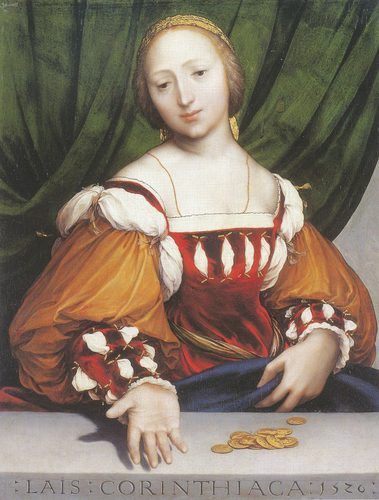
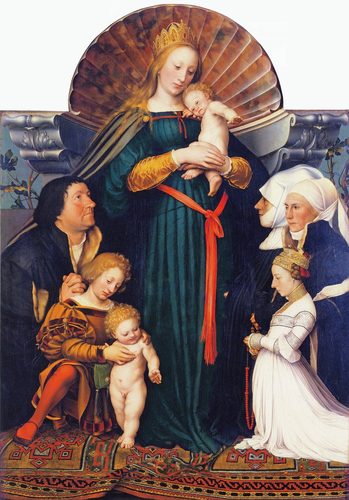
Hans Holbein the Younger (1497–1543) was a German painter whose portraits of the Tudor court remain the definitive visual record of Henry VIII's England. Trained in Augsburg under his own father, a respected late-Gothic painter, Holbein absorbed the precision of Northern panel painting before traveling to Basel, where he became the city's leading artist and a close associate of the humanist Erasmus of Rotterdam, whom he painted several times.
Recommended by Erasmus, Holbein crossed to England and eventually entered royal service, rising to King's Painter under Henry VIII. His portraits — of courtiers, merchants, and the king himself — combine unforgiving observation with a jeweler's finish: every fur collar, chain, and instrument rendered with near-scientific exactness. The Ambassadors (1533), with its anamorphic skull stretched across the foreground, remains his most studied single work, a meditation on mortality disguised as a diplomatic double portrait.
Holbein's likenesses did more than flatter power; they built its image. His drawings and paintings of Henry's ministers, wives, and rivals shaped how the Tudor age has been pictured ever since. He died in London, possibly of plague, having given a turbulent court a face that has outlasted it.
How to recognize a Younger
Unforgiving optical precision
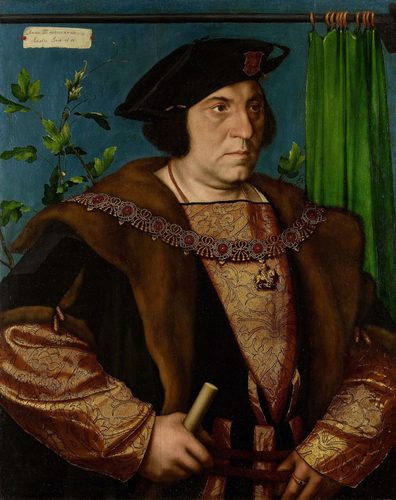
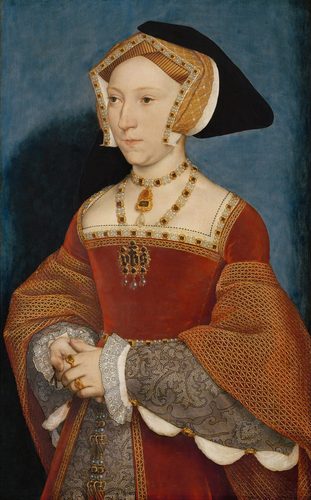
Holbein renders skin, fur, and metal with equal exactness, never softening a wrinkle or flattering a jawline. Velvet nap, gold chain links, and fur pile read as almost tangible, giving sitters a presence closer to inventory than idealization.
Flat, saturated backgrounds
Sitters stand against solid blue-greens or plain walls stripped of incident, so nothing competes with the face and hands. The effect is a specimen-like clarity, each figure isolated and held perfectly still for study.
Symbolic still-life props
Instruments, books, skulls, and coins appear beside sitters as coded reminders of learning, wealth, faith, or mortality. Nothing is decorative; every object earns its place, meant to be read as carefully as the face beside it.
Anamorphic trick perspective
His most famous device stretches an object into an unreadable smear unless viewed from an extreme angle, turning a portrait into a puzzle. It rewards patience and a change of position, hiding a private meaning in plain sight.
Restrained, near-invisible brushwork
Paint surfaces are smoothed to near invisibility, closer to enamel than oil, so the image reads as pure information rather than gesture. The hand of the painter all but disappears behind the fact of the sitter.
Confident three-quarter poses
Figures are typically set in a stable three-quarter turn, weight settled, gaze direct and unblinking. The pose favors authority over movement, presenting each sitter as someone already certain of their place in the room.
The life
Holbein was born in Augsburg into a family of painters; his father, Hans Holbein the Elder, ran a busy workshop and gave him his first training in the late-Gothic tradition. By his late teens Holbein had moved to Basel, then a thriving center of humanist printing, where he found work designing woodcuts and title pages alongside portrait commissions.
In Basel he met the scholar Erasmus of Rotterdam, painting him several times and absorbing the discipline of a circle devoted to exact observation. Political and religious upheaval — the Reformation was disrupting demand for religious art — pushed Holbein toward England around 1526, carrying a letter of introduction from Erasmus to the statesman Thomas More.
After a return trip to Basel, Holbein settled in England for good in 1532 and rose through court circles to become King's Painter to Henry VIII. He recorded the Tudor elite with a precision that made his sitters seem to stand in the room: courtiers, merchants of the London Steelyard, and the king's own wives passed under his eye, along with the double portrait now known as The Ambassadors.
In his final years Holbein also designed jewelry, cups, and ceremonial objects for the court. He died in London in 1543, probably during an outbreak of plague, leaving behind the most complete visual record of Henry VIII's reign that survives.
Timeline
- 1497Born in Augsburg, Germany
- 1515Moves to Basel to begin independent work
- 1519Becomes a master in the Basel painters' guild
- 1523Paints his first portraits of Erasmus of Rotterdam
- 1526Travels to England with a letter from Erasmus
- 1532Settles permanently in England
- 1533Paints The Ambassadors
- 1543Dies in London, likely of plague
Most famous works
| Work | Date | Why it matters |
|---|---|---|
| The Ambassadors | 1533 | A double portrait hiding a distorted skull, visible only from an angle. |
| Portrait of Henry VIII | c. 1536–37 | The commanding, frontal image that still defines the king's popular likeness. |
| Portrait of Erasmus of Rotterdam | 1523 | One of several studies of the humanist scholar who first recommended Holbein to England. |
| The Body of the Dead Christ in the Tomb | 1521–22 | A starkly unflinching image of death, painted with clinical exactness. |
| Sir Thomas More | 1527 | An early English portrait of the statesman who welcomed Holbein to London. |
| Portrait of Anne of Cleves | 1539 | A diplomatic marriage portrait later blamed, likely unfairly, for a royal disappointment. |
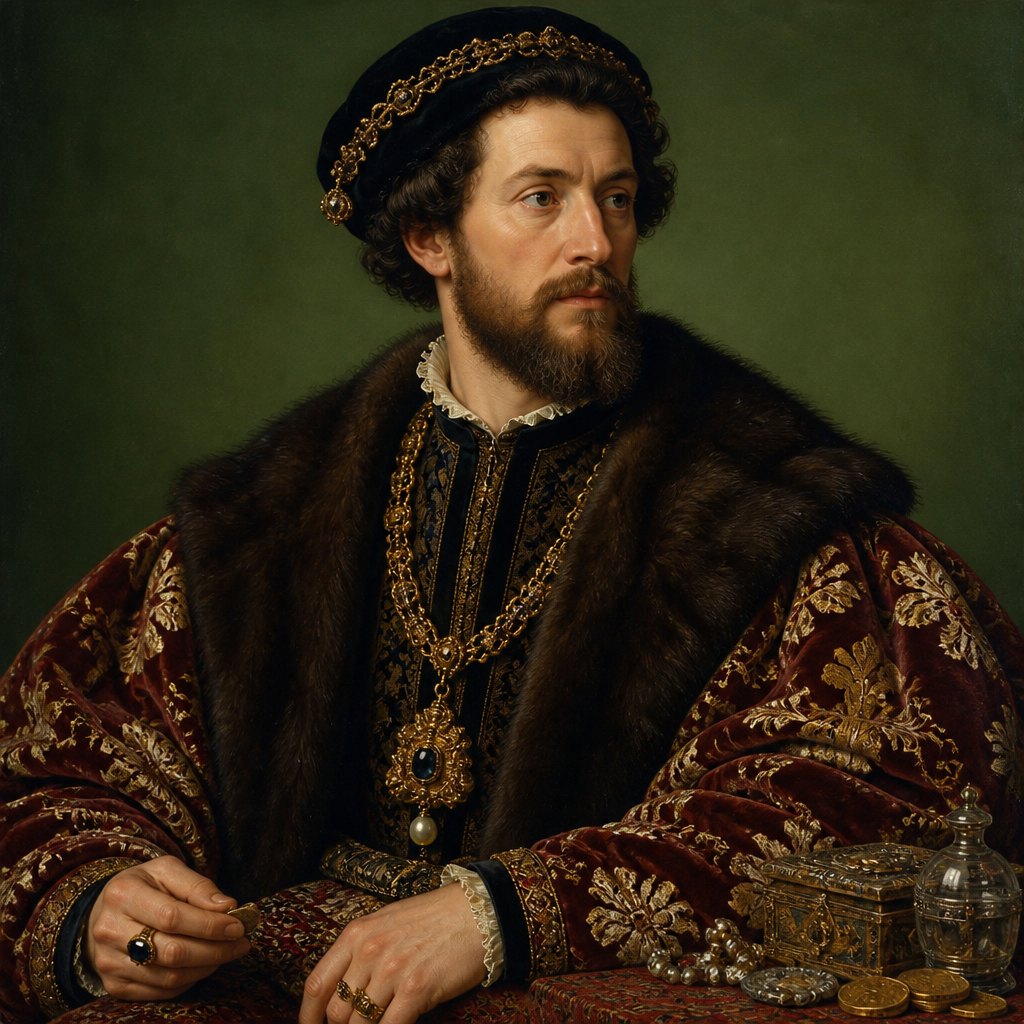 AI-generated
Create in the same spirit
Make Northern Renaissance art of your own
This AI interpretation echoes the aesthetic world Hans Holbein the Younger worked in — it depicts no real artwork. Generate your own with the Renaissance Portrait Art Style generator.
Open the Renaissance Portrait Art Style generator →Legacy
Holbein's portraits became the template for how Tudor England is remembered: the beefy, bejeweled Henry VIII of popular imagination is substantially his invention. Later English portraiture — from Elizabethan miniaturists to Van Dyck's own Stuart-era court commissions — worked in the long shadow of his exactness, even when painters chose looser, more flattering approaches. Art historians still mine his drawings, mostly silverpoint and chalk studies of courtiers, as the most reliable record of how the Tudor elite actually looked. Stand in front of The Ambassadors today, walk past the stretched skull at an angle until it resolves, and you feel exactly what Holbein wanted: a private joke about mortality, folded into a public image of power.
Frequently asked questions
What is Hans Holbein the Younger famous for?
Holbein is famous for the portraits he painted as King's Painter to Henry VIII, especially The Ambassadors (1533), a double portrait containing a distorted skull visible only from an angle. His unflinchingly precise likenesses of Tudor courtiers remain our clearest visual record of Henry's court.
Where can you see Hans Holbein's paintings today?
The National Gallery in London holds The Ambassadors; the Frick Collection in New York has his portraits of Thomas More and Thomas Cromwell facing each other. Further works hang in the Kunstmuseum Basel and the Royal Collection, which holds many of his court drawings.
What artistic movement did Holbein belong to?
Holbein worked within the Northern Renaissance, the tradition of exacting, detail-driven realism that flourished in Germany and the Low Countries. Unlike many Italian contemporaries, he prized close observation and material precision over idealized anatomy or dramatic gesture.
Did Holbein design objects besides paintings?
Yes. In his later years at the English court, Holbein designed jewelry, table ornaments, and ceremonial objects for Henry VIII, applying the same exacting eye he brought to portraiture. Several of his decorative sketches survive in British collections.