 Famous
![French: Moutons au bord de la Mer[1]Sheep by the Sea — Rosa Bonheur](https://media.famousartist.com/encyclopedia/rosa-bonheur/commons-4-thumb.jpg)
Rosa Bonheur (1822–1899) was a French painter renowned for her powerful, precisely observed depictions of animals, and one of the most celebrated woman artists of the nineteenth century. Born in Bordeaux to a painter father active in the utopian Saint-Simonian movement, she trained first under him after the family settled in Paris, developing an unusual dedication to firsthand study: she dissected animals at slaughterhouses and sketched for hours at horse fairs and stockyards to master anatomy other painters rendered from imagination.
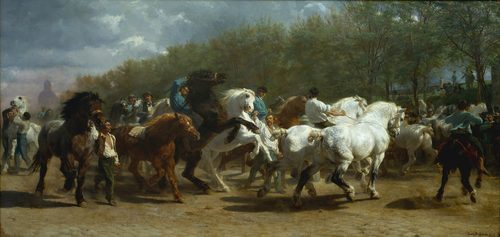
Her 1852–55 masterpiece, The Horse Fair, a monumental scene of horses and handlers at the Paris horse market, brought her international fame, touring England and the United States to enormous acclaim. To move freely and safely through markets and slaughterhouses, Bonheur obtained official police permission to wear trousers, a practical accommodation that also became part of her public legend.
In 1865 she became the first woman artist awarded France's Legion of Honor, presented personally by Empress Eugénie. Bonheur lived for decades at the Château de By near Fontainebleau, sharing her home first with her lifelong companion Nathalie Micas and later with the American painter Anna Klumpke, keeping a private menagerie of animals for study. She died at By in 1899, having outsold and outlasted most of her male contemporaries.
How to recognize a Bonheur
anatomically exact animals
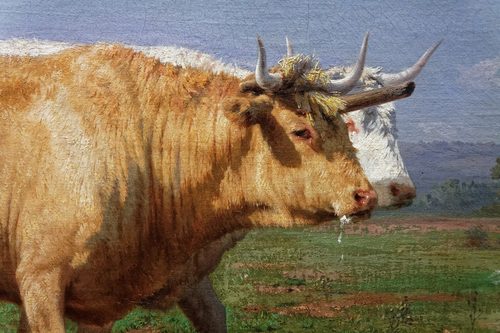
Bonheur renders horses, cattle, and lions with the muscular precision of a trained anatomist, the direct product of firsthand study at slaughterhouses, stockyards, and horse markets rather than inherited academic convention or imagination.
monumental group scenes
Works like The Horse Fair arrange dozens of animals and handlers in dynamic, tightly choreographed motion across a large canvas, giving ordinary working animals the physical scale and gravity usually reserved for history painting and battle scenes.
warm, earthy naturalism
Her palette favors warm browns, tans, and greys drawn directly from hide, coat, and pasture, largely avoiding decorative or fashionable color in favor of a believable, almost documentary naturalism grounded in observed fact.
animals as individuals
Even within crowded compositions, individual animals are given distinct postures, expressions, and personalities of their own, treated as characters with real presence rather than interchangeable, decorative elements filling out a rural scene.
rural French settings
Farmyards, markets, and open pasture recur as settings across her work, grounded in careful, repeated observation of actual French agricultural life and labor rather than sentimental, picturesque invention drawn from imagination.
confident, unfussy brushwork
Paint is applied with directness and control, capturing muscle, motion, and weight without excess detail, a technical assurance that impressed even critics skeptical of a woman painting animals at this scale.
The life
Bonheur was born in Bordeaux in 1822, the eldest child of Raimond Bonheur, a landscape and portrait painter involved in the utopian Saint-Simonian movement, which held progressive views on the roles of women. After the family moved to Paris, her father became her first teacher, and she was soon copying paintings at the Louvre and studying live animals wherever she could find them.
Unwilling to rely on imagination or convention, Bonheur pursued animal anatomy with unusual rigor, visiting slaughterhouses and horse markets to sketch directly from life, and obtaining a police permit allowing her to wear trousers so she could move through these spaces without harassment. This dedication produced The Horse Fair (1852–55), a vast, dynamic canvas that made her internationally famous when it toured Britain and the United States.
Honors followed: in 1865 Empress Eugénie personally presented her with the Legion of Honor, making Bonheur the first woman artist to receive it, and in 1894 she became the first woman promoted to the rank of Officer. She settled for decades at the Château de By near Fontainebleau with her companion Nathalie Micas, keeping horses, lions, and other animals on the grounds for study. After Micas's death, the American painter Anna Klumpke became her companion and later biographer. Bonheur died at By in 1899.
Timeline
- 1822Born in Bordeaux to painter Raimond Bonheur
- 1829Family relocates to Paris
- 1841Makes her Salon debut with animal paintings
- 1849Settles with Nathalie Micas, her lifelong companion
- 1853Completes The Horse Fair, her most famous work
- 1865First woman artist awarded the Legion of Honor
- 1889Meets American painter Anna Klumpke, later her companion
- 1894First woman promoted to Officer of the Legion of Honor
- 1899Dies at the Château de By near Fontainebleau
Most famous works
| Work | Date | Why it matters |
|---|---|---|
| The Horse Fair | 1852–55 | A monumental scene of horses and handlers at the Paris market that made her internationally famous. |
| Ploughing in the Nivernais | 1849 | Oxen straining at the plow across a French field, an early Salon success bought by the state. |
| The Lion at Home | 1881 | A domestic scene reflecting her lifelong practice of keeping lions and other animals to study firsthand. |
| Sheep by the Sea | 1865 | A quieter pastoral scene showing her range beyond the monumental animal groupings she was best known for. |
| Weaning the Calves | 1879 | A closely observed farmyard scene showing her sustained focus on French agricultural life and labor. |
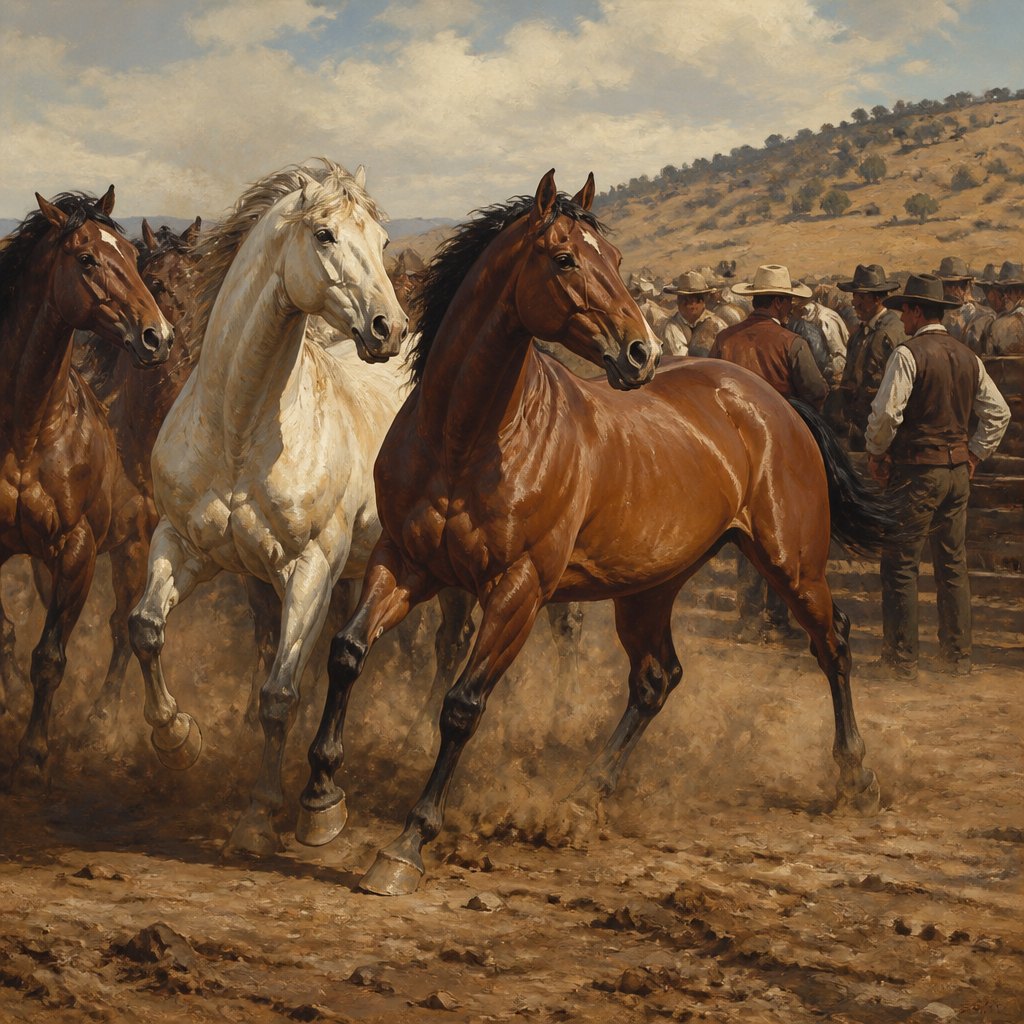 AI-generated
Create in the same spirit
Make Realism art of your own
This AI interpretation echoes the aesthetic world Rosa Bonheur worked in — it depicts no real artwork. Generate your own with the Realism Art Style generator.
Open the Realism Art Style generator →Legacy
Bonheur proved that animal painting, long ranked a minor genre, could sustain history-painting ambition and command the highest official honors of the French state. Her rigorous, firsthand method of study set a standard for anatomical accuracy that later animal and sporting painters followed. As the era's most famous woman artist, she also became an enduring symbol of professional independence for women in the arts, admired for building a successful, self-directed career on her own terms. You feel her now in any painting that treats an animal not as scenery but as a subject with its own weight, muscle, and character.
Frequently asked questions
What is Rosa Bonheur famous for?
Bonheur is famous for The Horse Fair and other monumental, anatomically precise animal paintings, and for becoming the first woman artist awarded France's Legion of Honor in 1865.
Where can I see Rosa Bonheur's paintings?
The Metropolitan Museum of Art in New York holds The Horse Fair. The Musée d'Orsay in Paris and the National Gallery in London also hold significant works.
Why did Rosa Bonheur wear trousers?
She obtained official police permission to wear men's clothing so she could move safely and practically through horse markets and slaughterhouses while sketching animals directly from life.
What movement did Rosa Bonheur belong to?
Bonheur is generally classed with Realism for her unsentimental, closely observed depictions of animals and rural labor, rendered with academic precision rather than idealized convention.