 Famous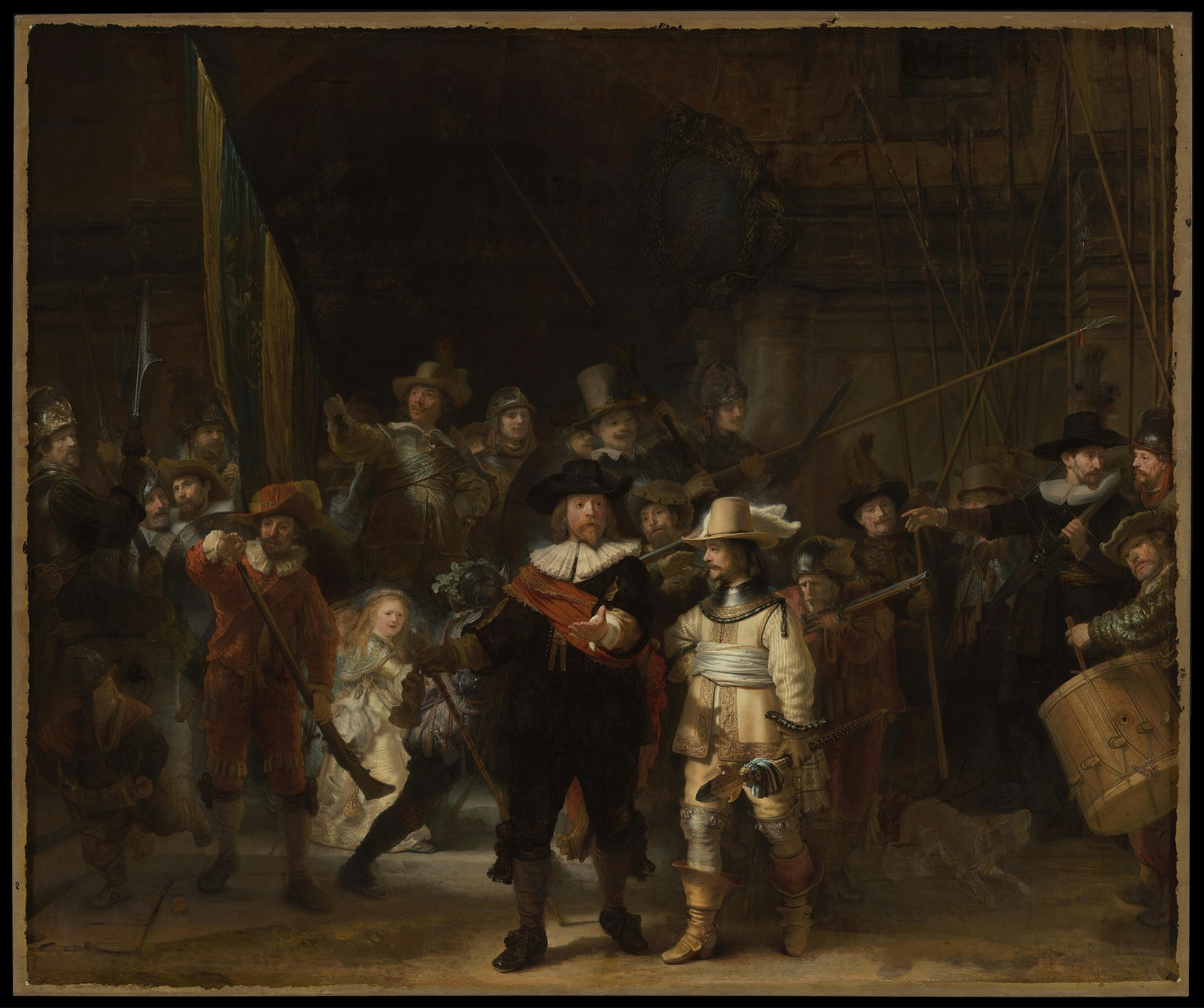
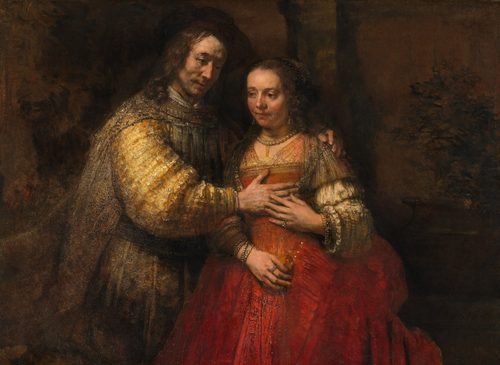
Rembrandt van Rijn (1606–1669) was a Dutch painter and printmaker whose command of light and unflinching honesty about the human face made him the towering figure of the Dutch Golden Age. Born in Leiden, the son of a miller, he trained locally before moving to Amsterdam, where his group portrait The Anatomy Lesson of Dr. Nicolaes Tulp made his reputation. He married well, bought an expensive house, and built a busy, successful studio through the 1630s, painting Amsterdam's merchant elite alongside biblical and mythological scenes rendered with startling emotional immediacy. His 1642 group portrait later nicknamed The Night Watch pushed the militia portrait into something closer to theater, dense with movement and dramatic light. Personal loss and financial mismanagement eroded his fortunes in later decades — he was declared insolvent in 1656 and lost his house — yet his late work only deepened, especially the roughly forty painted self-portraits he made across his lifetime, an unmatched visual diary of aging and self-scrutiny. He died in Amsterdam in 1669, having redefined what paint could do with a human face.
How to recognize a Rembrandt
Chiaroscuro, dramatic shadow
Rembrandt built his compositions around a single strong light source, letting most of the canvas dissolve into deep, velvety shadow so the illuminated passages — a face, a hand, a collar — carry all the emotional weight.
Thick, tactile impasto
In his later years he applied paint so thickly it stands off the canvas surface in visible ridges, catching real studio light on jewelry, collars, and wrinkled skin for a startling, almost sculptural physical presence.
Unsparing self-scrutiny
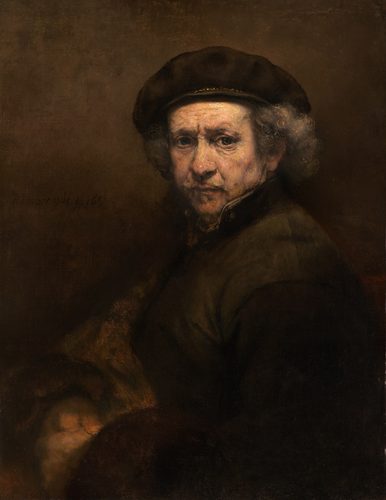
Across dozens of self-portraits spanning his entire career, from ambitious youth to worn old age, he recorded his own aging face, thickening body, and shifting expression with total honesty, refusing the flattery most painters gave themselves.
Warm earth-toned palette
Browns, ochres, and muted golds dominate nearly every canvas, punctuated by small, deliberate accents of red, white, or gold that draw the eye through the composition and give even crowded scenes a unified, warm glow.
Psychological group portraits
He broke decisively from stiff, evenly lit group-portrait conventions, arranging sitters in dynamic, overlapping poses caught mid-action and mid-gesture, as though the scene had been interrupted rather than carefully and formally assembled for the painter.
Masterful etched line
Beyond painting, Rembrandt ranks among history's greatest etchers, using scratchy, spontaneous lines, reworked plates, and selective wiping of ink to build the same dramatic contrasts of light and shadow he achieved on canvas, but in print.
The life
Rembrandt was born in Leiden in 1606, one of several children of a prosperous miller. After a short spell at Leiden University he trained as a painter, eventually studying briefly in Amsterdam under Pieter Lastman before returning home to establish a studio with fellow painter Jan Lievens.
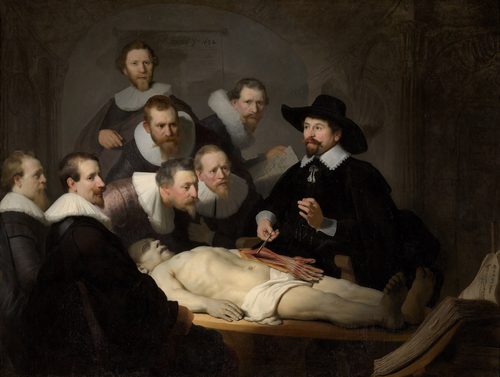
By 1631 he had relocated permanently to Amsterdam, where his 1632 group portrait The Anatomy Lesson of Dr. Nicolaes Tulp brought instant acclaim. He married Saskia van Uylenburgh in 1634, bought a substantial house on the Jodenbreestraat, and ran a large, in-demand studio producing portraits, biblical scenes, and prints throughout the 1630s.
The 1640s brought both triumph and grief: he completed his most ambitious group portrait, later called The Night Watch, in 1642, the same year Saskia died. His finances, strained by extravagant collecting and an expensive house, collapsed by the mid-1650s; he was declared insolvent in 1656 and forced to sell his home, art collection, and possessions.
Rembrandt's companion in his later years was Hendrickje Stoffels, who helped manage his affairs alongside his son Titus. Despite hardship, his final decade produced some of his most searching work. Titus died in 1668; Rembrandt followed in October 1669, buried in Amsterdam's Westerkerk.
Timeline
- 1606Born in Leiden
- 1625Establishes independent studio in Leiden with Jan Lievens
- 1631Moves permanently to Amsterdam
- 1632Paints The Anatomy Lesson of Dr. Nicolaes Tulp
- 1634Marries Saskia van Uylenburgh
- 1642Paints The Night Watch; Saskia dies
- 1656Declared insolvent, loses house and art collection
- 1669Dies in Amsterdam
Most famous works
| Work | Date | Why it matters |
|---|---|---|
| The Night Watch | 1642 | A militia group portrait transformed into a dramatic, light-flooded scene of movement, far beyond the static conventions the genre usually demanded. |
| The Anatomy Lesson of Dr. Nicolaes Tulp | 1632 | The group portrait that launched his Amsterdam career, uniting a roomful of individualized faces around a single dramatic action. |
| Self-Portrait with Two Circles | c. 1665–69 | A late self-portrait of remarkable rough honesty, the aging painter facing himself with tools in hand and no vanity. |
| The Jewish Bride | c. 1665 | A tender double portrait, likely of a couple, built from thick, glowing paint applied with extraordinary tactile freedom. |
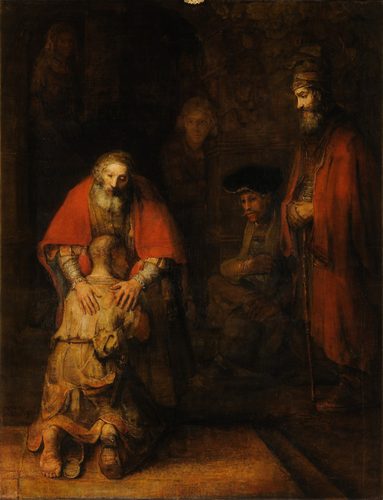
| The Return of the Prodigal Son | c. 1668 | A late biblical scene of forgiveness rendered with quiet, weighty compassion, among the most emotionally direct paintings of his life. |
 AI-generated
Create in the same spirit
Make Dutch Golden Age art of your own
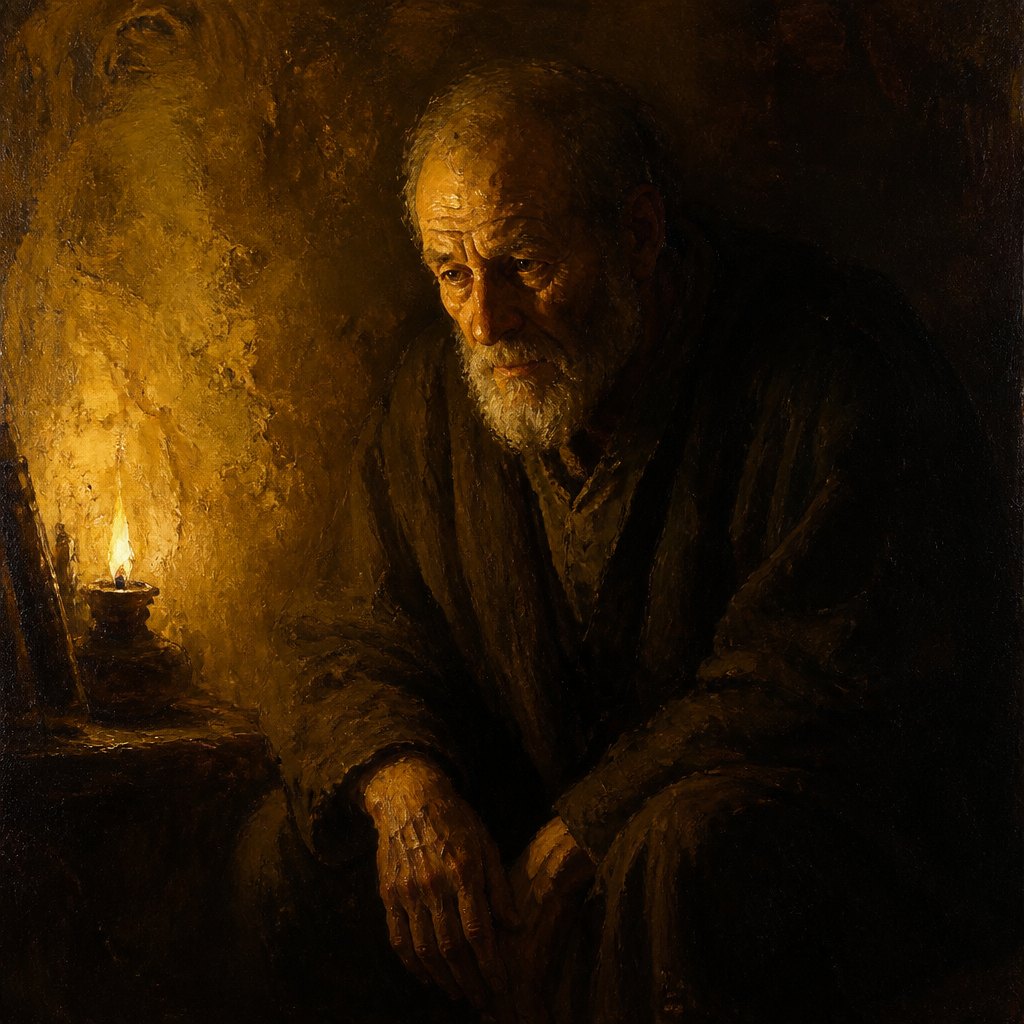
This AI interpretation echoes the aesthetic world Rembrandt worked in — it depicts no real artwork. Generate your own with the Dutch Golden Age Still Life Art Style generator.
Open the Dutch Golden Age Still Life Art Style generator →Legacy
Rembrandt's influence runs through nearly every painter who has used light to reveal character rather than simply describe a scene. His pupils, including Carel Fabritius and Nicolaes Maes, carried his methods across the Netherlands, and later artists from Goya to Van Gogh studied his handling of paint and shadow. His prolific etchings circulated across Europe during his lifetime, spreading his reach beyond anyone who could afford a painting. His unsentimental self-portraits, tracking an entire life from ambitious young master to worn, undefeated old man, remain a touchstone for what a self-portrait can confess. The Rijksmuseum's Night Watch still draws crowds daily, and his name remains shorthand, worldwide, for dramatic, soul-baring light.
Frequently asked questions
What is Rembrandt famous for?
Rembrandt is famous for The Night Watch and for his roughly forty painted self-portraits, and more broadly for a mastery of light and psychological depth that made him the leading painter of the Dutch Golden Age.
Where can I see Rembrandt's paintings today?
Amsterdam's Rijksmuseum holds The Night Watch and many major works; further examples are in the Mauritshuis in The Hague, the Louvre, London's National Gallery, and New York's Metropolitan Museum.
How many paintings did Rembrandt make?
Scholars generally accept a few hundred surviving paintings as authentic Rembrandts, alongside roughly three hundred etchings and hundreds of drawings, though attribution debates continue over some works.
What art movement was Rembrandt part of?
Rembrandt worked within the Dutch Golden Age and the broader Baroque, though his interest in inner psychology and dramatic light set him apart from more decorative contemporaries.