 Famous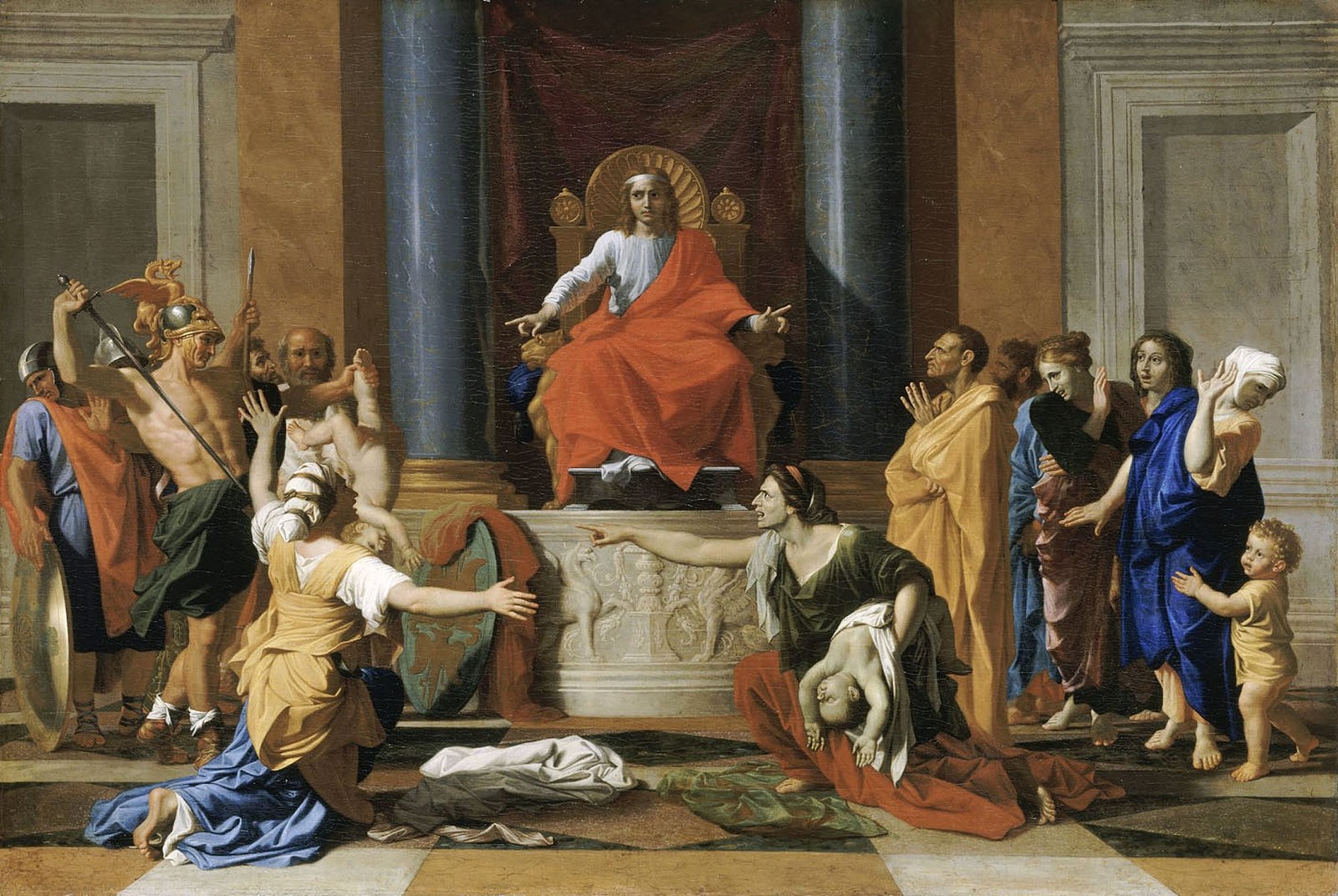
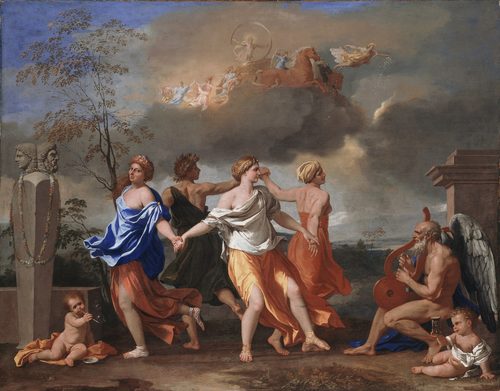
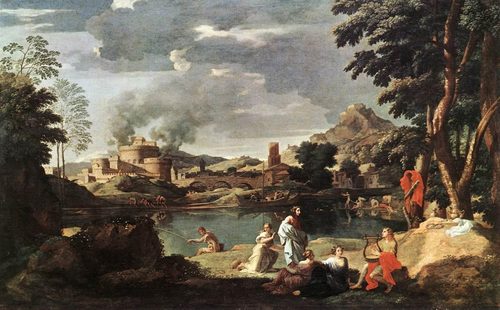
Nicolas Poussin (1594–1665) was the French painter who spent nearly his entire career in Rome yet became the founding figure of French classicism, prizing intellectual clarity and compositional order over Baroque theatrics. Trained partly in Paris, he settled permanently in Rome by 1624, immersing himself in ancient sculpture, Raphael, and the landscape around the city, which he studied on long walks with fellow painter Claude Lorrain.
Poussin built his mythological and biblical scenes like carefully argued essays, arranging figures at measured intervals across a shallow stage-like space, each gesture chosen for legibility and meaning rather than drama. Color served structure rather than sensation, cool and evenly distributed across a composition rather than concentrated for emotional effect. A brief, unhappy stint as First Painter to Louis XIII in Paris from 1640 to 1642 convinced him to return to Rome for good, free of court politics.
In his final decades he turned increasingly toward landscape, subordinating figures to vast, ordered views of nature governed by the same rational structure as his figure paintings. He died in Rome in 1665, revered by French academic painting for the next two centuries as its founding rationalist.
How to recognize a Poussin
Geometric, stage-like composition
Figures are arranged at measured intervals across a shallow, frieze-like space, as if positioned by careful calculation rather than natural gathering. The effect recalls a stage set, every figure placed to clarify the story's meaning.
Cool, evenly distributed color
Poussin used color to structure a composition rather than to stir emotion, spreading blues, ochres, and muted reds evenly across the canvas so no single passage overwhelms the whole. The palette stays restrained and legible.
Classical, sculptural figures
His figures draw directly on ancient statuary, with poses and drapery that recall marble relief more than living flesh. Gestures are deliberate and rhetorical, each pose chosen to communicate a precise emotional or narrative point.
Ordered, philosophical landscapes
In his later career, sweeping landscapes of trees, ruins, and distant mountains are organized with the same rational clarity as his figure compositions, nature itself made to feel governed by reason and proportion.
Restrained, legible narrative
Rather than a single dramatic climax, Poussin often chose a moment of moral or intellectual consequence, trusting careful arrangement and gesture over theatrical lighting or violent action to carry the story.
Muted, earthy autumn tones
His mature palette favors warm browns, dusty greens, and soft blues over the saturated color of his Baroque contemporaries, giving his canvases a measured, contemplative temperature rather than dramatic heat.
The life
Nicolas Poussin was born in 1594 near Les Andelys in Normandy. After early training in Paris, where he studied ancient sculpture and Renaissance prints, he made two unsuccessful attempts to reach Rome before finally settling there in 1624, where he would spend nearly the rest of his life.
In Rome, Poussin studied antiquity intensively and formed a close working friendship with the landscape painter Claude Lorrain, with whom he sketched the countryside around the city. Through the 1620s and 1630s he built a reputation among connoisseurs and collectors, especially the Roman antiquarian Cassiano dal Pozzo, for meticulously composed mythological, biblical, and historical scenes grounded in careful research into ancient costume and setting.
In 1640, Cardinal Richelieu and King Louis XIII summoned him to Paris to serve as First Painter to the King, but Poussin found the position's political demands and collaborative commissions uncongenial, and he returned to Rome permanently in 1642. His later decades saw an increasing focus on landscape, culminating in his celebrated Four Seasons cycle. He continued working despite failing health in his final years, and died in Rome in 1665.
Timeline
- 1594Born near Les Andelys, Normandy
- 1624Settles permanently in Rome
- 1628Paints The Martyrdom of Saint Erasmus
- 1634Paints The Rape of the Sabine Women
- 1640Summoned to Paris as First Painter to the King
- 1642Returns permanently to Rome
- 1648Paints Landscape with the Burial of Phocion
- 1664Completes The Four Seasons cycle
- 1665Dies in Rome
Most famous works
| Work | Date | Why it matters |
|---|---|---|
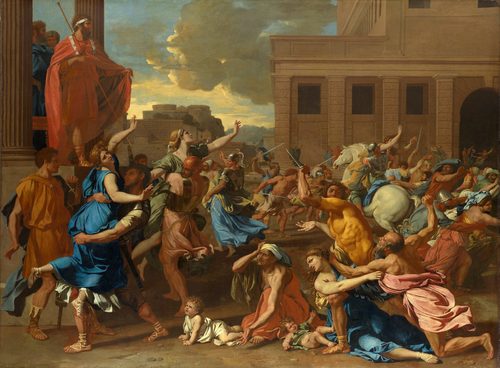
| The Rape of the Sabine Women | c. 1634–1635 | A tightly choreographed frieze of violent abduction, its chaos organized into clear, legible geometric groupings. |
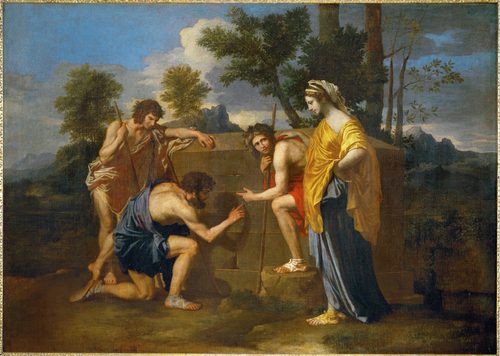
| Et in Arcadia Ego (The Arcadian Shepherds) | c. 1638 | Shepherds confront a tomb inscription reminding them that death reaches even an idyllic Arcadia. |
| Landscape with the Burial of Phocion | 1648 | A vast, orderly landscape dwarfing a small funeral procession, nature made to embody moral and rational order. |
| The Four Seasons | 1660–1664 | His late masterwork, four biblical landscapes mapping the cycle of the year onto sacred narrative and time itself. |
| Self-Portrait | 1650 | A severe, intellectual self-image surrounded by framed canvases, asserting painting's status as a liberal art. |
| The Martyrdom of Saint Erasmus | 1628–1629 | A rare early excursion into Baroque physical drama, painted for an altar in St. Peter's Basilica. |
 AI-generated
Create in the same spirit
Make Baroque art of your own
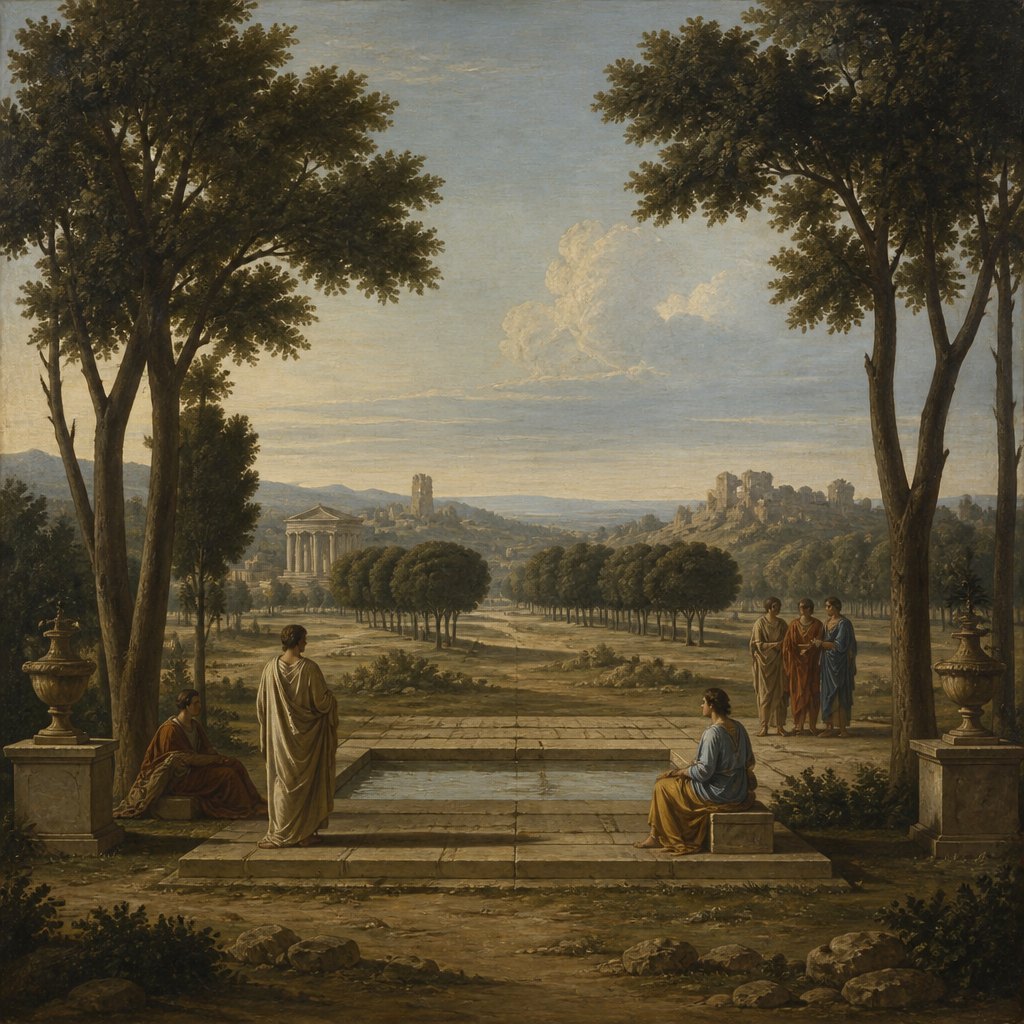
This AI interpretation echoes the aesthetic world Nicolas Poussin worked in — it depicts no real artwork. Generate your own with the Baroque Art Style generator.
Open the Baroque Art Style generator →Legacy
Poussin's insistence on order, clarity, and intellectual seriousness became the founding creed of the French Royal Academy, which for two centuries held him up as the model against which all history painting was measured. Ingres and the Neoclassicists looked directly to his example; Cézanne later spoke of wanting to redo Poussin after nature, carrying his structural logic into modern landscape painting. The recurring academic debate between Poussinistes, who prized drawing and structure, and Rubénistes, who prized color, structured French art theory for generations. His disciplined, thinking approach to composition remains a touchstone wherever painters value structure over spectacle.
Frequently asked questions
What is Nicolas Poussin famous for?
Poussin is famous for meticulously ordered classical and biblical scenes, painted mostly in Rome, that founded the French classical tradition and prized rational composition and clarity over Baroque drama and spectacle.
Where can you see Nicolas Poussin's paintings?
Major holdings are in the Louvre in Paris, London's National Gallery, the Metropolitan Museum in New York, and Rome's Galleria Doria Pamphilj, along with several other European and American museums.
How many paintings did Nicolas Poussin make?
Roughly two hundred paintings survive, a comparatively modest output reflecting his slow, deliberate working method and his preference for research and revision over rapid production.
What artistic movement was Nicolas Poussin part of?
Poussin worked during the Baroque era but became the founder of French classicism, a rational, order-driven counter-current within it that later shaped the French Royal Academy and Neoclassicism.