 Famous
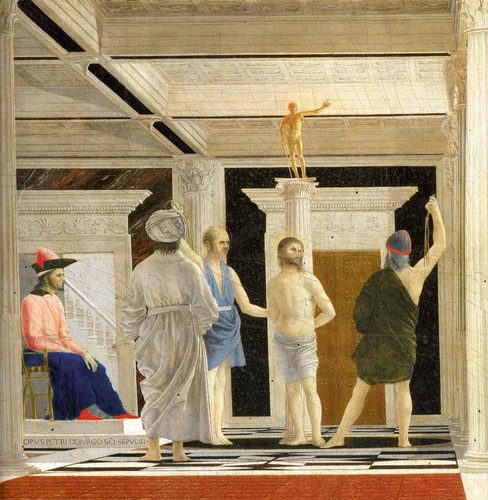
Piero della Francesca (c. 1415–1492) was an Italian painter and mathematician from Sansepolcro whose serene, geometrically ordered compositions and treatises on perspective made him one of the Early Renaissance's most rigorous and influential artists.
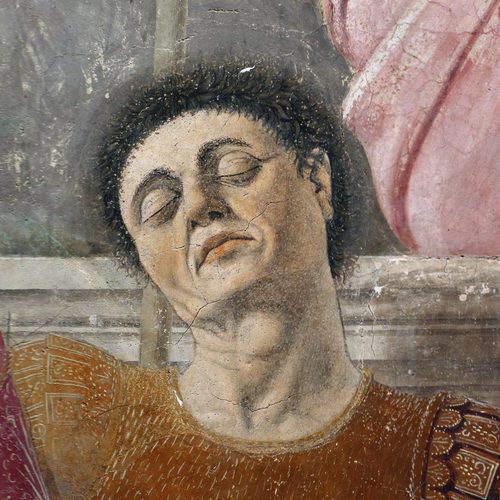
Trained in Florence in the 1430s, where he likely encountered the work of Masaccio and Domenico Veneziano, Piero spent most of his career working for courts and towns across central Italy: Ferrara, Rimini, Rome, and above all Urbino, where he painted for the humanist duke Federico da Montefeltro. His paintings are built on precise mathematical perspective and a cool, clear northern Italian light, arranging figures with an almost architectural stillness, most famously in the fresco cycle The History of the True Cross in Arezzo and the double portrait of Federico da Montefeltro and his wife Battista Sforza. He also wrote influential mathematical treatises on geometry and perspective, treating painting as a discipline as exact as arithmetic.
In his later years failing eyesight is thought to have led him to set painting aside in favor of mathematics. He died in Sansepolcro in 1492, and for centuries afterward was remembered chiefly as a mathematician, his paintings rediscovered and fully celebrated only in the twentieth century.
How to recognize a Francesca
Precise mathematical perspective
Piero constructed his compositions with exact geometric perspective, treating architecture and space with the same rigor he brought to his mathematical treatises, so every figure sits in convincingly measured space.
Cool, clear daylight
His scenes are lit with an even, cool northern-Italian light rather than dramatic shadow, giving faces, fabric, and architecture a crisp, almost crystalline clarity found in few of his contemporaries.
Still, monumental figures
Piero's people stand with an almost architectural stillness, calm and upright, their poses reduced to simple, stable geometric forms rather than dramatic gesture or movement, giving even a crowd the poise of statuary.
Egg-shaped, idealized faces
Faces in his paintings share a smooth, rounded, faintly abstracted quality, idealized rather than individualized, closer to geometric form than to the sharper realism of Northern portraiture, calm rather than expressive.
Muted, pastel color harmonies
He favored soft pinks, dusty blues, and pale greens balanced in careful harmony across a composition, color used to unify a scene rather than to dramatize it, giving each panel a quiet, even temperature.
Profile portraiture
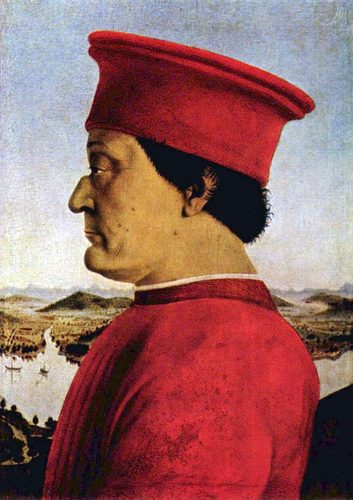
Following the fashion of Italian courts, Piero painted key sitters in strict profile, most famously Federico da Montefeltro, turning a portrait into a stable, emblem-like image rather than a candid likeness.
The life
Piero della Francesca was born around 1415 in Borgo Sansepolcro, in what is now eastern Tuscany, the son of a tanner and wool merchant. By 1439 he is documented in Florence, where he is thought to have absorbed the perspective and weighted realism of Masaccio and the color sense of Domenico Veneziano, alongside whom he worked there on a fresco cycle.
Piero spent his career moving between the small courts and towns of central Italy rather than settling permanently in one artistic center. In Arezzo he painted his largest surviving work, the fresco cycle The History of the True Cross, over roughly a decade beginning in the 1450s. At the court of Urbino he became closely associated with Duke Federico da Montefeltro, painting his celebrated profile double portrait with his wife, Battista Sforza, and later the Brera Altarpiece for the ducal chapel.
Alongside painting, Piero wrote mathematical treatises on geometry, solid bodies, and perspective, work respected enough that a later mathematician was accused of plagiarizing it. Failing eyesight in his last years is believed to have curtailed his painting. He died in Sansepolcro in October 1492, and for much of the following four centuries was remembered mainly as a mathematician rather than a painter.
Timeline
- 1415Born in Borgo Sansepolcro
- 1439Documented working in Florence
- 1450Paints for the court of Rimini
- 1452Begins The History of the True Cross in Arezzo
- 1465Paints the double portrait of Federico da Montefeltro
- 1470Paints the Brera Altarpiece for the court of Urbino
- 1480Turns increasingly to writing mathematical treatises
- 1492Dies in Sansepolcro
Most famous works
| Work | Date | Why it matters |
|---|---|---|
| The History of the True Cross | c. 1452-1466 | A large fresco cycle in Arezzo telling the legend of the True Cross, his most ambitious surviving work. |
| Federico da Montefeltro and Battista Sforza | c. 1465-1472 | A profile double portrait of the Duke and Duchess of Urbino set against a sweeping distant landscape. |
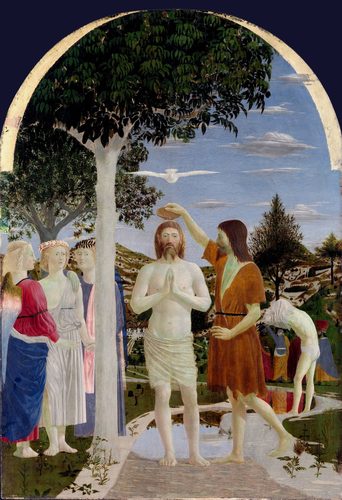
| The Baptism of Christ | c. 1450 | An early panel prized for its clear geometric composition and unusually cool, crystalline light. |
| The Flagellation of Christ | c. 1455-1460 | A small, precisely constructed panel whose exact meaning and figures remain debated by scholars. |
| Brera Altarpiece | c. 1472-1474 | A sacra conversazione painted for Federico da Montefeltro, famous for an egg suspended above the enthroned Madonna. |
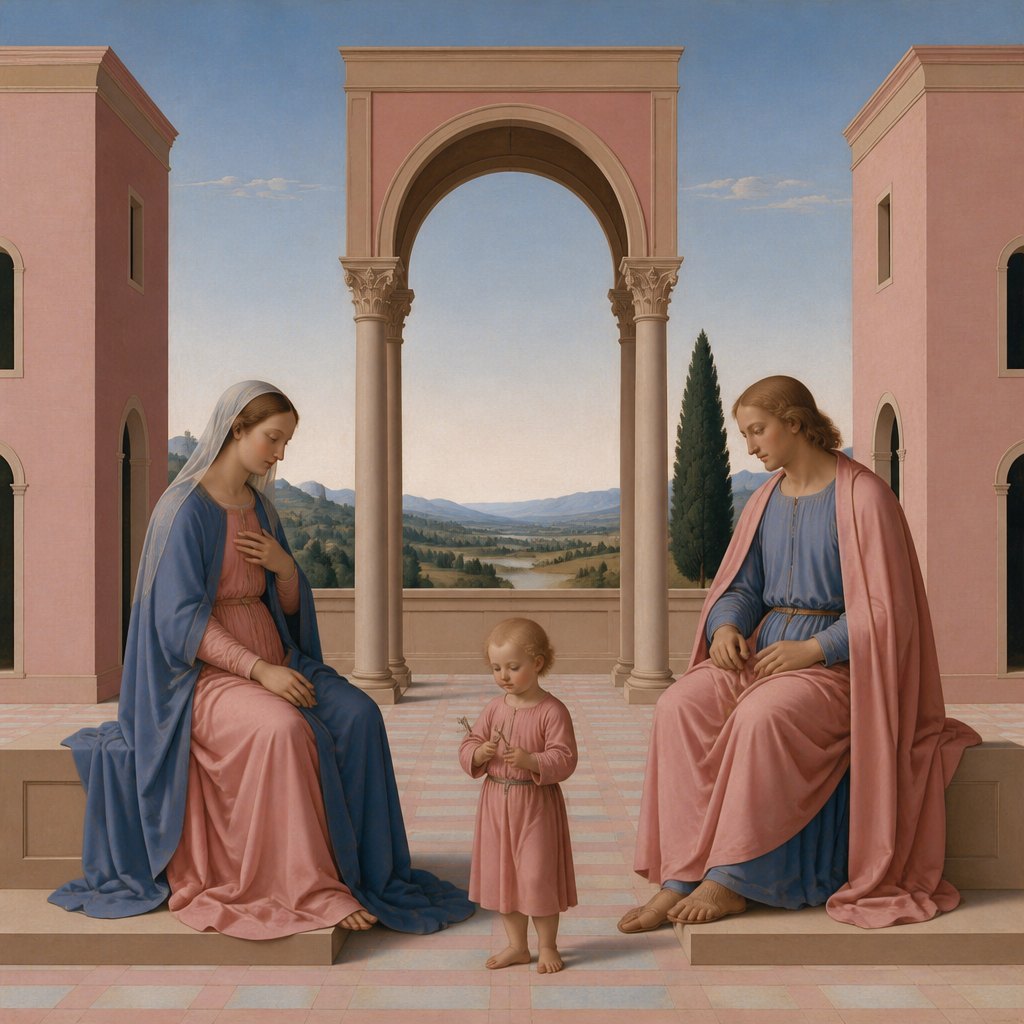 AI-generated
Create in the same spirit
Make Early Renaissance art of your own
This AI interpretation echoes the aesthetic world Piero della Francesca worked in — it depicts no real artwork. Generate your own with the Quattrocento Perspective Renaissance Art Style generator.
Open the Quattrocento Perspective Renaissance Art Style generator →Legacy
Piero della Francesca treated painting as an extension of mathematics, and that rigor gave his work a stillness that later ages, especially the twentieth century, found strikingly modern. Largely forgotten as a painter for centuries, he was rediscovered in the early 1900s and became a touchstone for artists drawn to geometric clarity and calm, ordered composition. You feel him now in any image built on quiet, exact structure rather than incident, a horizon precisely placed, a figure standing in a measured space, in the plain conviction that mathematics and beauty were never really separate disciplines.
Frequently asked questions
What is Piero della Francesca famous for?
Piero della Francesca is famous for serene, geometrically precise paintings, especially The History of the True Cross fresco cycle in Arezzo and his profile double portrait of Federico da Montefeltro and Battista Sforza.
Where can you see Piero della Francesca's work today?
His largest cycle remains in the Basilica of San Francesco in Arezzo. Panels are held by the Uffizi in Florence, the Brera in Milan, the National Gallery in London, and the Ducal Palace in Urbino.
Was Piero della Francesca also a mathematician?
Yes. He wrote respected treatises on geometry, perspective, and solid bodies, and spent much of his later life focused on mathematics, reportedly after his eyesight made painting more difficult.
What movement did Piero della Francesca belong to?
Piero worked within the Early Renaissance, applying the perspective pioneered by Masaccio and Brunelleschi with unusual mathematical rigor, developing a style prized for its clarity, calm, and precise structure.