 Famous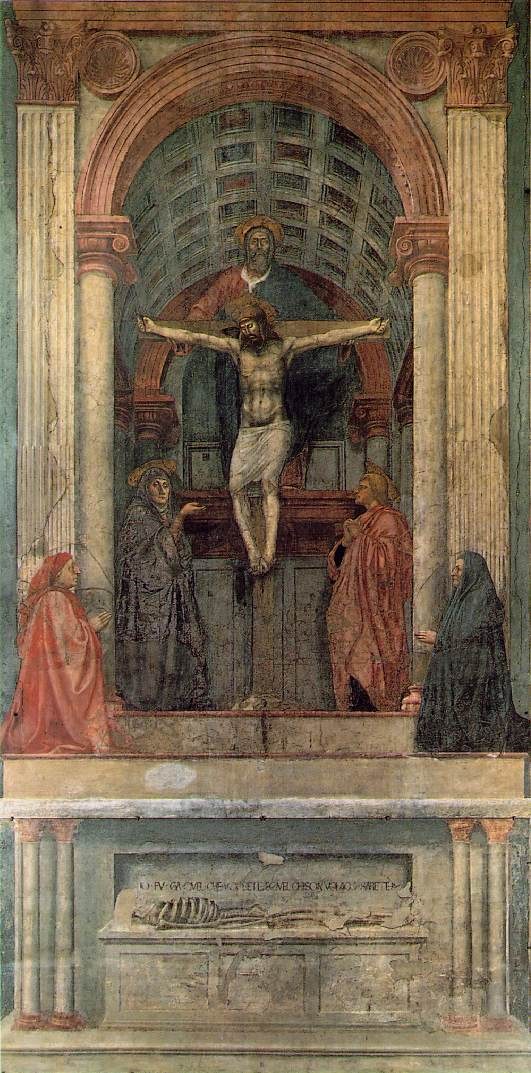
Masaccio (1401–1428) was a Florentine painter who, in a career cut short at twenty-six, founded Renaissance painting by fusing Giotto's solid, weighted figures with the newly formalized science of linear perspective, creating pictures with a convincing sense of real, breathable space.
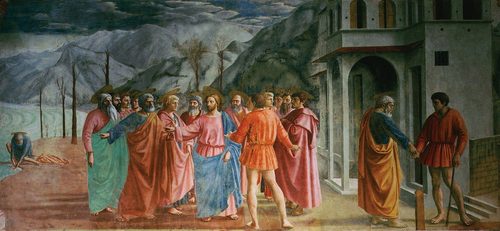
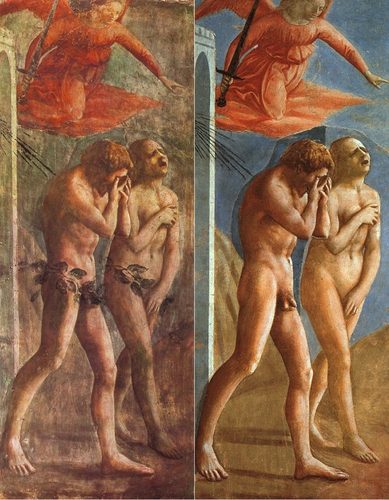
Born Tommaso di Ser Giovanni di Simone in the town of San Giovanni Valdarno, he trained in Florence and joined the painters' guild there in 1422. His central achievement is the fresco cycle in the Brancacci Chapel of Santa Maria del Carmine, painted largely alongside the older Masolino, where scenes like The Tribute Money and The Expulsion from the Garden of Eden show figures with true anatomical mass, modeled by a single consistent light source, standing in settings built on rigorous perspective. His Holy Trinity fresco in Santa Maria Novella used mathematical perspective so convincingly that the painted chapel appears to punch a hole through the real wall.
Masaccio died in Rome in 1428, probably in his mid-twenties, under circumstances that are not clearly recorded. Despite his brief career, Florentine painters for the rest of the century, including Michelangelo, studied his Brancacci Chapel frescoes as a primary school of painting.
How to recognize a Masaccio
Single, consistent light source
Masaccio modeled every figure as if lit from one real, fixed direction, giving bodies convincing shadow and volume instead of the patchy, decorative lighting common in earlier Florentine painting, so faces and drapery read as solidly three-dimensional.
Rigorous linear perspective
Buildings and interiors recede toward a single vanishing point with mathematical consistency, most famously in the Holy Trinity fresco, where the architecture appears to open a real, three-dimensional chapel into the wall.
Heavy, sculptural bodies
His figures stand with real gravity and weight, feet planted, drapery falling according to the body beneath it, closer to sculpture than to the more decorative linear figures of his contemporaries.
Plain, unsentimental faces
Masaccio's people, including Adam and Eve expelled from Eden, show raw, direct emotion rather than the graceful poise typical of the period, faces creased with grief, shame, or plain human strain.
Restrained, earthy palette
He favored a sober range of browns, dusty reds, and greens over the bright decorative color of earlier Gothic painting, keeping attention on form and light rather than ornament, a restraint that reads as gravity rather than dullness.
Economy of gesture
Compositions are pared down to only the figures and architecture a scene requires, each pose and gesture doing real narrative work, with none of the crowding common in earlier fresco cycles.
The life
Masaccio was born Tommaso di Ser Giovanni di Simone in 1401 in San Giovanni Valdarno, a town southeast of Florence. Little is documented of his early training, but he entered the Florentine painters' guild, the Arte dei Medici e Speziali, in 1422, suggesting a swift, capable apprenticeship.
His major surviving work was produced in close partnership with the more established painter Masolino, most importantly the fresco cycle in the Brancacci Chapel at Santa Maria del Carmine in Florence, likely begun around 1424. There, in scenes such as The Tribute Money and The Expulsion from the Garden of Eden, Masaccio applied Filippo Brunelleschi's new theory of linear perspective and a single, unified light source to figures of real anatomical weight, a combination that had no real precedent in Florentine painting.
Around 1427 or 1428 he also painted the Holy Trinity fresco in Santa Maria Novella, using perspective to simulate an architectural space that does not exist. Masaccio left Florence for Rome in 1428 to work alongside Masolino again, and died there that same year, still in his twenties, in circumstances that were never clearly recorded by contemporaries.
Timeline
- 1401Born in San Giovanni Valdarno
- 1422Enters the Florentine painters' guild
- 1424Begins the Brancacci Chapel frescoes with Masolino
- 1425Paints The Tribute Money in the Brancacci Chapel
- 1427Paints the Holy Trinity fresco in Santa Maria Novella
- 1428Travels to Rome to work with Masolino
- 1428Dies in Rome, in his mid-twenties
Most famous works
| Work | Date | Why it matters |
|---|---|---|
| The Tribute Money | c. 1425 | A Brancacci Chapel fresco whose figures, lit from one source, established a new standard for weight and unity in painting. |
| The Expulsion from the Garden of Eden | c. 1425 | A small, raw fresco of Adam and Eve's grief that became one of the most studied images of human emotion in Florence. |
| Holy Trinity | c. 1427 | A fresco in Santa Maria Novella using rigorous linear perspective to simulate a chapel recessed into the real wall. |
| The Brancacci Chapel Frescoes | c. 1424-1427 | A cycle on the life of Saint Peter, painted with Masolino, that later Florentine painters treated as a school of painting. |
| San Giovenale Triptych | 1422 | His earliest securely dated work, already showing an unusual solidity of form for so young a painter. |
 AI-generated
Create in the same spirit
Make Early Renaissance art of your own
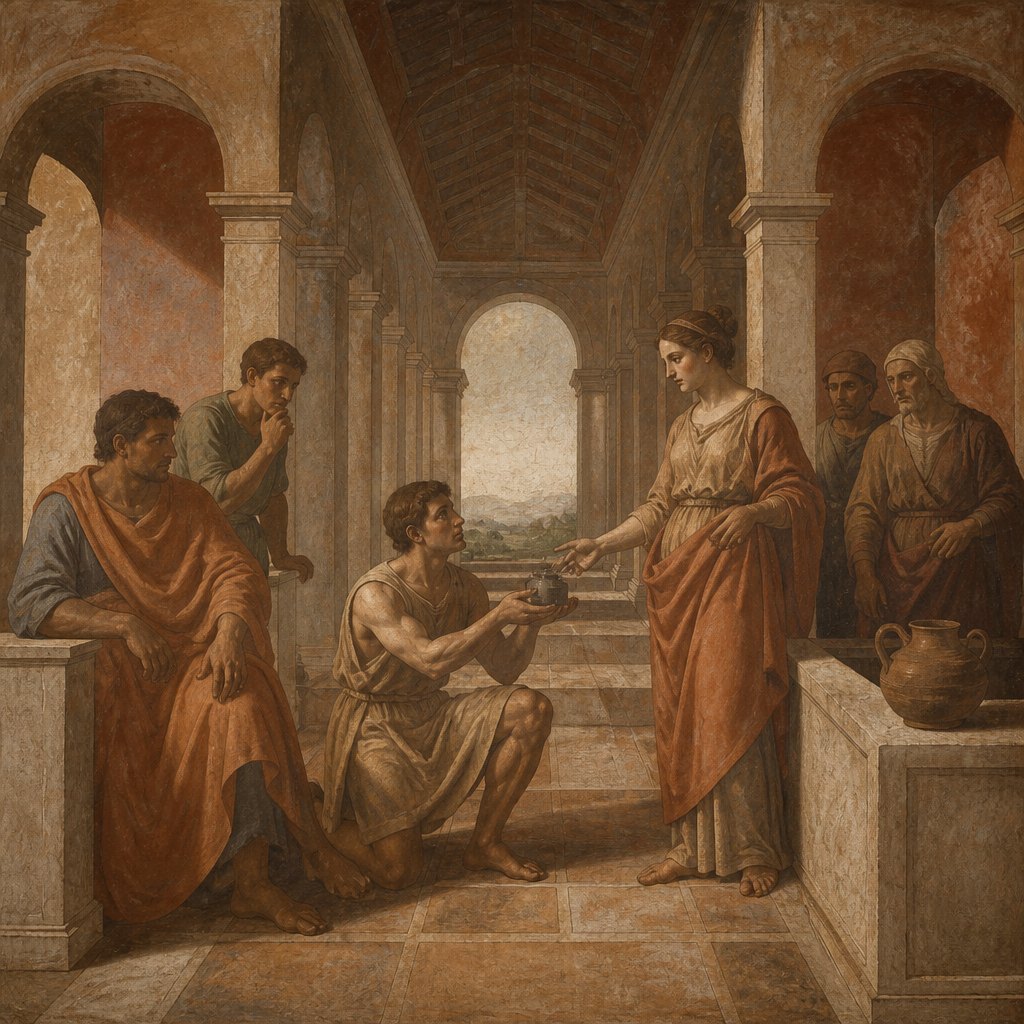
This AI interpretation echoes the aesthetic world Masaccio worked in — it depicts no real artwork. Generate your own with the Quattrocento Perspective Renaissance Art Style generator.
Open the Quattrocento Perspective Renaissance Art Style generator →Legacy
Masaccio worked for barely six years, but he set the terms for Florentine painting for the rest of the century. By fusing Brunelleschi's perspective with Giotto's sculptural weight, he showed how a painted wall could behave like a real, measurable room. Fra Angelico, Piero della Francesca, and Michelangelo all studied the Brancacci Chapel directly, sketching from his frescoes as a basic education in painting. You feel him now in any picture that convinces you of its own depth, in a floor tile that recedes correctly, or a figure that seems to carry its own weight rather than float on the surface.
Frequently asked questions
What is Masaccio famous for?
Masaccio is famous for founding Renaissance painting by combining true linear perspective with weighty, realistic human figures, especially in the Brancacci Chapel frescoes and the Holy Trinity in Santa Maria Novella.
Where can you see Masaccio's work today?
His major surviving frescoes remain in Florence: the Brancacci Chapel at Santa Maria del Carmine and the Holy Trinity at Santa Maria Novella. Panel paintings are held in museums including the Uffizi and the National Gallery, London.
How did Masaccio die so young?
Masaccio died in Rome in 1428 at around twenty-six or twenty-seven. The exact cause was never clearly recorded by contemporaries, though he was working there alongside Masolino at the time of his death.
What movement did Masaccio belong to?
Masaccio is considered the founder of Early Renaissance painting in Florence, the first artist to fully combine Brunelleschi's linear perspective with a sculptural, Giotto-derived sense of human weight.