 Famous
![The Hay Wagon.
Alternative title(s):
Hay Wain.[1] — Hieronymus Bosch](https://media.famousartist.com/encyclopedia/hieronymus-bosch/commons-0.jpg)
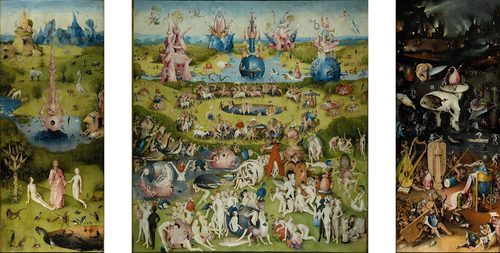
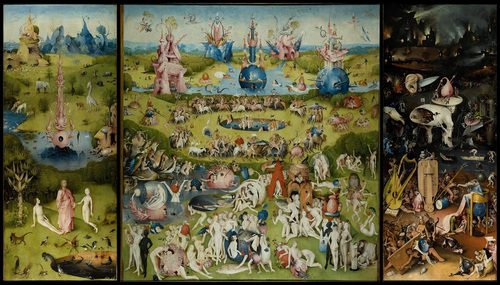
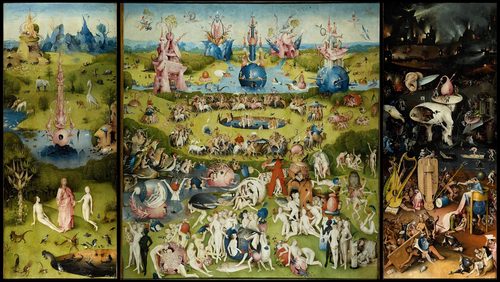
Hieronymus Bosch (c. 1450–1516) was a Netherlandish painter who turned religious moralizing into some of the most inventive and unsettling imagery in Western art, populating his panels with hybrid creatures born from fish, insects, birds, and human anatomy. He spent nearly his entire life in the prosperous Dutch town of 's-Hertogenbosch, running a workshop that served wealthy patrons, religious confraternities, and eventually the Spanish court. Little is documented about the man himself beyond guild records, tax rolls, and a short list of surviving commissions, so his psychology remains a matter of speculation rather than fact. What survives is the work: triptychs of sin, temptation, and judgment painted with the cool precision of a manuscript illuminator. His masterpiece, The Garden of Earthly Delights, moves from an Edenic paradise through a crowded panorama of pleasure into a nightmarish hell, each scene as meticulously rendered as the last. Bosch painted for a devout, apocalypse-minded audience steeped in sermons and proverbs, not classical mythology. Centuries later, Surrealist painters recognized a kindred imagination in his hallucinatory invention, and his creatures still feel disturbingly original today.
How to recognize a Bosch
Hybrid monster anatomy
Bosch's creatures fuse fish, birds, insects, and human limbs into single impossible bodies, walking upright or sprouting from eggs and shells. No two are alike, and each seems built from an internal logic of sin, punishment, or appetite rather than any natural model.
Crowded panoramic panels
His triptychs pack hundreds of small figures into continuous, high-horizon landscapes, inviting close inspection panel by panel. The eye wanders rather than settles, discovering new vignettes of temptation or torment the longer it looks.
Cool, precise brushwork
Despite the chaos of his subjects, Bosch painted with the fine, controlled hand of a manuscript illuminator, using thin, exact strokes rather than visible drama. The technique makes even his most grotesque inventions feel calmly observed.
Egg and shell motifs
Bosch repeatedly enclosed figures inside eggs, shells, fruit husks, and hollow trees, treating the body as something fragile and containable. These vessels recur across his work as symbols of temptation, folly, or fleeting pleasure.
Musical instruments as torment
In his hell scenes, lutes, harps, and horns become instruments of punishment, with sinners impaled on or crushed inside them. The pairing of music and suffering reflects contemporary warnings against idle pleasure and vanity.
Muted earth and flesh tones
Bosch favored soft grays, browns, and pinkish flesh tones punctuated by small bursts of red or blue, keeping his palette restrained even in scenes of chaos. The quiet coloring lets the strangeness of the imagery do the work.
The life
Almost nothing is documented about Hieronymus Bosch's training. He was born Jheronimus van Aken into a family of painters in 's-Hertogenbosch, in the Duchy of Brabant, and likely learned the craft from his father or uncles before adopting the name Bosch, after his home town. He remained there his entire life, a prosperous market town rather than a major artistic center, which makes his singular imagination all the more striking.
By the 1480s he was an established master with his own workshop, producing altarpieces and panel paintings for local churches, the town's leading religious confraternity, and noble patrons across the Netherlands. His reputation grew quickly beyond Brabant; by the early 1500s collectors in Italy and Spain were seeking out his work, and King Philip II of Spain would later assemble one of the largest collections of his paintings.
Bosch's mature period, roughly the last two decades of his life, produced his most ambitious works, including The Garden of Earthly Delights and The Haywain. He continued to run an active workshop until his death in 1516, and members of his family carried on painting in a similar style for years afterward, which has complicated efforts to separate authentic works from close followers.
Timeline
- 1450Born Jheronimus van Aken in 's-Hertogenbosch
- 1481Marries Aleyt Goyaerts van den Meervenne, a wealthy heiress
- 1486Joins the prestigious Confraternity of Our Lady
- 1495Paints The Garden of Earthly Delights (approx.)
- 1500Paints The Haywain Triptych (approx.)
- 1504Commissioned by Philip the Fair for a Last Judgment
- 1516Dies in 's-Hertogenbosch; buried in St. John's Church
Most famous works
| Work | Date | Why it matters |
|---|---|---|
| The Garden of Earthly Delights | c. 1495–1505 | His largest and strangest triptych, a panorama of paradise, pleasure, and punishment filled with impossible creatures. |
| The Haywain Triptych | c. 1500–1502 | An allegory of human folly, following a wagon of hay toward hell as the world grasps and fights over trifles. |
| The Temptation of St. Anthony | c. 1501 | A crowded, hallucinatory vision of the saint besieged by demons, now in Lisbon's national art museum. |
| Death and the Miser | c. 1485–1490 | A small, taut panel showing a dying man torn between salvation and the temptations of gold. |
| The Ship of Fools | c. 1500–1510 | A satirical panel skewering clerical and worldly excess aboard a boat adrift with no destination. |
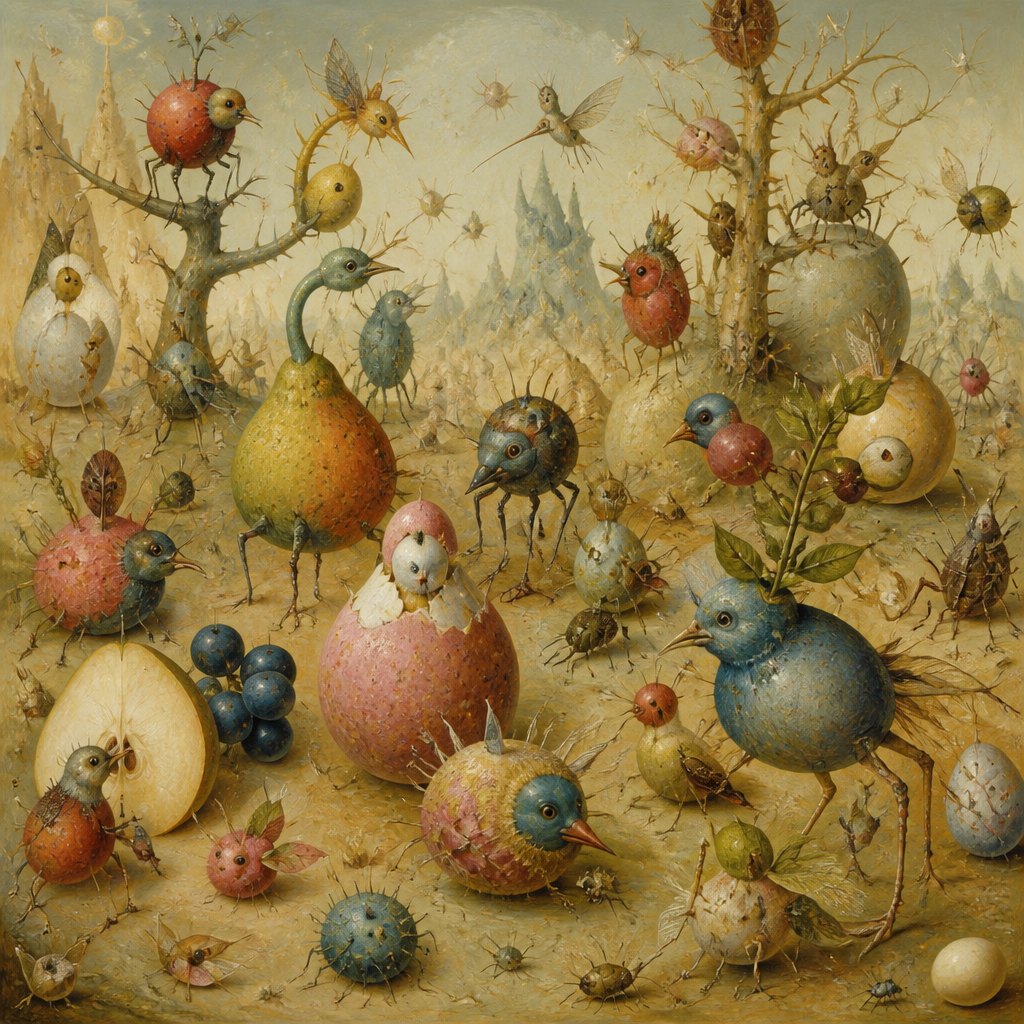 AI-generated
Create in the same spirit
Make Northern Renaissance art of your own
This AI interpretation echoes the aesthetic world Hieronymus Bosch worked in — it depicts no real artwork. Generate your own with the Renaissance Portrait Art Style generator.
Open the Renaissance Portrait Art Style generator →Legacy
Bosch left no direct school, but his hallucinatory imagination outlived the religious culture that produced it. Pieter Bruegel the Elder studied his crowded compositions and moral satire directly, carrying Bosch's eye for human folly into a new generation of Netherlandish painting. His paintings were prized by the Spanish court, and King Philip II's collection preserved many of the surviving panels now in the Prado. In the twentieth century, Surrealists including Salvador Dalí and Max Ernst claimed Bosch as an ancestor, recognizing in his fused creatures and dreamlike logic an early version of their own methods. His work remains a reference point for anyone imagining what nightmares and utopias might look like rendered in exacting detail.
Frequently asked questions
What is Hieronymus Bosch famous for?
Bosch is famous for The Garden of Earthly Delights and other panels crowded with hybrid monsters, moral allegory, and visions of hell, painted with meticulous, almost scientific precision.
Where can you see Hieronymus Bosch's paintings?
The largest collection is in Madrid's Museo del Prado, including The Garden of Earthly Delights and The Haywain. Other major works are held in Lisbon, Venice, Vienna, and the Museum Boijmans Van Beuningen in Rotterdam.
How many paintings by Bosch survive?
Roughly two dozen paintings and about twenty drawings are widely accepted as authentic Bosch works, out of a much larger number once attributed to him. Many surviving pieces are debated among specialists.
What art movement was Bosch part of?
Bosch worked within the Northern Renaissance, the tradition of Jan van Eyck and Albrecht Dürer, though his imagery is unusually personal and owes as much to folklore and sermon literature as to any shared style.