 Famous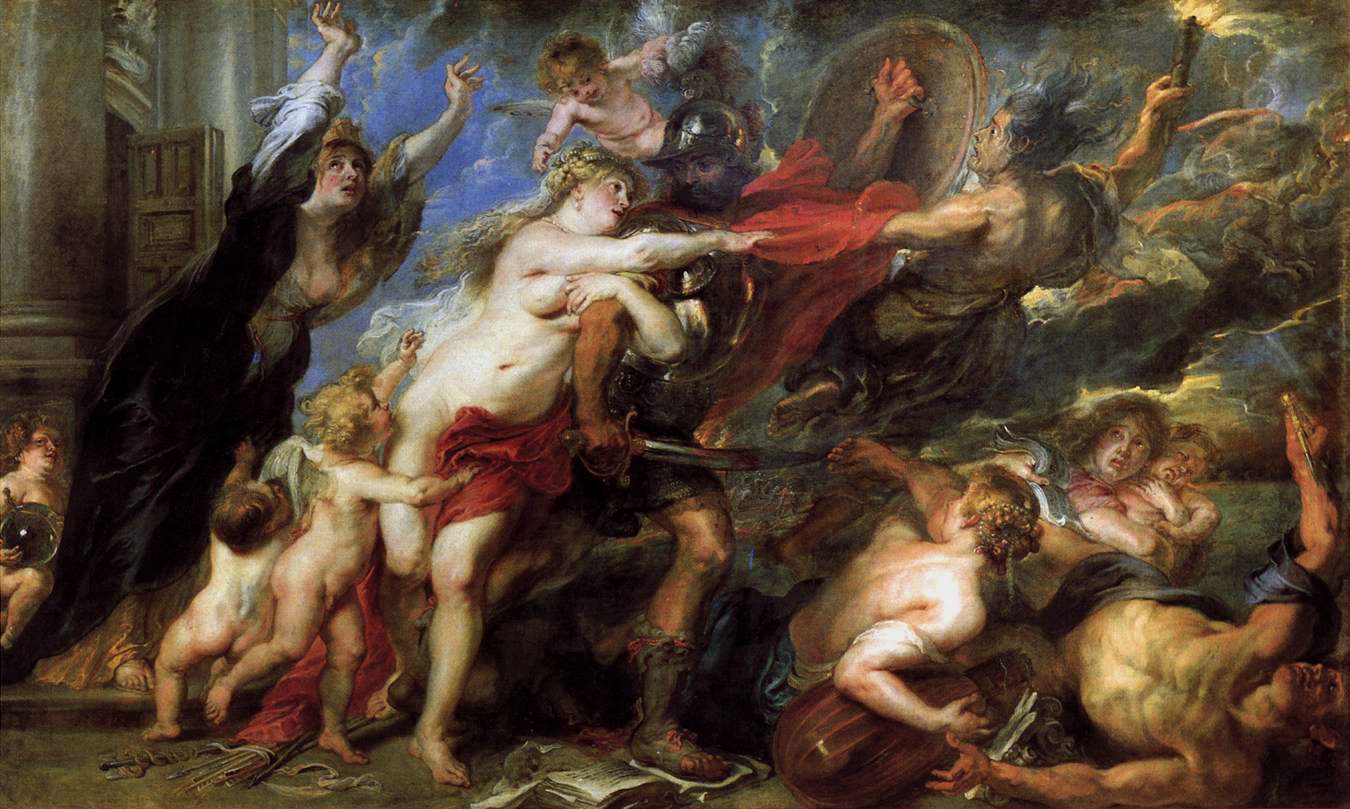
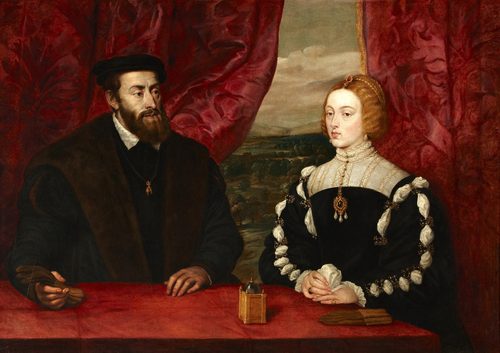
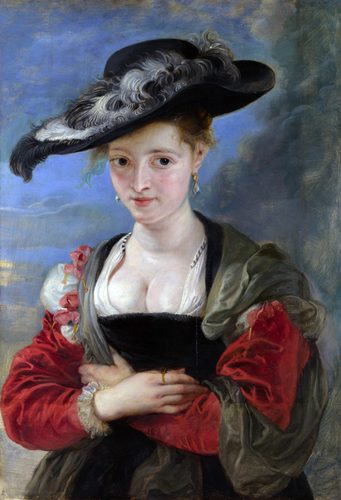
Peter Paul Rubens (1577–1640) was the Flemish painter and diplomat whose swirling, muscular canvases defined Baroque painting across Catholic Europe. Trained in Antwerp and seasoned by eight years in Italy studying Titian, Michelangelo, and ancient sculpture, he returned home in 1608 with a synthesis no rival could match: Venetian color, Roman monumentality, and a Flemish eye for texture.
Back in Antwerp he built the era's largest and most efficient painting workshop, producing altarpieces, mythologies, portraits, and tapestry designs for courts from Madrid to London. His figures move with tremendous physical force — twisting torsos, straining muscle, cascading drapery — rendered in warm, confident color that seems to glow from within. Beyond the studio, Rubens served as a trusted diplomat, negotiating peace between Spain and England and earning knighthoods from both crowns.
He remained prolific until his death at sixty-two, having trained a generation of assistants, including Anthony van Dyck, and left behind an output so vast that his workshop's division of labor became legendary. Few painters have matched his combination of artistic force and worldly success.
How to recognize a Rubens
Twisting, muscular figures
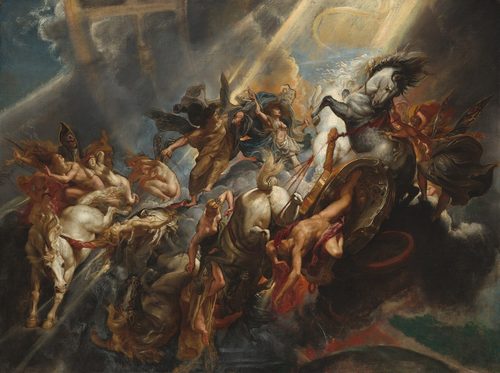
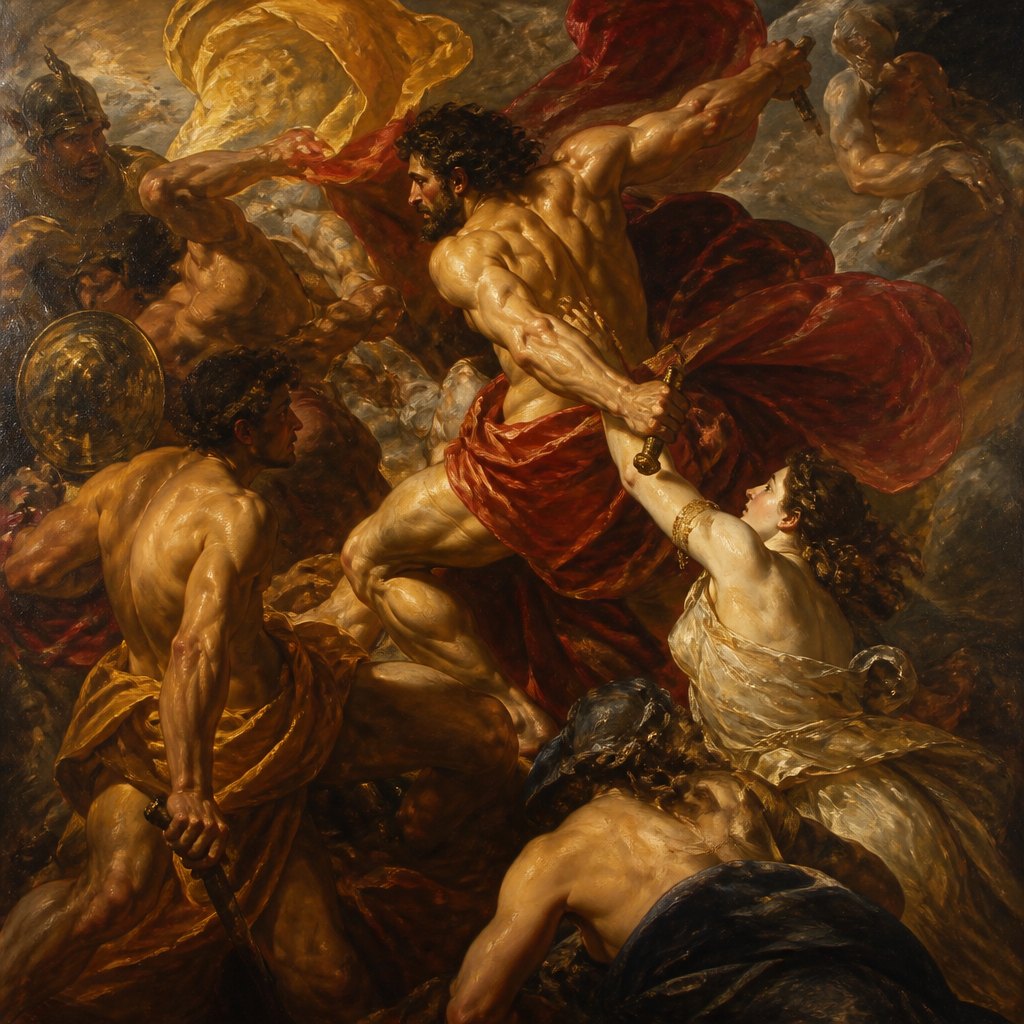
Bodies spiral through his compositions in exaggerated contrapposto, straining shoulders and flexed limbs caught mid-motion. Even quiet subjects seem to strain against the picture's edges, giving his mythologies and hunts a sense of barely contained physical force.
Warm, luminous flesh tones
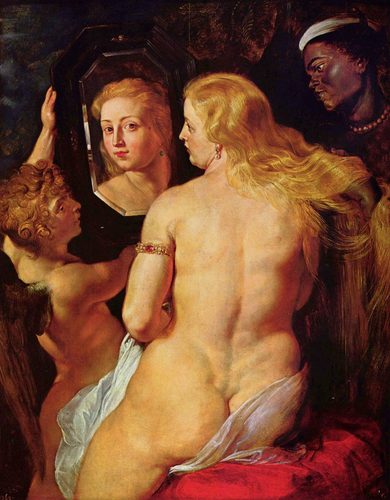
Rubens built skin from layered translucent glazes over a ruddy underpainting, so flesh seems lit from within rather than merely lit from without. Cheeks, knuckles, and shoulders carry a warm flush that became his signature across every genre.
Swirling diagonal composition
Figures and drapery are arranged along sweeping diagonals rather than static pyramids, pulling the eye through the canvas in a single dynamic arc. The effect is theatrical momentum — a scene caught at its most turbulent instant.
Rich, cascading drapery
Fabric billows and coils around his figures in thick, confident strokes, red and gold silk catching light in broad, wet-looking passages. Drapery often does as much compositional work as the bodies it wraps, guiding movement across the canvas.
Workshop-scale grandeur
Many canvases run to enormous scale, designed for altarpieces or palace ceilings, with Rubens supplying the master passages — faces, hands — while trained assistants completed backgrounds and drapery. The result is consistent bravura at an industrial pace.
Animal energy and hunts
Lions, horses, and hounds appear in violent, tangled combat scenes rendered with the same anatomical relish as his human figures. Fur, muscle, and motion blur together in compositions built entirely around collision and struggle.
The life
Peter Paul Rubens was born in 1577 in Siegen, Westphalia, to Flemish parents in religious exile, and grew up in Antwerp after the family's return. He trained under several local masters before departing in 1600 for Italy, where he spent eight formative years as court painter to the Duke of Mantua while absorbing Venetian color and Roman antiquity firsthand.
Rubens returned to Antwerp in 1608 and quickly became court painter to the Spanish Habsburg governors of the Netherlands. He married Isabella Brant in 1609 and established a large workshop that turned out altarpieces, portraits, and mythological cycles at remarkable speed, employing talented assistants including the young Anthony van Dyck. Major commissions poured in from across Catholic Europe, culminating in a cycle for Marie de' Medici in Paris and ceiling paintings for the English crown.
In his final decade, following Isabella's death, Rubens married the much younger Helena Fourment, who appears in many late paintings, and increasingly balanced painting with diplomatic missions between Spain, England, and the Netherlands, helping broker peace between the warring courts. He continued painting almost to the end, dying in Antwerp in 1640, celebrated as the most successful painter of his generation.
Timeline
- 1577Born in Siegen, Westphalia
- 1600Departs for Italy, joins the Mantuan court
- 1608Returns to Antwerp
- 1609Marries Isabella Brant, becomes court painter
- 1622Begins the Marie de' Medici cycle in Paris
- 1630Knighted by England's Charles I
- 1630Marries Helena Fourment
- 1640Dies in Antwerp
Most famous works
| Work | Date | Why it matters |
|---|---|---|
| The Elevation of the Cross | 1610–1611 | An early Antwerp altarpiece announcing his full-blown Baroque style, straining muscular figures hauling Christ's cross skyward. |
| The Descent from the Cross | 1612–1614 | A tightly choreographed diagonal composition considered one of the great achievements of Flemish Baroque altarpiece painting. |
| Marie de' Medici Cycle | 1622–1625 | Twenty-four monumental canvases glorifying the French queen's life, blending allegory and history at astonishing scale. |
| The Garden of Love | c. 1633 | A swirling outdoor gathering of courting couples, showcasing his late mastery of warm color and fluid movement. |
| Portrait of Helena Fourment | c. 1630s | An intimate late portrait of his young second wife, radiant with the warm glazed flesh tones he pioneered. |
| Consequences of War | 1637–1638 | A dense allegorical composition mourning the Thirty Years' War, combining mythological figures with urgent political commentary. |
 AI-generated
Create in the same spirit
Make Baroque art of your own
This AI interpretation echoes the aesthetic world Peter Paul Rubens worked in — it depicts no real artwork. Generate your own with the Baroque Art Style generator.
Open the Baroque Art Style generator →Legacy
Rubens's fusion of Italian monumentality with Flemish color and texture became the template for Baroque painting across Catholic Europe, and his workshop model — a master directing skilled specialists — shaped how large studios operated for centuries after. Van Dyck carried his lessons into English portraiture; later French painters leaned on his color and his handling of flesh and movement. His diplomatic career also proved that a painter could move at the highest levels of European politics. Today his influence surfaces wherever painters chase movement, warmth, and physical presence over stillness — in history painting, in fashion imagery's love of drapery, in any image built on sweep rather than symmetry.
Frequently asked questions
What is Peter Paul Rubens famous for?
Rubens is famous for large, dynamic Baroque paintings — muscular mythologies, dramatic altarpieces, and portraits — marked by rich color, swirling composition, and warm, glowing flesh tones, produced by Europe's most successful painting workshop.
Where can you see Rubens's paintings today?
Major holdings are in Antwerp's Cathedral of Our Lady and Rubens House, Madrid's Prado, Paris's Louvre, home to the Marie de' Medici cycle, London's National Gallery, and Munich's Alte Pinakothek.
How many paintings did Rubens make?
Estimates vary, but scholars attribute well over one thousand paintings to Rubens and his workshop, an output made possible by his large studio of trained assistants working alongside him.
What artistic movement was Rubens part of?
Rubens is the defining painter of the Flemish Baroque, blending Italian Renaissance monumentality, Venetian color, and northern European realism into a single dynamic, ornate style.