 Famous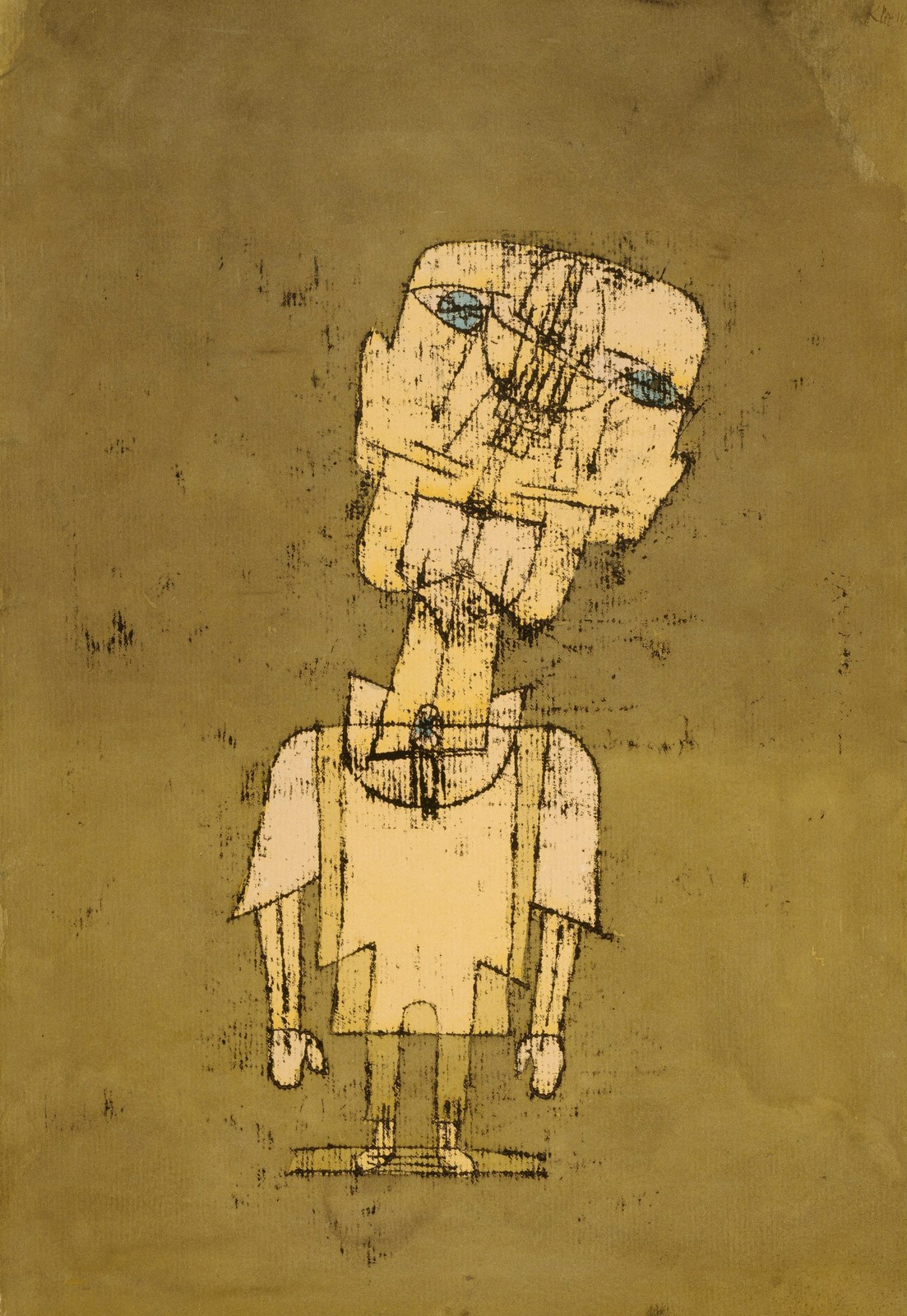
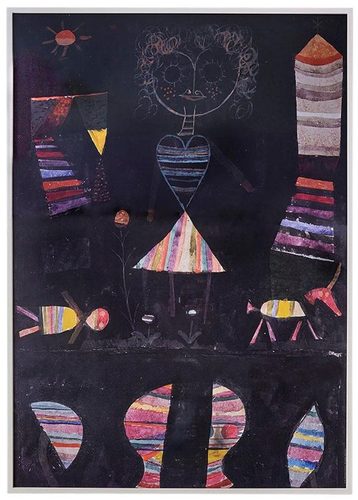
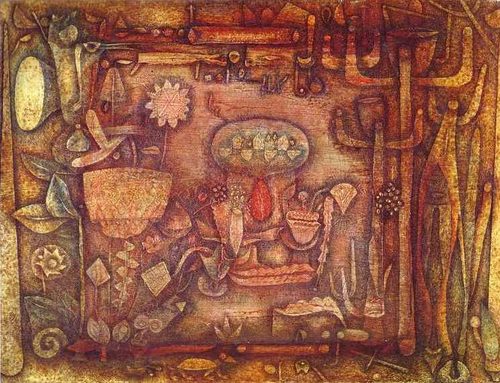
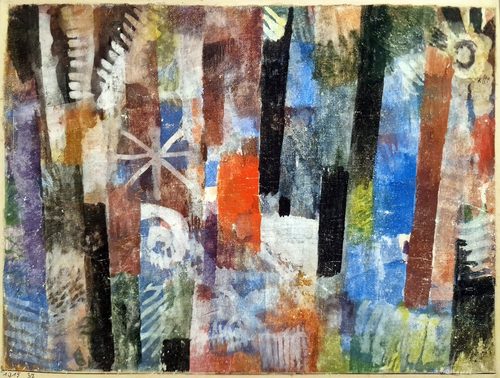
Paul Klee (1879–1940) was a Swiss-German painter whose small, intricately built pictures treated drawing as a private language — a line set loose to wander, cross itself, and become a face, a fish, or a city. Trained in Munich, he found his voice slowly, working for years as a black-and-white draftsman before a 1914 trip to Tunisia convinced him, in his own words, that he and color were one. He joined the Bauhaus in 1921, teaching color theory and pictorial form with a rigor that shaped a generation of designers, while his own paintings stayed playful — grids, arrows, ladders, and childlike figures built from careful geometry rather than accident. Dismissed by the Nazis as a producer of "degenerate art," he left Germany for Switzerland in 1933. His final years brought a rare autoimmune illness, scleroderma, and a late style of thick black lines and stark, urgent marks. Klee left behind roughly nine thousand works and a body of teaching notes still studied as a foundational text of modern design.
How to recognize a Klee
Lines that wander
Klee's contours rarely go straight where they could wander instead — a pencil-thin line meanders across the sheet, crossing back on itself until a fish, a face, or a ladder emerges from what looks like idle sketching.
Grids and color fields
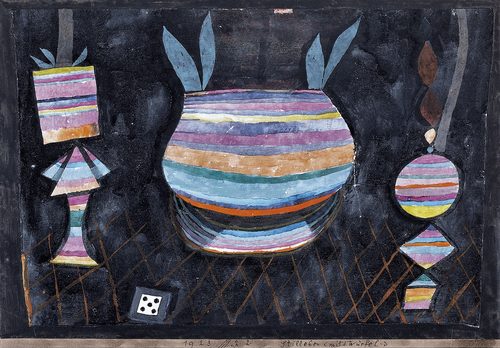
Many works are built from small colored squares or rectangles, laid down like mosaic tiles or woven cloth, each square a slightly different hue so the whole surface seems to breathe and shift.
Arrows and signs
Klee filled his pictures with a private vocabulary of arrows, ladders, suns, and eyes — pictographic marks borrowed from children's drawing and ancient script that turn each canvas into something closer to a coded message.
Tiny, jewel-like scale
He often worked small, on cardboard, muslin, or gauze rather than stretched canvas, so his paintings reward close looking the way a page of illuminated manuscript does, dense with incident in a modest frame.
Whimsical, exact titles
Klee gave his works playful, poetic titles — Twittering Machine, Fish Magic, Senecio — that steer the eye without pinning down a single meaning, treating the title itself as part of the composition.
Watercolor luminosity
Even in oil, his surfaces often keep a watercolor's translucency, thin washes layered so light seems to come from behind the picture rather than reflecting off its top, a glow he chased after Tunisia.
The life
Klee grew up in Bern in a musical family — his father taught music, and Klee himself was a skilled violinist — and he wavered between music and art before settling on painting. He trained at Munich's Academy of Fine Arts, then spent years honing a spare, satirical line as a printmaker and illustrator, uncertain he had any gift for color at all.
That changed in 1914, when a two-week trip to Tunisia with August Macke and Louis Moilliet dissolved his doubts; watching the light on Kairouan's walls, he wrote that he and color had become one, and painting no longer needed to be pursued separately. He had already fallen in with Munich's Der Blaue Reiter circle, and through the 1920s he taught at the Bauhaus in Weimar and Dessau, developing color and form theories that became core texts of modern design education.
The Nazi rise ended that life. Klee was dismissed from his teaching post in Düsseldorf, more than a hundred of his works were seized as "degenerate art," and in 1933 he returned to Bern. There, battling the wasting skin disease scleroderma, he entered an astonishingly productive final period — thousands of works in a few years, the line grown heavier and starker as his health failed. He died in Switzerland in 1940; the Swiss citizenship he had applied for was granted only days after his death.
Timeline
- 1879Born in Münchenbuchsee, near Bern, Switzerland
- 1898Moves to Munich to study art; enters the Academy in 1900
- 1911Joins the Der Blaue Reiter circle in Munich
- 1914Tunisia trip with Macke and Moilliet transforms his color sense
- 1921Begins teaching at the Bauhaus in Weimar
- 1931Moves to teach at the Düsseldorf Academy
- 1933Dismissed by the Nazis, returns to Switzerland
- 1940Dies in Muralto, Switzerland, after years of illness
Most famous works
| Work | Date | Why it matters |
|---|---|---|
| Twittering Machine | 1922 | A spindly wire contraption of birds on a crank, equal parts whimsical toy and quietly sinister machine — Klee's satire on mechanized nature. |
| Senecio (Head of a Man) | 1922 | A face built entirely from circles and warm color blocks, one of Klee's clearest fusions of geometry and portraiture. |
| Fish Magic | 1925 | A dark, star-strewn canvas crowded with fish, flowers, and clock faces, showing Klee's love of layered symbolic imagery. |
| Ad Parnassum | 1932 | A mosaic-like pointillist landscape built from thousands of dabs, considered one of his most ambitious late paintings. |
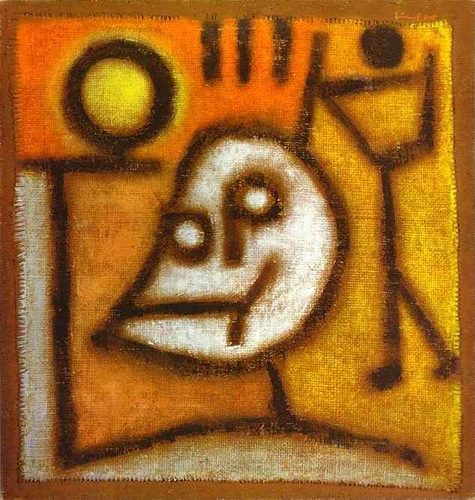
| Death and Fire | 1940 | A stark late self-confrontation with mortality, a skull-like face rendered in heavy black line as his illness advanced. |
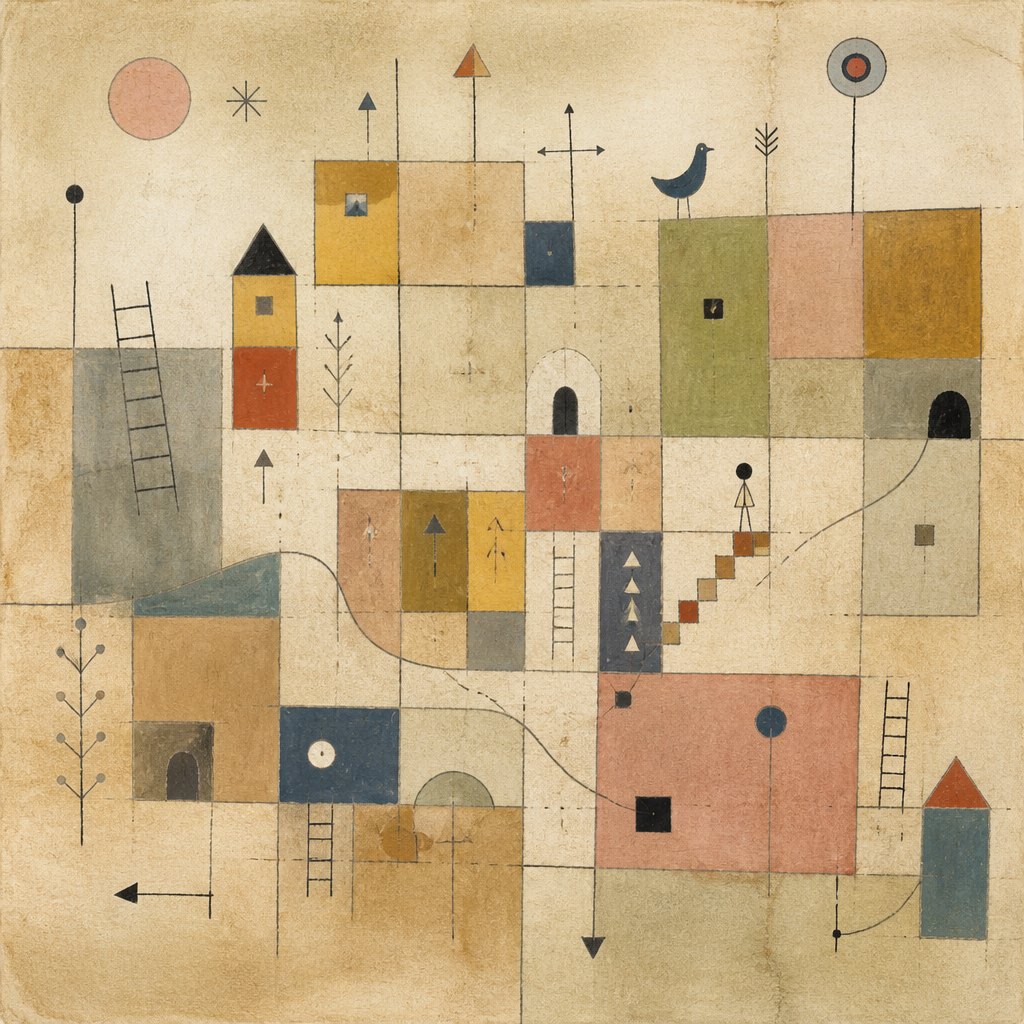 AI-generated
Create in the same spirit
Make Bauhaus art of your own
This AI interpretation echoes the aesthetic world Paul Klee worked in — it depicts no real artwork. Generate your own with the Bauhaus Art Style generator.
Open the Bauhaus Art Style generator →Legacy
Klee's influence runs directly into design education: his Bauhaus notebooks on color, line, and pictorial structure are still assigned wherever visual thinking is taught, decades after his students carried that grammar into architecture, graphic design, and painting. Abstract Expressionists and later color-field painters absorbed his belief that a mark could carry feeling before it carried meaning, while illustrators and cartoonists still borrow his taste for the sign — the arrow, the eye, the stick figure — as legitimate artistic vocabulary. You feel him now in any image that trusts a simple line to do serious emotional work, and in the ongoing idea that a small, modest-looking picture can hold an entire private cosmos.
Frequently asked questions
What is Paul Klee famous for?
Klee is famous for small, intricately built paintings that treat drawing as a private language of signs — arrows, grids, faces — blending childlike simplicity with rigorous color theory developed at the Bauhaus.
Where can I see Paul Klee's paintings?
The Zentrum Paul Klee in Bern holds the largest collection, with major groups also at MoMA in New York, the Metropolitan Museum, and the Kunstmuseum Basel.
How many works did Paul Klee create?
Klee was extraordinarily prolific, leaving roughly nine thousand catalogued paintings, drawings, and prints, with an especially large output in his final years in Switzerland.
What art movement was Paul Klee part of?
Klee is linked to German Expressionism and the Blaue Reiter circle, then to the Bauhaus, though his hybrid style resists being fully claimed by any one movement.