 Famous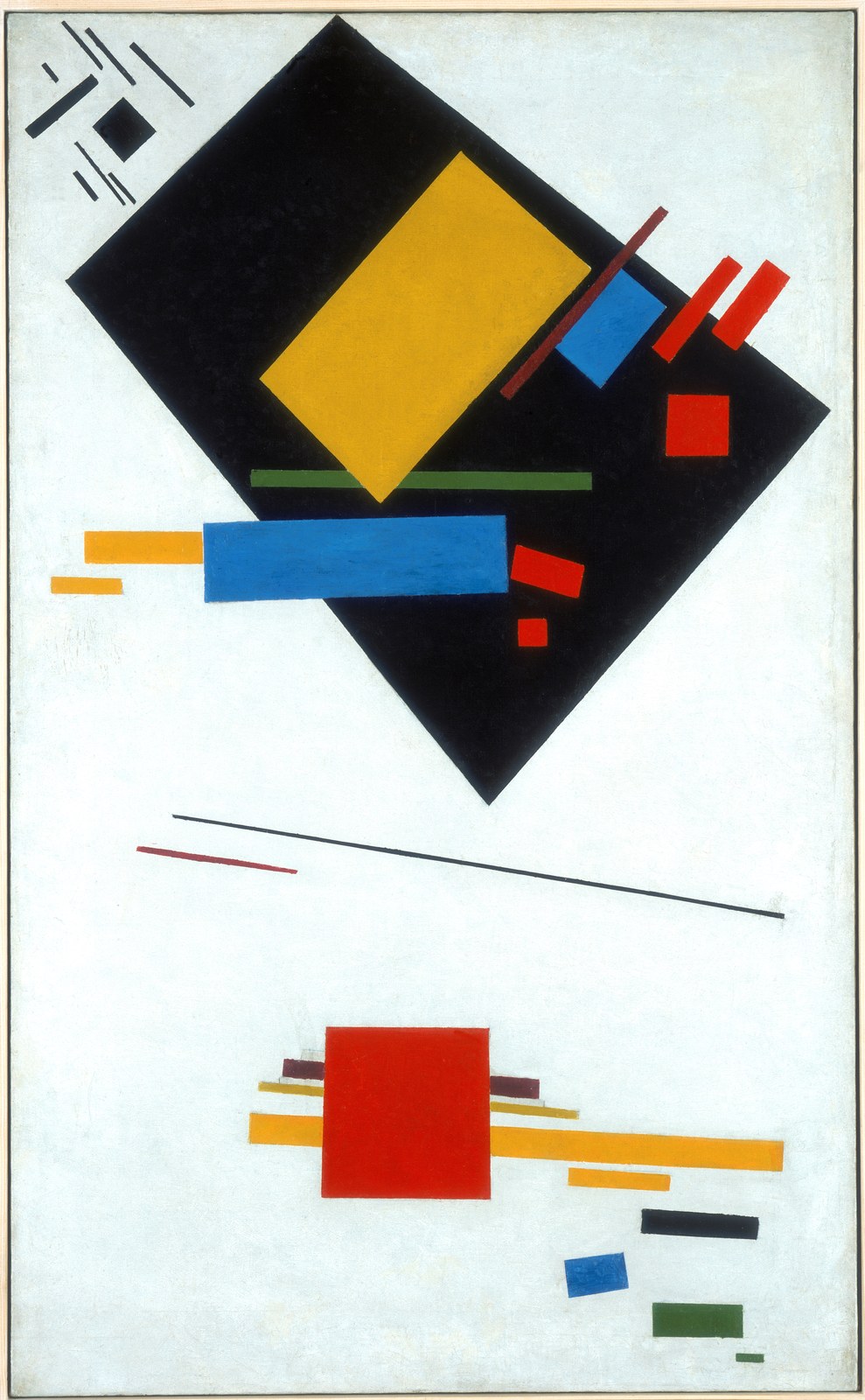
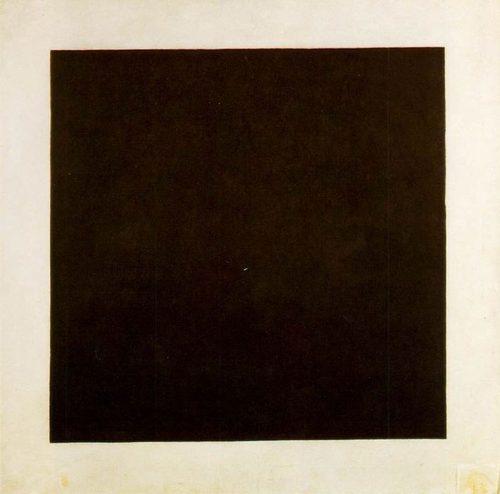
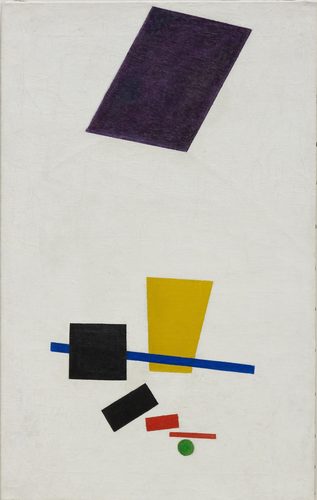
Kazimir Malevich (1879–1935) was a Russian-Ukrainian painter and theorist who founded Suprematism, the radical abstract movement built around pure geometric form, and whose 1915 canvas Black Square remains one of the most consequential single paintings of the twentieth century.
Born near Kyiv to a family of Polish descent, Malevich trained in Moscow and moved through Impressionist, Symbolist, and Cubo-Futurist phases before arriving, around 1913, at a conviction that painting should abandon depiction entirely. He unveiled Suprematism in 1915 with Black Square, hung high across a room corner in the traditional place of a Russian icon, followed by canvases of floating colored geometric shapes he described as pure "artistic feeling" freed from any object.
Malevich taught and theorized extensively through the Russian Revolution, influencing a generation at the Vitebsk and Leningrad art schools alongside El Lissitzky. As Soviet cultural policy hardened against abstraction in the late 1920s, Malevich was pressured back toward figurative painting and briefly detained on suspicion of espionage. He continued working, including late self-portraits and peasant subjects painted in a deliberately archaic style, until his death from cancer in Leningrad in 1935.
How to recognize a Malevich
Pure geometric form
Malevich reduced painting to flat squares, circles, crosses, and rectangles floating on white or colored grounds, stripped of any reference to a recognizable object, landscape, or figure.
The zero of form
He described Suprematism as painting's arrival at "zero," a deliberate erasure of subject matter so that color and geometry alone could carry pure feeling, unburdened by imitation.
Weightless composition
Shapes hover at angles across the canvas rather than sitting on a stable baseline, giving even simple rectangles a sense of drift or flight through undefined white space.
Icon-corner placement
He first hung *Black Square* high in a room's corner, the traditional place for an Orthodox icon, deliberately proposing pure abstraction as a new object of contemplation.
Restrained, near-monochrome palette
Many Suprematist works favor a few flat, unmodulated colors — black, red, white — applied without visible brushwork, sharpening the sense of geometric shapes as autonomous objects.
Late return to the figure
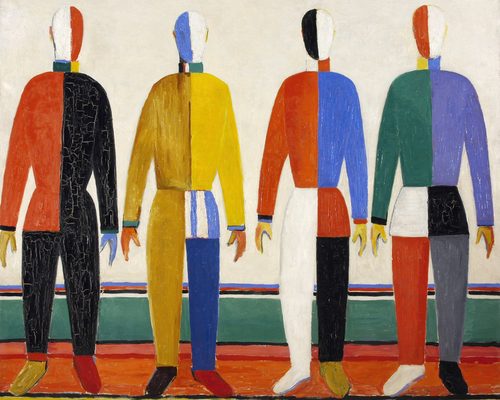
Under Soviet pressure in his final years, Malevich painted stylized peasants and self-portraits in an archaic, icon-like manner, folding his abstract logic back into flattened human form.
The life
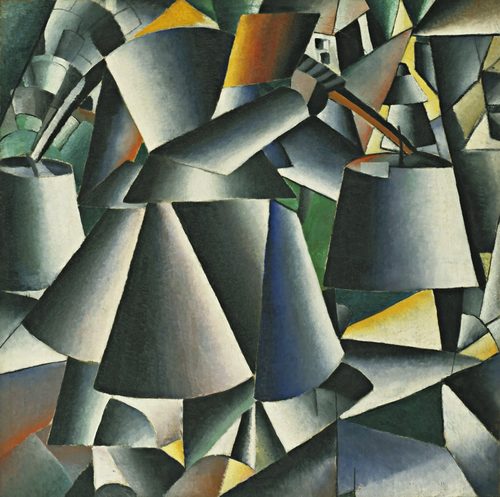
Kazimir Malevich was born in 1879 near Kyiv, then part of the Russian Empire, to a family of Polish descent working in the sugar-beet industry. He moved to Moscow around 1904 to pursue art seriously, passing through Impressionist, Symbolist, and Neo-Primitivist styles before Cubism and Italian Futurism reached Russia and reshaped his approach into a fractured, dynamic Cubo-Futurism.
Around 1913, working on set designs for the opera Victory over the Sun, Malevich began developing an entirely non-objective geometric language. He unveiled it publicly in the 1915 exhibition "0.10" in Petrograd, showing Black Square alongside dozens of other Suprematist canvases and issuing a manifesto declaring the "supremacy of pure feeling" over depiction.
After the 1917 Revolution, Malevich taught in Vitebsk, where he led an influential circle that included El Lissitzky, and later in Leningrad, extending Suprematist principles into architecture and design theory. As the Soviet state increasingly demanded Socialist Realist figuration during the late 1920s and 1930s, Malevich's abstract work fell out of official favor; he was briefly detained in 1930 on suspicion of espionage. In his last years he painted peasant subjects and self-portraits in a deliberately old-fashioned, icon-influenced style. He died of cancer in Leningrad in May 1935.
Timeline
- 1879Born near Kyiv, Russian Empire
- 1904Moves to Moscow to pursue painting
- 1913Begins developing Suprematist geometric abstraction
- 1915Unveils Black Square at the "0.10" exhibition, Petrograd
- 1919Teaches in Vitebsk, influencing El Lissitzky and others
- 1927Travels to Warsaw and Berlin; exhibits Suprematist work in Europe
- 1930Briefly detained by Soviet authorities on suspicion of espionage
- 1935Dies of cancer in Leningrad
Most famous works
| Work | Date | Why it matters |
|---|---|---|
| Black Square | 1915 | Suprematism's founding icon, a stark black square on white that declared painting's break from depiction. |
| Black Circle | 1915 | A companion geometric canvas exploring pure form alongside Black Square in the movement's debut. |
| Suprematist Composition: White on White | 1918 | A near-invisible tilted square on a white ground, pushing abstraction to its most minimal edge. |
| Red Cavalry | c. 1932 | A later, semi-figurative work applying Suprematist flatness and rhythm to a Soviet historical subject. |
| Suprematist Painting (Eight Red Rectangles) | 1915 | A floating arrangement of red geometric bars demonstrating Suprematism's weightless, dynamic sense of composition. |
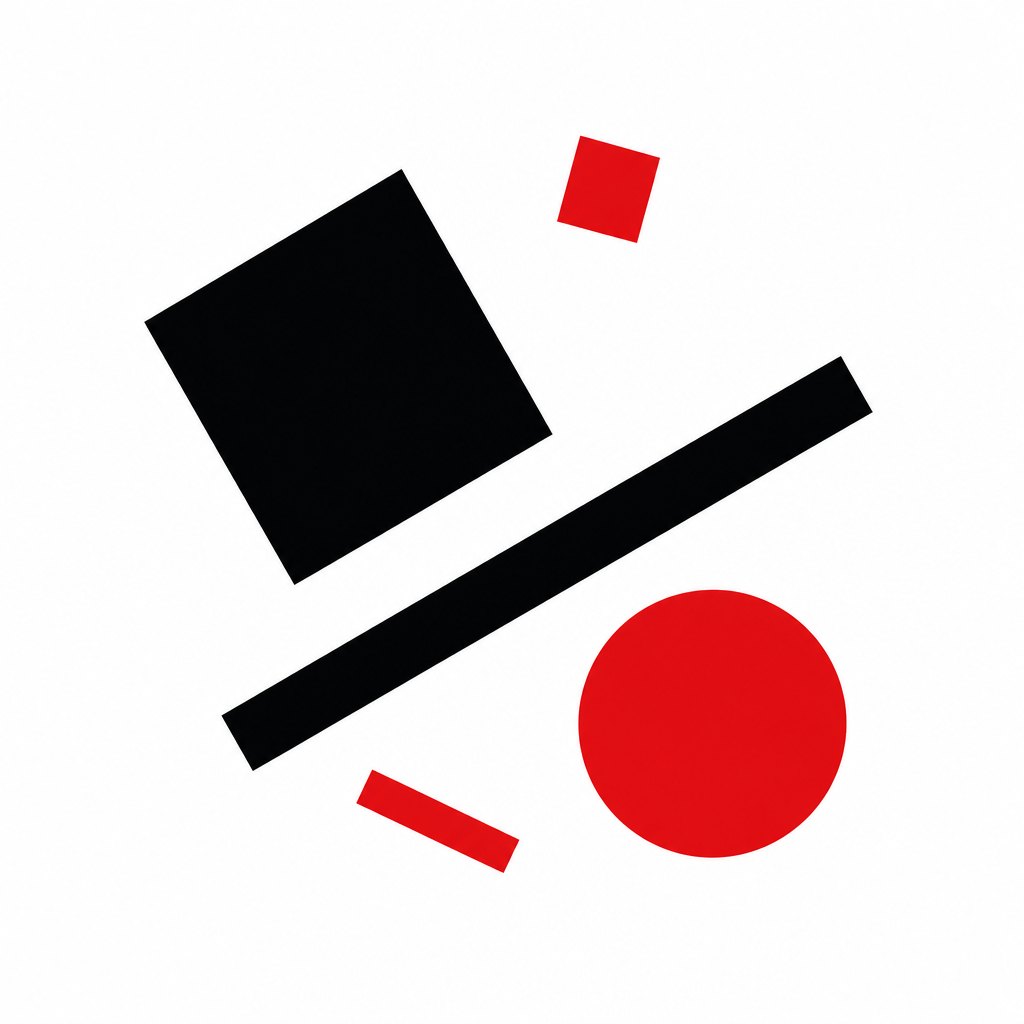 AI-generated
Create in the same spirit
Make Suprematism art of your own
This AI interpretation echoes the aesthetic world Kazimir Malevich worked in — it depicts no real artwork. Generate your own with the Suprematism Art Style generator.
Open the Suprematism Art Style generator →Legacy
Malevich's Suprematism helped establish the very idea of pure abstraction as a legitimate, even spiritual, artistic goal, a claim that reshaped painting, sculpture, and design across the twentieth century. His Vitebsk colleague and follower El Lissitzky carried Suprematist geometry into graphic design and architecture, and echoes of Malevich's flat, weightless shapes surface in Minimalism, Color Field painting, and countless later abstract movements. Suppressed for decades in the Soviet Union after his death, his reputation was fully restored only once his major works reached Western museums. Black Square remains one of art history's most argued-over and imitated single images.
Frequently asked questions
What is Kazimir Malevich famous for?
Malevich is famous for founding Suprematism and for *Black Square* (1915), a stark abstract canvas that declared painting could abandon depicting the visible world entirely.
Where can I see Malevich's paintings?
Major holdings are at the State Tretyakov Gallery and State Russian Museum in Russia, the Stedelijk Museum in Amsterdam, and the Museum of Modern Art in New York.
What art movement did Malevich belong to?
Malevich founded Suprematism in 1915, a Russian abstract art movement built on pure geometric form; he earlier worked through Cubo-Futurist and Neo-Primitivist styles.
How many Malevich paintings survive?
Several hundred works survive in Russian and Western collections, though many early canvases were lost, confiscated, or destroyed during Soviet suppression of his abstract work.