 Famous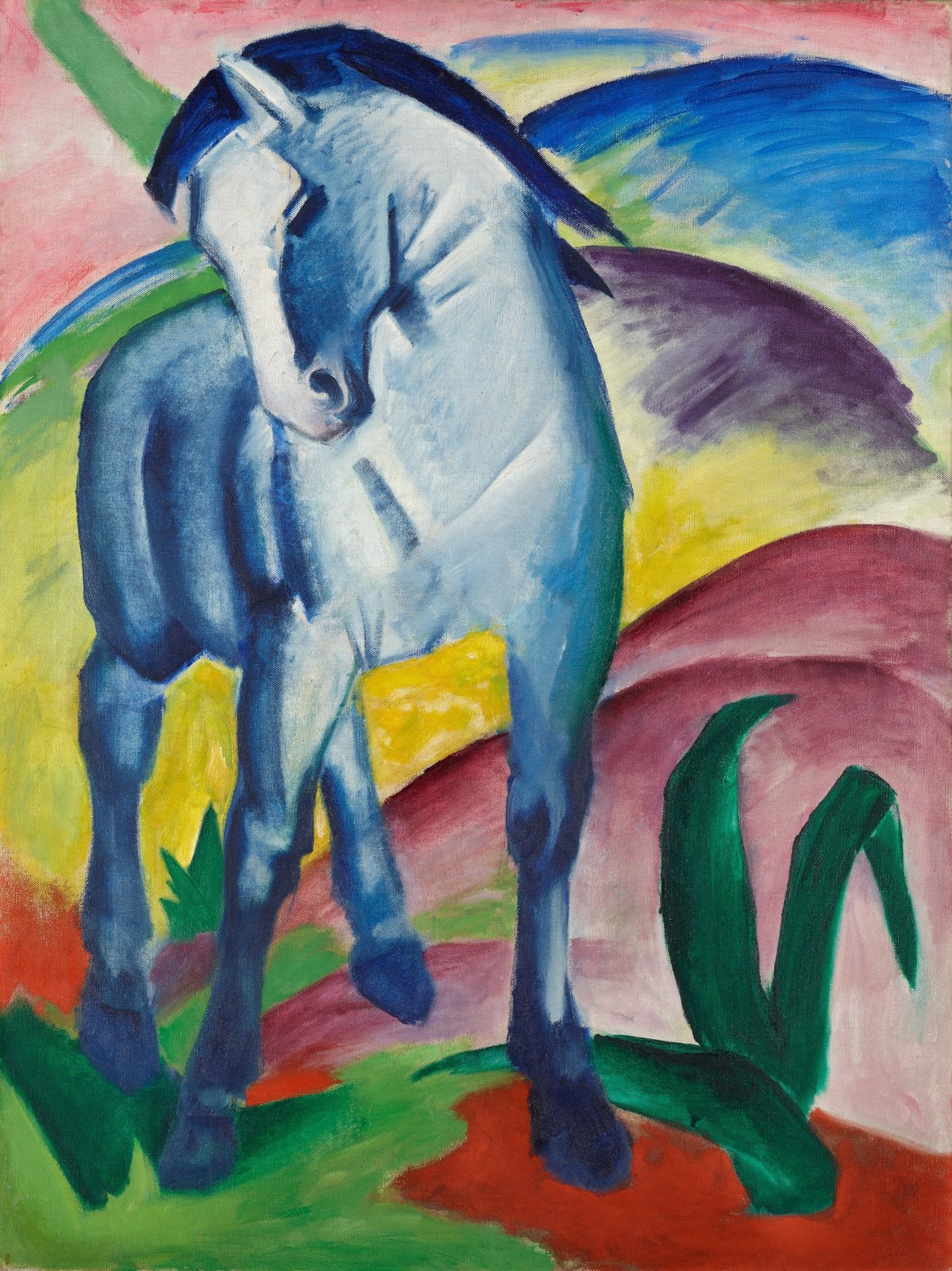
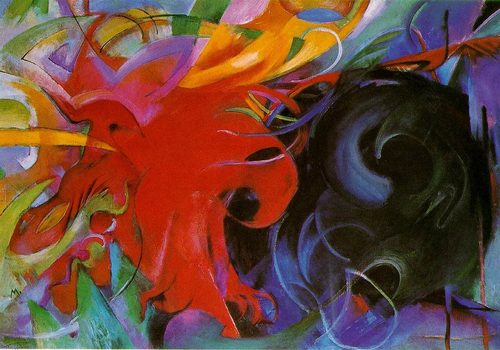
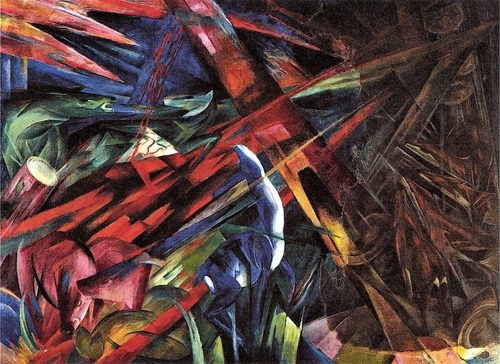
Franz Marc (1880–1916) was a German painter best known for luminous, color-saturated animal paintings, above all his blue horses, made as part of a spiritual quest to find a purer world than the human one. Trained in Munich, he turned early toward animals as subjects, believing them closer to nature's essential truth than corrupted human society, and developed a personal color symbolism in which blue stood for the masculine and spiritual, yellow for the feminine and joyful, red for brutal matter. In 1911 he co-founded the Der Blaue Reiter (Blue Rider) group with Wassily Kandinsky, gathering Munich's most adventurous painters around shared exhibitions and an influential almanac exploring art's spiritual dimension. Over the following years his animal forms grew increasingly abstracted, fractured into faceted planes influenced by Cubism and Futurism, as he pushed toward a fully non-representational art he did not live to complete. Enlisting in the German army at the outbreak of war in 1914, he continued painting and corresponding from the front, producing works of mounting apocalyptic intensity, until he was killed by shrapnel at the Battle of Verdun in March 1916, at thirty-six.
How to recognize a Marc
Symbolic, non-naturalistic color
Marc assigned colors fixed spiritual meanings — blue for the masculine and spiritual, yellow for gentle femininity, red for heavy, brutal matter — so an animal's hue carries as much meaning as its form.
Animals as spiritual subjects
Horses, deer, foxes, and cattle dominate his work, chosen because he believed animals held an unspoiled purity that human figures, tainted by civilization, no longer possessed in his eyes as a painter.
Blue horses
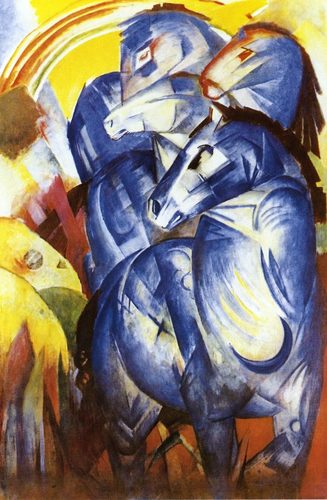
His recurring blue horse, most famously in a large grouped composition, became his signature image, the color chosen for its calm spiritual weight rather than any observed reality, a symbol more than a description.
Faceted, crystalline forms
In his later works, animals and landscape alike fracture into angular, translucent planes influenced by Cubism and Futurism, as if the whole scene were seen through cut glass lit from within.
Interwoven animal and landscape
Creatures merge into their surroundings rather than standing apart from them, curved bodies echoing hills and trees, expressing his belief in one continuous natural harmony that human presence tends to break.
Radiant, glowing palette
Even his darker late paintings keep an inner luminosity, color applied in layered, semi-transparent passages so forms seem lit from within rather than by an external sun, glowing like stained glass.
The life
Marc was born in Munich, the son of a landscape painter, and initially considered theology before turning to art, studying at the Munich Academy. Early trips to Paris exposed him to Van Gogh, Gauguin, and the Impressionists, and he settled increasingly on animals as his central subject, drawn to what he saw as their unspoiled, natural innocence.
Around 1910 he began developing his distinctive color symbolism, and in 1911 he and the Russian painter Wassily Kandinsky broke from the Neue Künstlervereinigung München to found Der Blaue Reiter, publishing an almanac and organizing exhibitions that became a landmark of German Expressionism. Marc's animal paintings grew more radiant and increasingly abstract through these years, his forms fracturing into the faceted planes he adapted from Cubism and Italian Futurism.
The outbreak of the First World War interrupted this trajectory. Marc, initially swept up in the era's enthusiasm for the war, volunteered for the German army in 1914 and continued to paint and write from the front, his outlook darkening steadily as the fighting wore on. He was killed by a shell fragment at Verdun in March 1916, one of many artists of his generation lost to the war.
Timeline
- 1880Born in Munich, Germany
- 1900Begins studies at the Munich Academy of Fine Arts
- 1907Travels to Paris, encounters Van Gogh and Gauguin
- 1910Develops his personal symbolic color theory
- 1911Co-founds Der Blaue Reiter with Wassily Kandinsky
- 1913Paints Fate of the Animals amid rising unease
- 1914Volunteers for the German army at the war's start
- 1916Killed at the Battle of Verdun
Most famous works
| Work | Date | Why it matters |
|---|---|---|
| The Large Blue Horses | 1911 | Three rounded blue horses nested against red hills, the clearest statement of his color symbolism and best-known image. |
| Tower of Blue Horses | 1913 | A large stacked composition of horses, one of his major achievements and missing since the Second World War. |
| Fate of the Animals | 1913 | A fractured, fiery apocalyptic scene of animals amid collapsing tree trunks, painted as anxiety about war was rising across Europe. |
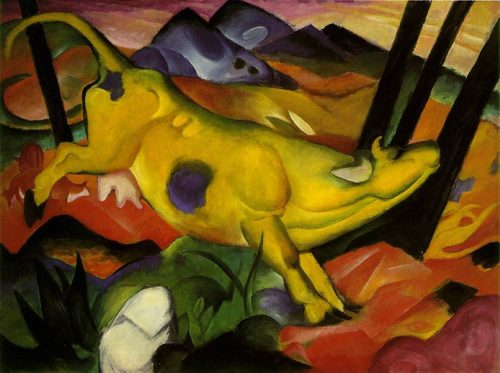
| The Yellow Cow | 1911 | A joyful leaping yellow cow across a mountain landscape, using his color symbolism to suggest playful femininity. |
| Deer in the Forest II | 1913–14 | A faceted, crystalline forest scene with deer folded into angular planes of color, showing Cubist and Futurist influence. |
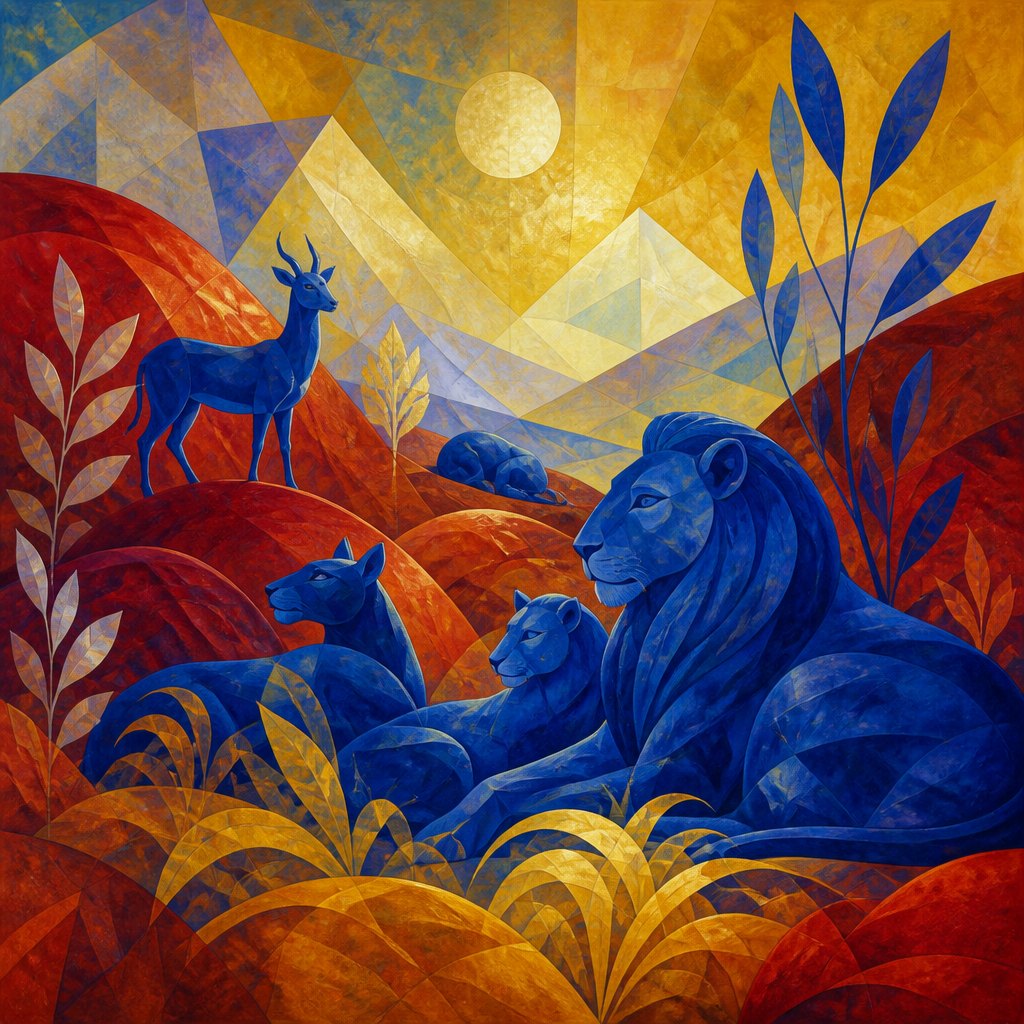 AI-generated
Create in the same spirit
Make der Blaue Reiter art of your own
This AI interpretation echoes the aesthetic world Franz Marc worked in — it depicts no real artwork. Generate your own with the Expressionism Art Style generator.
Open the Expressionism Art Style generator →Legacy
Marc's belief that color and form could carry spiritual meaning independent of realistic depiction fed directly into abstract art, and Der Blaue Reiter's almanac remains a foundational document of Expressionist theory, still read wherever the movement is studied. His blue horses became one of German art's most reproduced and beloved images, softening his radical intent into something closer to a gentle popular icon. His death at Verdun, alongside the war losses of contemporaries like August Macke, came to symbolize a whole generation of European avant-garde promise cut short by the First World War. You feel him now in any painting that trusts color to carry a feeling animals themselves cannot voice.
Frequently asked questions
What is Franz Marc famous for?
Marc is famous for luminous, symbolically colored animal paintings, especially blue horses, made while co-founding the Expressionist group Der Blaue Reiter with Wassily Kandinsky.
Where can I see Franz Marc's paintings?
Munich's Lenbachhaus holds the core Blaue Reiter collection, with further works at the Städel Museum in Frankfurt, the Guggenheim, and MoMA in New York.
How did Franz Marc die?
Marc was killed by shrapnel at the Battle of Verdun in March 1916, while serving in the German army during the First World War, at age thirty-six.
What art movement was Franz Marc part of?
Marc co-founded Der Blaue Reiter (the Blue Rider) in 1911, a key group within German Expressionism focused on color's spiritual and emotional power.