 Famous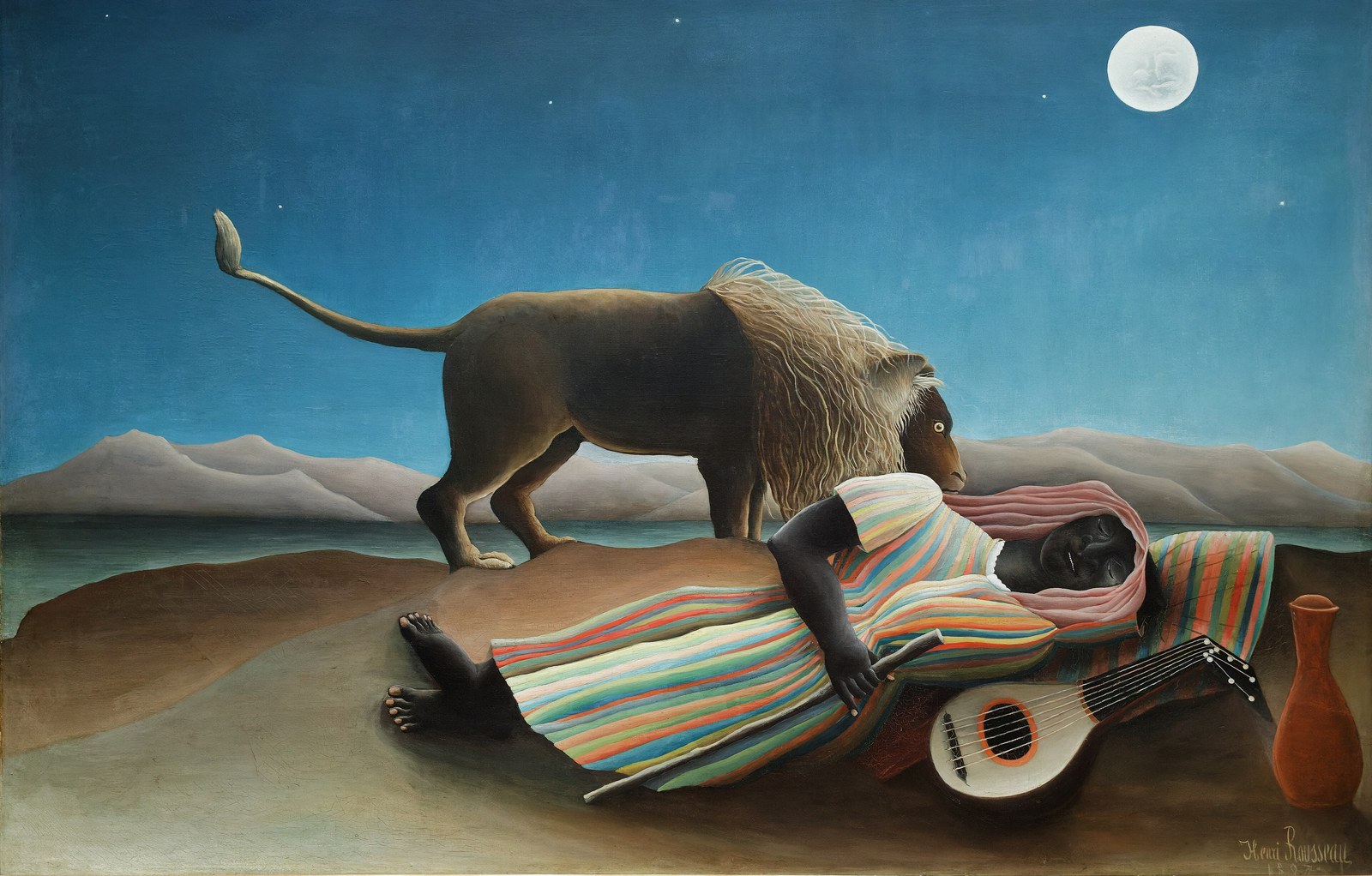
Henri Rousseau (1844–1910) was a French self-taught painter who spent decades as a minor customs official in Paris before becoming, in his final years, one of modern art's most improbable originators — a naive visionary whose dense, dreamlike jungles helped open the door to twentieth-century abstraction.
Rousseau took up painting seriously only in his forties, with no academic training and little regard for perspective or anatomy as taught in the ateliers. He studied plants at Paris's botanical gardens and zoo, pored over illustrated travel books, and built lush, invented tropics from these fragments — tigers, lions, and hidden figures locked in flat, patterned foliage. Critics mocked his awkward proportions for years; he exhibited doggedly at the Salon des Indépendants, undeterred.
By the 1900s, his sincerity and strangeness won him unlikely champions. Pablo Picasso staged a legendary banquet in Rousseau's honor in 1908, and poets and painters around him, including Guillaume Apollinaire, recognized in his work a directness the academy had trained out of everyone else. He died in 1910, poor but finally seen, having proven that vision could outrun technique.
How to recognize a Rousseau
Flattened jungle foliage
Rousseau built dense, layered greenery from overlapping leaf shapes rather than observed light — each frond outlined and stacked like wallpaper, giving his forests a hallucinatory, decorative flatness closer to a diorama than a naturalist's field study.
Deadpan, wide-eyed animals
Lions, tigers, and monkeys stare out with fixed, doll-like eyes, painted with the same careful patience he gave a leaf — unsettling not because they're fierce, but because they hold utterly still, watching.
Stiff, frontal portraiture
His figures stand rigid and symmetrical, facing the viewer directly like folk-art icons or photographic studio portraits, with none of the twisting contrapposto academic painters prized — an honesty of pose rather than a flaw.
Moonlight and full-noon light
Rousseau favored flat, shadowless illumination, whether a jungle noon or one of his eerie moonlit scenes, avoiding the flicker of Impressionist brushwork in favor of even, poster-like clarity across every surface.
Saturated, unmixed greens
He built his forests from dozens of distinct greens, layered leaf by leaf rather than blended, so the canvas reads as an almost botanical inventory of shapes and hues rather than a single wash of color.
Everyday Parisians as icons
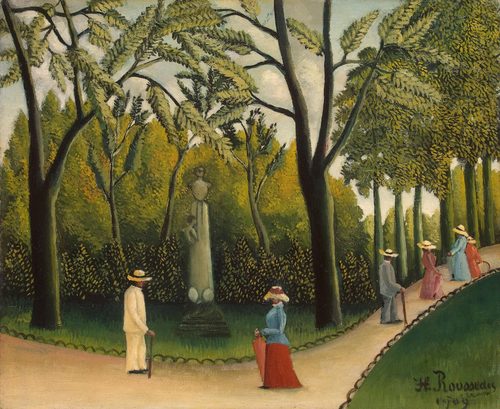
Alongside jungles, Rousseau painted self-portraits, wedding parties, and suburban scenes with the same flattened solemnity he gave his lions — treating a toll-booth colleague or a football match with the gravity of myth.
The life
Henri Rousseau was born in Laval in 1844 and had almost no formal art education. He worked as a municipal toll collector in Paris — earning him the enduring nickname 'Le Douanier' — and painted only in his spare time, largely self-taught, copying and studying at the Louvre and observing the exotic plants and taxidermy of the city's gardens and natural history museum.
He began exhibiting at the Salon des Indépendants in 1886, the venue's open-door policy giving him a stage the official Salon never would have. For two decades his stiff figures and invented tropics drew ridicule from critics and cartoonists, who saw only a clumsy amateur. Rousseau kept painting regardless, producing jungle scenes despite never leaving France, working entirely from botanical gardens, illustrated books, and imagination.
Recognition arrived late. Around 1905 younger artists, including Picasso and the poet Apollinaire, began seeking him out, drawn to the uncanny conviction of his work. Picasso's 1908 banquet in Rousseau's honor, half tribute and half joke, marked his arrival among the Paris avant-garde. He continued painting large jungle canvases in his final years, including 'The Dream,' completed shortly before his death in 1910 from a leg infection, poor and largely unrewarded financially but finally taken seriously as an artist.
Timeline
- 1844Born in Laval, France
- 1868Moves to Paris and takes a municipal clerkship
- 1886First exhibits at the Salon des Indépendants
- 1893Retires from customs work to paint full time
- 1897Paints 'The Sleeping Gypsy'
- 1905Shown alongside the Fauves at the Salon d'Automne
- 1908Picasso hosts a banquet in his honor
- 1910Dies in Paris, months after finishing 'The Dream'
Most famous works
| Work | Date | Why it matters |
|---|---|---|
| The Sleeping Gypsy | 1897 | A lion sniffs at a sleeping figure under a full moon, one of his most reproduced and enigmatic paintings — a moonlit desert rather than one of his jungles. |
| The Dream | 1910 | His largest and final major work, a reclining figure amid dense jungle foliage and hidden animals. |
| Tiger in a Tropical Storm (Surprised!) | 1891 | His first jungle painting, a tiger caught mid-leap in wind-lashed vegetation, exhibited to public mockery. |
| The Football Players | 1908 | A rare sporting scene, four men in striped uniforms rendered with his signature stiff formality. |
| Myself, Portrait-Landscape | 1890 | A monumental self-portrait as painter, palette in hand, dwarfing the Paris skyline behind him. |
| The Snake Charmer | 1907 | A silhouetted figure charms snakes from dark reeds in one of his most hypnotic nocturnal jungles. |
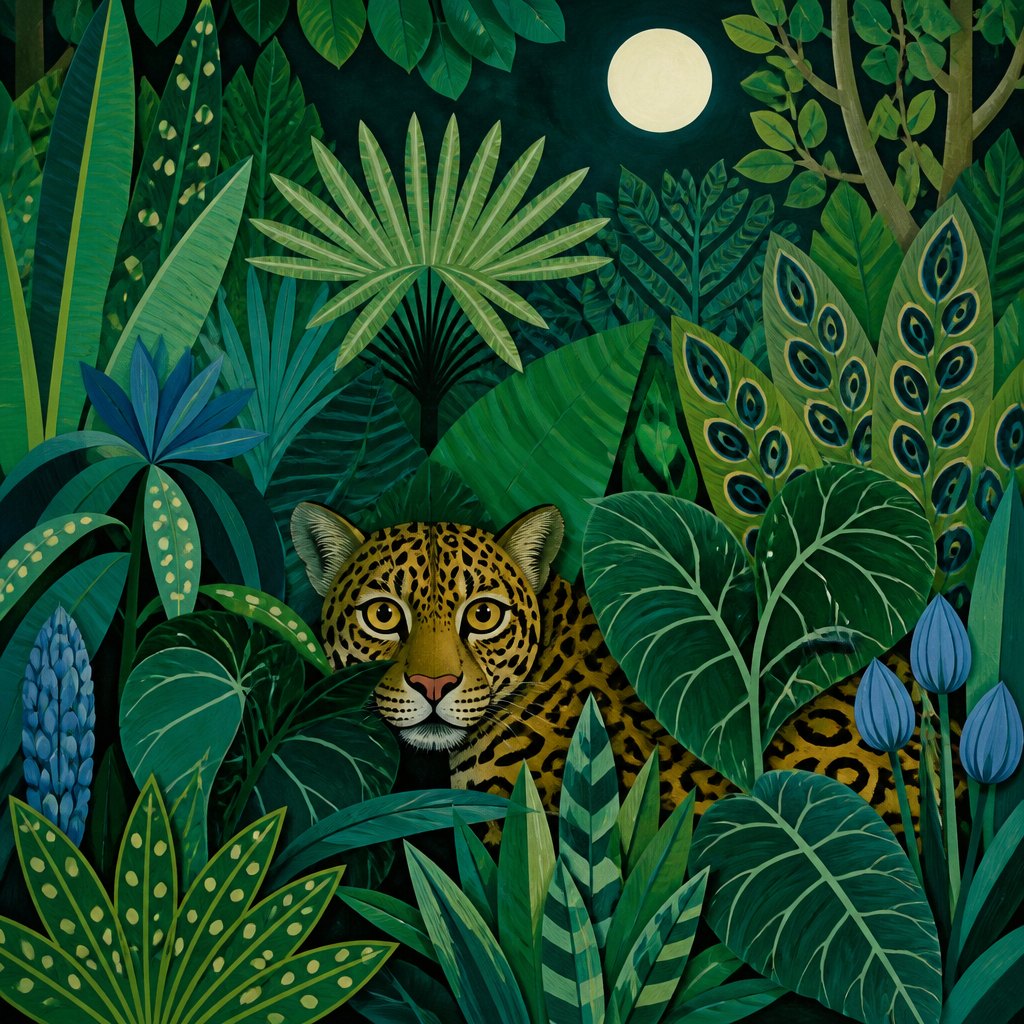 AI-generated
Create in the same spirit
Make Naive Art art of your own
This AI interpretation echoes the aesthetic world Henri Rousseau worked in — it depicts no real artwork. Generate your own with the Naive Art Style generator.
Open the Naive Art Style generator →Legacy
Rousseau's naive, untrained vision opened a door the academies had bolted shut: proof that sincerity and invented imagery could rival technical mastery. Picasso's circle, and later the Surrealists, prized his work as a model for painting from imagination rather than observation, and his flattened space and pattern-driven color anticipated moves that abstract and modern painters would later make deliberately. Museums now treat him as a founder of modern primitivism, not a curiosity. Walk through any gallery of dream-logic jungles, invented creatures, or deadpan folk portraiture in contemporary art, and Rousseau's example — trust the vision, let the technique follow — is still doing quiet work in the background.
Frequently asked questions
What is Henri Rousseau famous for?
Rousseau is famous for dense, dreamlike jungle paintings — filled with tigers, lions, and tropical foliage — made entirely from imagination by a self-taught French customs official who never left Europe.
Where can you see Henri Rousseau's paintings?
Major holdings include the Museum of Modern Art in New York (home to 'The Dream'), the Musée d'Orsay in Paris, and the Barnes Foundation in Philadelphia, among other collections worldwide.
Did Henri Rousseau ever visit a real jungle?
No. He never left France, building his tropical scenes from visits to Paris's Jardin des Plantes and zoo, illustrated travel books, and taxidermied animals rather than firsthand observation.
What art movement is Henri Rousseau associated with?
He's classed as a Naive or Primitive painter, self-taught and outside the academic system, though his late-life embrace by the Paris avant-garde tied him closely to early modernism.