 Famous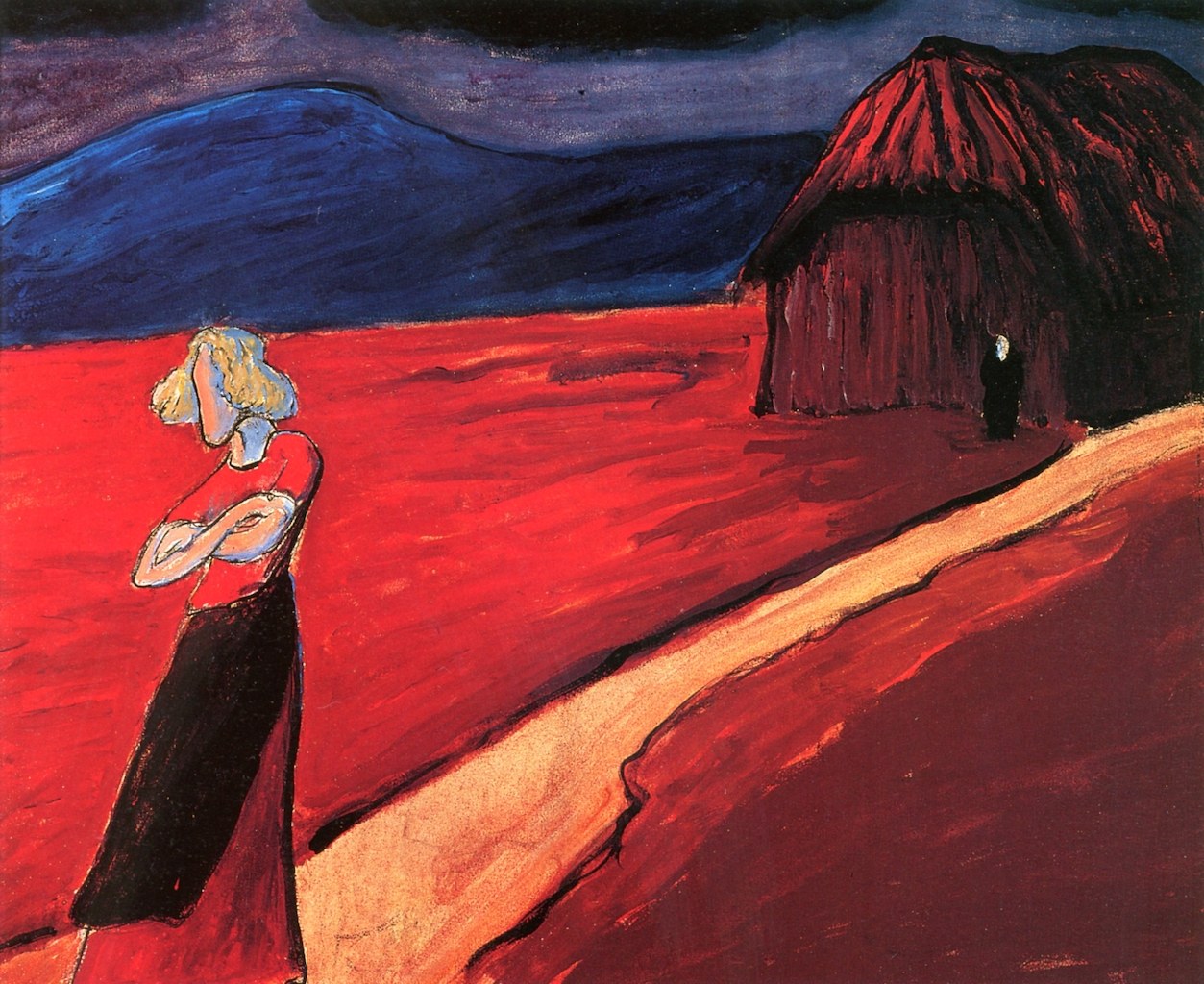
Marianne von Werefkin (1860–1938) was a Russian-born Expressionist painter whose intense, symbolic canvases in acid, non-naturalistic color helped shape the Munich avant-garde that led to Der Blaue Reiter, though her own painting career was interrupted for nearly a decade by her devotion to her partner's work.
Trained in Russia, where a hunting accident injured her right hand, she was already acclaimed by her teacher as a gifted realist before emigrating to Munich in 1896 with the painter Alexej Jawlensky. There, she stopped painting almost entirely for roughly ten years, hosting an influential salon and channeling her energy into promoting Jawlensky's career and mentoring younger artists.
Around 1906 she resumed painting with new intensity, producing visionary, emotionally charged scenes of workers, city streets, and moonlit landscapes rendered in violent, unnatural color. She helped found the New Munich Artists' Association in 1909 and remained closely tied to the circle that became Der Blaue Reiter.
After the outbreak of World War I she settled in Ascona, Switzerland, continuing to paint and mentor younger artists until her death there in 1938.
How to recognize a Werefkin
Acid, non-naturalistic color
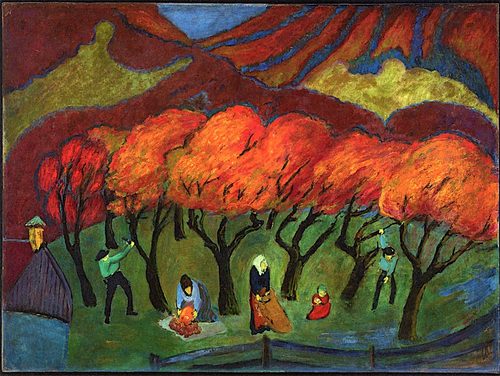
She rejected descriptive color for jarring greens, violets, and acid yellows applied in flat expressive zones, using hue to convey emotional and psychological states rather than the true colors of a scene.
Symbolist, visionary subjects
Her mature paintings favor allegorical and dreamlike scenes — solitary figures, processions, moonlit crowds — charged with symbolic weight rather than straightforward observation, closer to Symbolism than to realist painting.
Flattened, simplified figures
She reduced bodies to simplified silhouettes and masks of color, dispensing with modeled anatomy in favor of bold, graphic shapes that read clearly even at a distance, closer to symbol than to portrait likeness.
Urban and worker subjects
She painted laborers, washerwomen, and city crowds under electric or moonlit light, treating modern working life as a subject worthy of the same intensity she gave to landscapes and self-portraits.
Thick, decisive outlines
Her forms are bounded by heavy, dark contour lines that flatten depth and push compositions toward pattern, a technique shared with other Munich and Fauve painters and visible across nearly all her mature Expressionist canvases.
Nocturnal, moonlit scenes
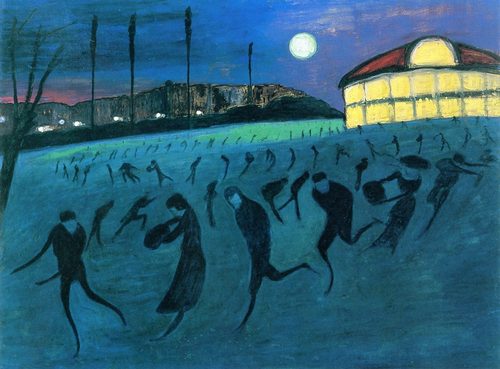
She returned often to night scenes — streets, processions, and landscapes under moonlight — using cool blues and violets against hot accent colors to build an unsettled, dreamlike atmosphere that recurs throughout her mature work.
The life
Marianne von Werefkin was born in 1860 in Tula, Russia, to an aristocratic military family, and trained under the realist painter Ilya Repin, who admired her mastery of tonal painting. Her early work already earned her serious recognition in Russian art circles before she ever left the country. A hunting accident injured her right hand in her twenties, though she continued working.
In 1896 she moved to Munich with the painter Alexej Jawlensky, her companion, and largely stopped painting for close to a decade. During these years she ran an influential salon that drew Munich's avant-garde, wrote extensively about art theory, and devoted herself to advancing Jawlensky's career rather than her own.
She resumed painting around 1906, now working in a radically different style: flat, intense color and simplified, symbolic forms far removed from her early realism. In 1909 she helped found the New Munich Artists' Association with Jawlensky, Wassily Kandinsky, and Gabriele Munter, a precursor to Der Blaue Reiter.
World War I forced her relocation to Ascona, Switzerland, where she lived modestly but kept painting and mentoring younger artists. She remained a working painter into old age, continuing to exhibit and teach despite the hardships of two world wars, until her death in 1938.
Timeline
- 1860Born in Tula, Russia
- 1896Moves to Munich with painter Alexej Jawlensky
- 1906Resumes painting after nearly a decade of silence
- 1909Co-founds the New Munich Artists' Association
- 1911Associated with the emerging Der Blaue Reiter circle
- 1914Leaves Germany for Switzerland at the outbreak of World War I
- 1938Dies in Ascona
Most famous works
| Work | Date | Why it matters |
|---|---|---|
| The Red Tree | 1910 | A stark landscape in unnatural red and violet, using color alone to charge a simple scene with psychological tension. |
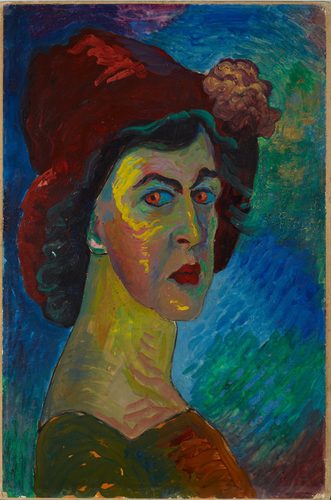
| Self-Portrait | c. 1910 | An intense self-portrait with piercing, reddened eyes and simplified planes, marking her turn toward visionary Expressionism. |
| Tragic Mood | c. 1910 | A visionary scene of solitary, grieving figures rendered in acid color, typical of her Symbolist-inflected Expressionism. |
| Autumn (School) | c. 1907 | A scene of schoolchildren rendered with simplified forms and expressive color soon after she resumed painting. |
| Skating Rink | c. 1911 | A crowded winter leisure scene rendered in flattened, acid color, typical of her interest in modern city life. |
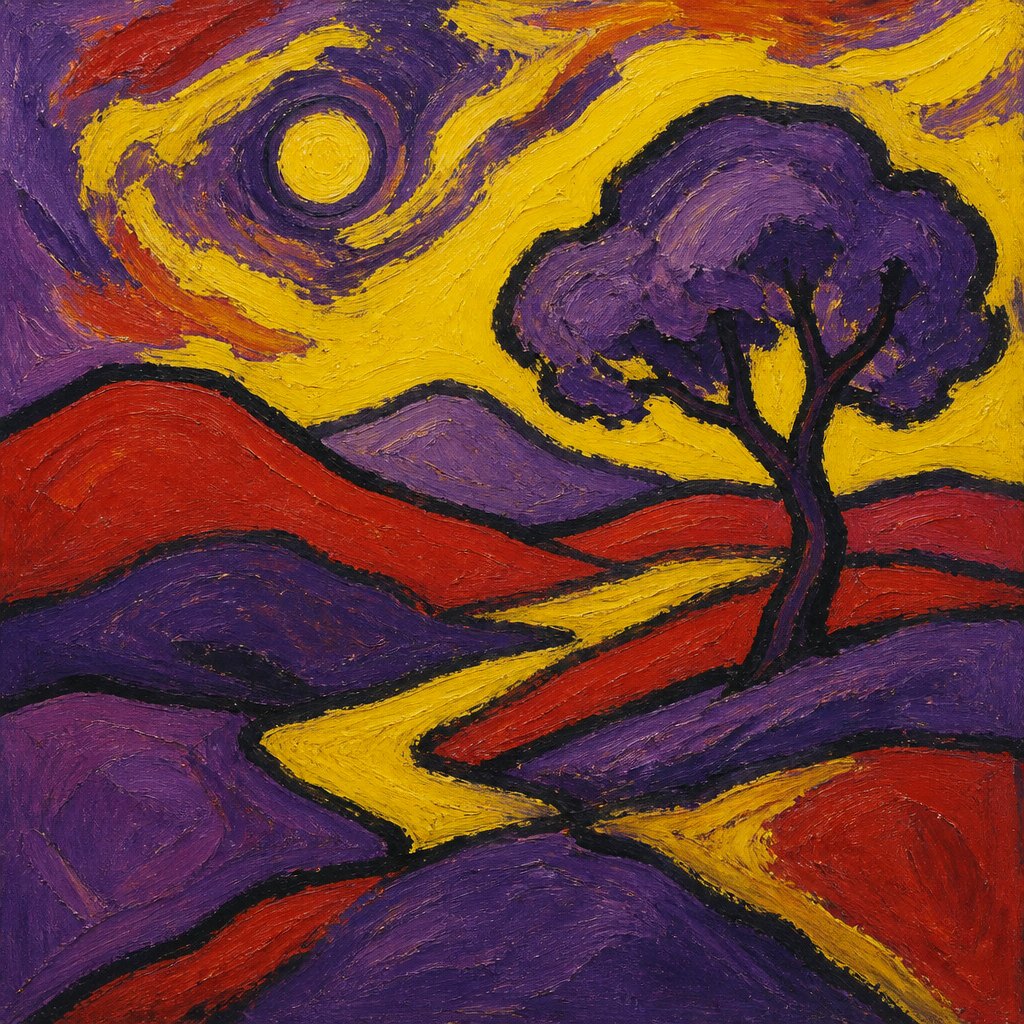 AI-generated
Create in the same spirit
Make Expressionism art of your own
This AI interpretation echoes the aesthetic world Marianne von Werefkin worked in — it depicts no real artwork. Generate your own with the Expressionism Art Style generator.
Open the Expressionism Art Style generator →Legacy
Werefkin's late-blooming return to painting helped seed the visual language of German Expressionism, and her Munich salon gave younger artists like Kandinsky and Jawlensky a space to test radical ideas about color years before Der Blaue Reiter formed. Long overshadowed by Jawlensky, whose career she prioritized for a decade, she is now recognized as a major Expressionist in her own right and an important link between Russian Symbolism and German modernism. Her adopted home of Ascona, Switzerland, holds the largest collection of her work at its Museo Comunale d'Arte Moderna, and her acid-toned, visionary canvases continue to influence painters drawn to color as emotion rather than description.
Frequently asked questions
What is Marianne von Werefkin famous for?
She is known for intense, symbolically charged Expressionist paintings in acid, non-naturalistic color, and for helping shape the Munich avant-garde circle that led to Der Blaue Reiter.
Where can you see Marianne von Werefkin's paintings?
The Museo Comunale d'Arte Moderna in Ascona, Switzerland, holds a major collection of her work, alongside pieces in the Lenbachhaus in Munich and other European museums.
Why did Marianne von Werefkin stop painting for years?
After moving to Munich in 1896 with the painter Alexej Jawlensky, she set aside her own art for close to a decade to support and promote his career instead.
What art movement was Marianne von Werefkin part of?
She is classified as an Expressionist, closely tied to the Munich circle around Kandinsky and Jawlensky that gave rise to Der Blaue Reiter, though rooted originally in Russian Symbolism.