 Famous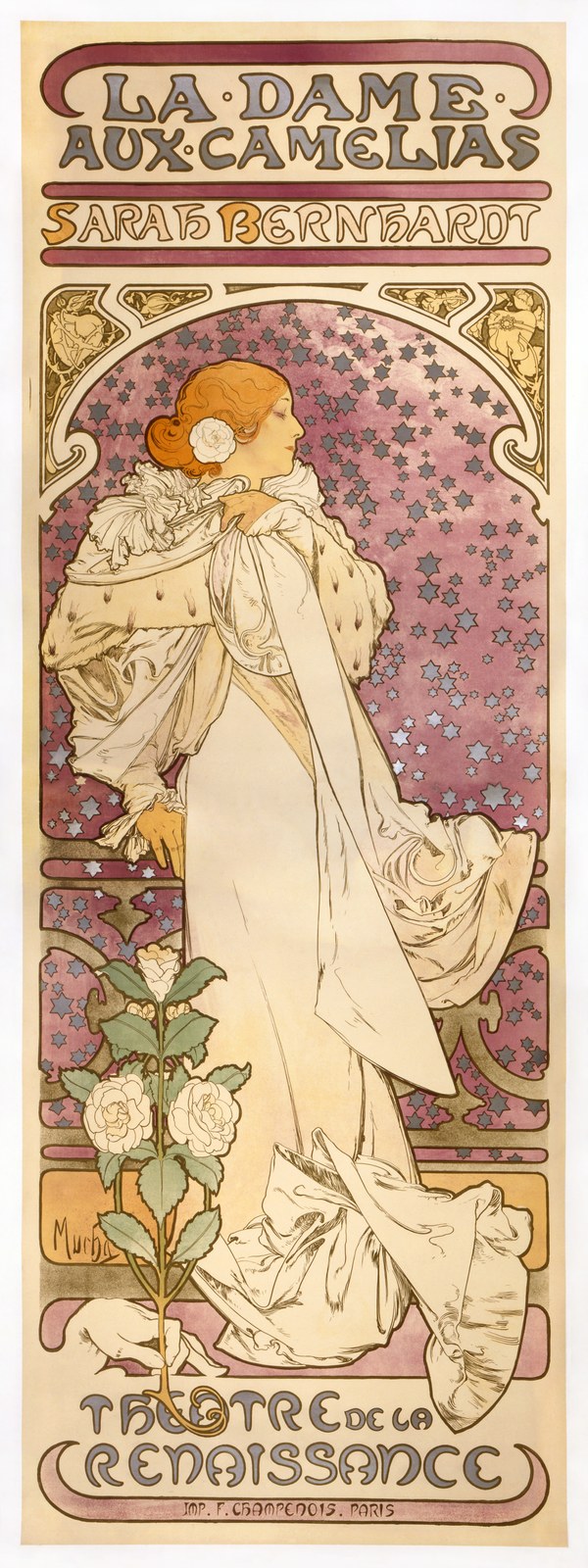
Alphonse Mucha (1860–1939) was a Czech painter and decorative artist whose flowing, ornamental posters for actress Sarah Bernhardt made him the defining visual voice of Art Nouveau in 1890s Paris.
Born in Moravia, he worked as a scenery painter before studying art in Munich and Paris, where he supported himself illustrating magazines and books through the late 1880s. His career changed overnight in December 1894, when he produced an emergency poster for Bernhardt's play Gismonda; its tall format, muted colors, and elaborate framing were unlike anything then on Parisian walls, and Bernhardt signed him to a long-term contract.
Through the following decade Mucha became Paris's most sought-after decorative artist, designing posters, packaging, jewelry, and interiors built around his signature women — serene figures with cascading hair set within halo-like decorative borders of flowers and pattern. He compiled his ornamental vocabulary into instructional pattern books used by other designers.
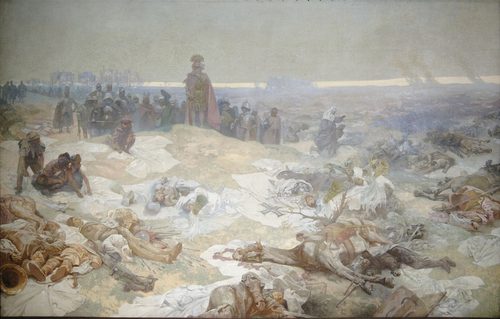
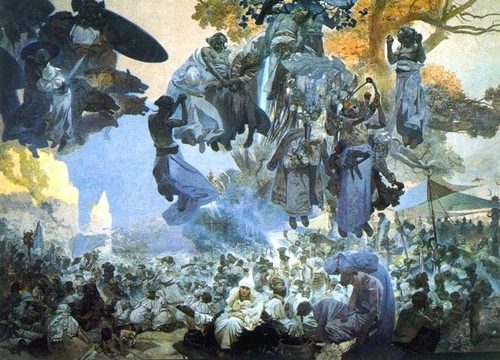
Later in life he turned away from commercial work to pursue what he considered his true purpose: The Slav Epic, a cycle of twenty monumental canvases on Slavic history, painted over nearly two decades and donated to the city of Prague. Mucha died in Prague in 1939, shortly after being questioned by the occupying Gestapo.
How to recognize a Mucha
Flowing, decorative hair
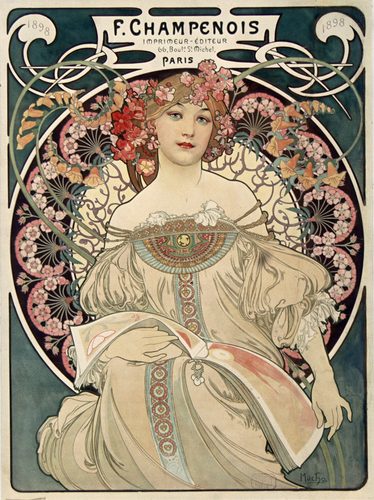
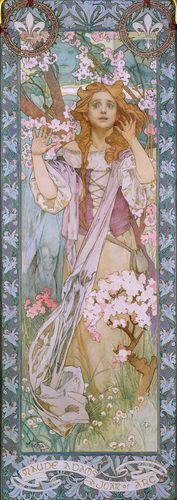
Mucha's women are crowned with long, sinuous hair that curls and branches like vines across the entire composition, doing as much decorative work as any painted border or ornamental pattern.
Halo-like circular framing
Figures are frequently set within a large circular or arched motif behind the head, echoing a stained-glass window or religious halo and giving even ordinary commercial posters a quiet, devotional stillness.
Muted, harmonious color
Rather than the bright, flat colors typical of posters, he favored soft, restrained palettes of dusty gold, pale blue, and muted rose, giving his work a rich decorative warmth without visual shouting.
Botanical, interlocking pattern
Borders overflow with stylized flowers, vines, and geometric bands that interlock directly with the main figure rather than simply framing it, blurring the line between human figure and decorative ornament.
Idealized, serene female figures
His central women are calm, statuesque, and gently posed rather than active or emotionally expressive, functioning as allegorical types — the seasons, the arts, a product — more than specific individuals.
Elongated vertical format
Many of his posters stretch tall and narrow, a format suited to Parisian street columns, which he used to elongate the figure and let ornament cascade the full height of the sheet.
The life
Mucha was born in 1860 in Ivančice, Moravia, then part of the Austro-Hungarian Empire, and showed early artistic talent while working odd jobs, including painting theater scenery. Patronage from a Moravian count allowed him to study formally in Munich and then at Paris academies in the mid-1880s, after which he supported himself as a magazine and book illustrator through the late 1880s and early 1890s.
His breakthrough came almost by accident. In December 1894, filling in for another artist over the holidays, Mucha designed an emergency poster for Sarah Bernhardt's play Gismonda. Its unusual tall format and muted, elegant style caused a sensation on the streets of Paris, and Bernhardt engaged him on a long-term contract that made him the city's most visible decorative artist for the rest of the decade.
Through the 1890s and 1900s he designed posters, packaging, jewelry, and interior schemes, developing the ornamental vocabulary of swirling hair, floral borders, and halo-like framing that came to define Art Nouveau. He also produced instructional pattern books used by other decorative artists.
Believing his commercial fame had eclipsed more serious ambitions, he later devoted nearly two decades to The Slav Epic, a cycle of twenty large history paintings, which he donated to Prague. Mucha died in the city in 1939, shortly after questioning by the Gestapo following the German occupation.
Timeline
- 1860Born in Ivančice, Moravia
- 1887Moves to Paris to work as an illustrator
- 1894Creates the breakthrough Gismonda poster for Sarah Bernhardt
- 1896Designs the Job poster and The Seasons decorative panels
- 1900Designs a pavilion at the Paris World's Fair
- 1904Begins traveling to and working in the United States
- 1912Begins painting The Slav Epic cycle
- 1928Completes and donates The Slav Epic to Prague
- 1939Dies in Prague
Most famous works
| Work | Date | Why it matters |
|---|---|---|
| Gismonda (poster for Sarah Bernhardt) | 1894 | The overnight sensation that launched his career, its tall format and muted palette breaking sharply from typical Parisian posters. |
| Job (cigarette paper poster) | 1896 | One of his most famous commercial posters, showing a woman with cascading hair wrapped around the product's lettering. |
| The Seasons (series) | 1896 | A widely reproduced decorative panel series personifying spring, summer, autumn, and winter as flowing female figures. |
| Documents Décoratifs | 1902 | An instructional pattern book distilling his ornamental style into templates other designers could study and reuse. |
| The Slav Epic (cycle) | 1912–1928 | Twenty monumental history paintings on Slavic history and mythology, the culmination of what Mucha considered his real life's work. |
 AI-generated
Create in the same spirit
Make Art Nouveau art of your own
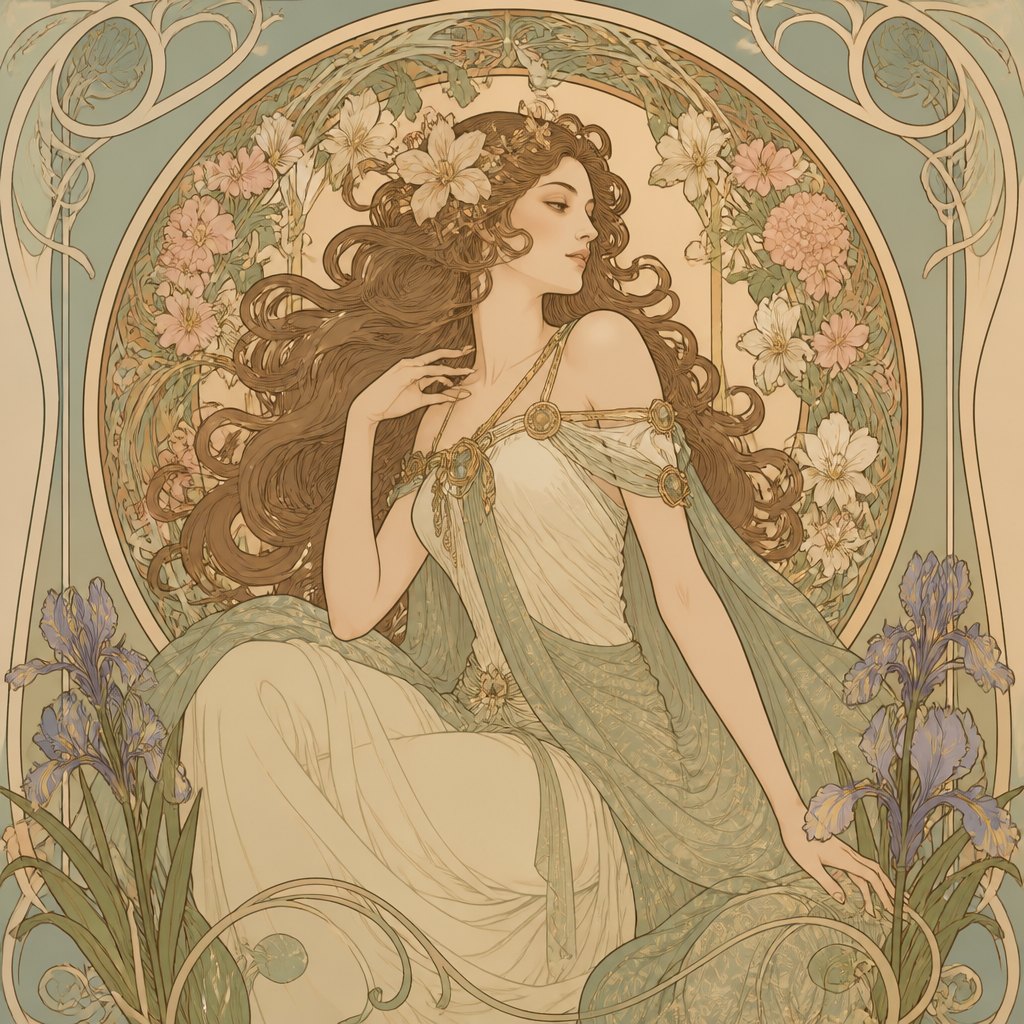
This AI interpretation echoes the aesthetic world Alphonse Mucha worked in — it depicts no real artwork. Generate your own with the Art Nouveau Style generator.
Open the Art Nouveau Style generator →Legacy
Mucha's posters defined the look of Art Nouveau so completely that the style was known for a time simply as 'Style Mucha.' His fusion of fine art and commercial design helped legitimize the poster and advertising art as serious visual media, and his decorative vocabulary of flowing hair, floral borders, and halo-like framing has been endlessly echoed in graphic design, fashion illustration, and comic-book art ever since. The Slav Epic, long overlooked next to his posters, is now recognized as a major achievement of history painting in its own right and remains one of the largest painting cycles by a single artist anywhere.
Frequently asked questions
What is Alphonse Mucha famous for?
Mucha is famous for his Art Nouveau posters, especially those for actress Sarah Bernhardt, featuring flowing-haired women framed by floral, halo-like ornament that defined the style's look.
Where can you see Mucha's work today?
His posters and paintings are held in museums worldwide, including the Mucha Museum in Prague, and The Slav Epic cycle belongs to the city of Prague, to which he donated it, though in recent years it has been exhibited at Moravsky Krumlov Castle in Moravia.
What was The Slav Epic?
A cycle of twenty large history paintings depicting Slavic history and mythology, painted over roughly two decades; Mucha considered it his most important work, more than his famous posters.
What art movement did Mucha belong to?
He is considered one of the defining artists of Art Nouveau, the ornamental, nature-inspired style that flourished across European design and illustration around 1890 to 1910.