 Famous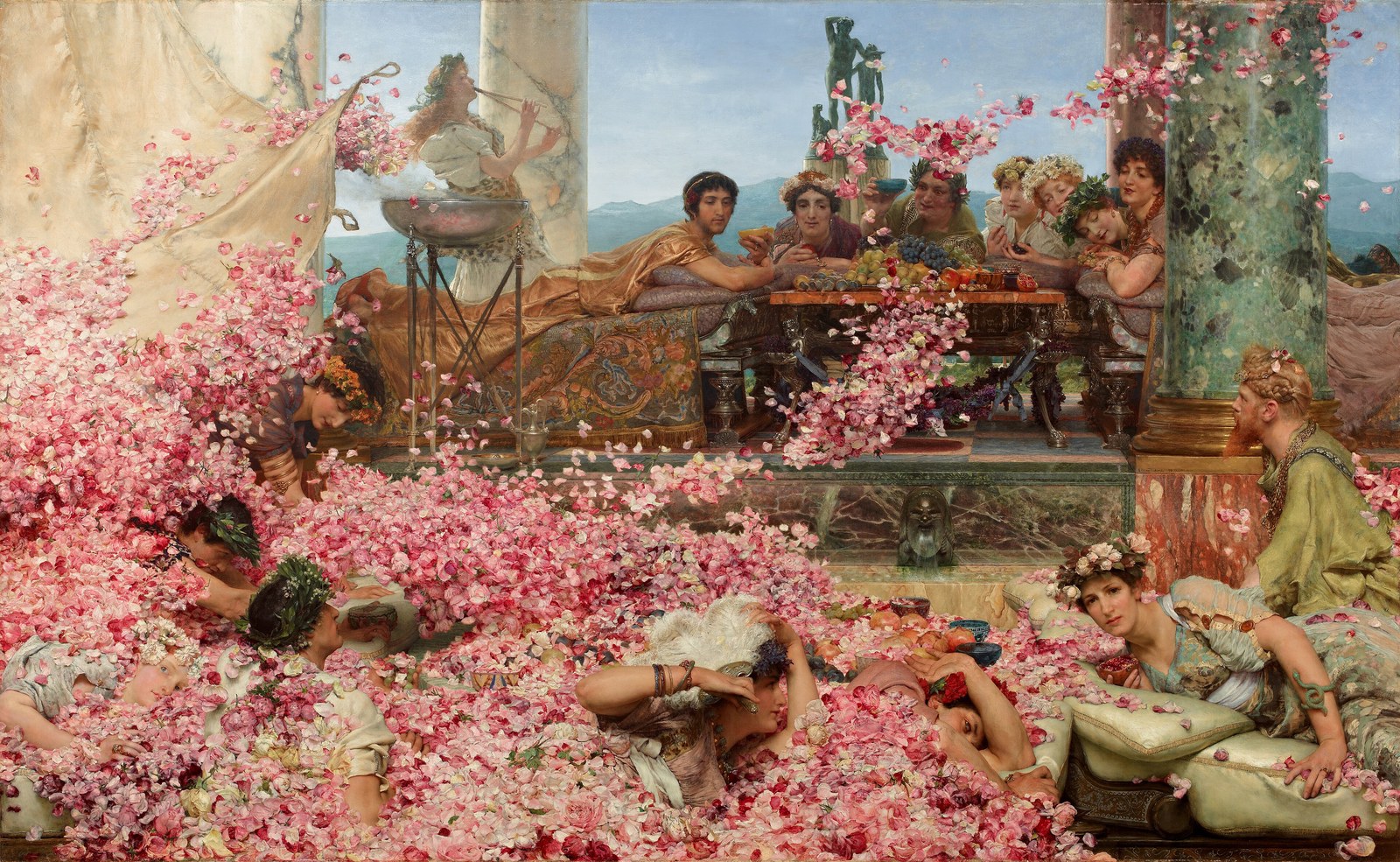
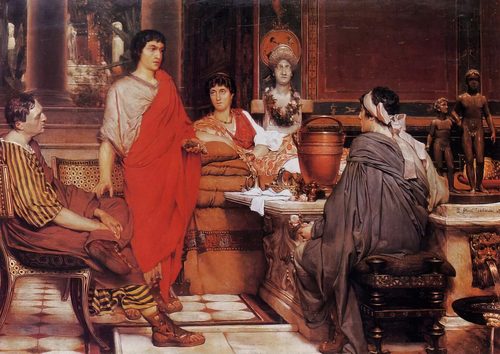
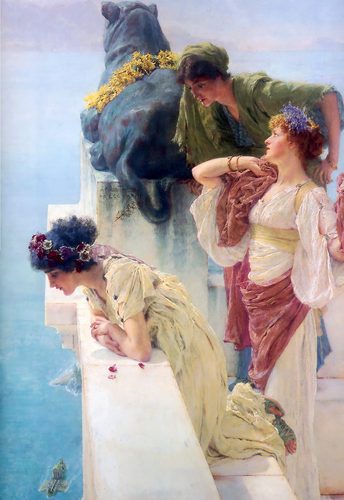
Lawrence Alma-Tadema (1836–1912) was a Dutch-born British painter renowned for reconstructing scenes of ancient Rome, Greece, and Egypt with archaeological precision, placing Victorian figures and sensibilities inside sun-drenched marble settings that made classical antiquity feel immediately, luxuriously present.
Born in Dronrijp in the Netherlands, Alma-Tadema trained at the Antwerp Academy and began his career painting Merovingian and Egyptian historical subjects before a honeymoon trip to Italy in 1863 exposed him to the ruins of Pompeii, which redirected his career toward Greco-Roman life. He settled in London in 1870, becoming a British citizen and one of the era's wealthiest painters.
His mature works — women lounging on marble benches above the sea, flower-strewn courtyards, elaborate architectural settings copied from archaeological sources — combined meticulous historical research with a distinctly Victorian sense of comfort and leisure. He was knighted in 1899 and received the Order of Merit in 1905, honors reflecting his enormous popularity, before his reputation collapsed after his death alongside the broader fall of Victorian academic painting. It was rehabilitated only decades later.
How to recognize a Alma-Tadema
Photorealistic marble
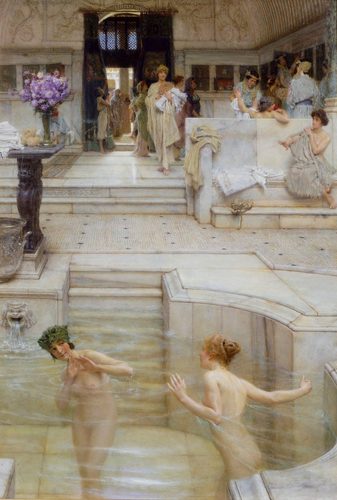
Alma-Tadema rendered marble surfaces with an almost trompe-l'oeil convincingness — veining, translucency, and reflected light all carefully observed — so that stone becomes as sensuous and tactile as skin or fabric in his compositions.
Archaeological accuracy
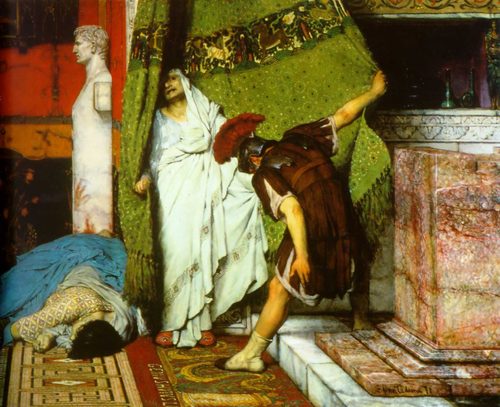
Furniture, jewelry, and architectural details were researched from real excavations and museum artifacts, giving his invented scenes a documentary confidence even though the leisurely moments themselves were purely imagined.
Mediterranean sea and sky
A glimpse of intensely blue sea or sky often frames his marble terraces, using color contrast to suggest warmth, distance, and the luxury of leisure time by the water.
Flowers in abundance
Roses, oleander, and other blooms spill across benches, floors, and hair in almost excessive quantity, turning his classical scenes into displays of sensory abundance and controlled, decorative color.
Lounging, informal poses
Figures recline, sprawl, or drape themselves across furniture in relaxed, unposed-looking attitudes rather than formal classical stances, projecting Victorian ideas of comfort and domestic ease onto ancient settings.
Vast architectural framing
Colonnades, sweeping staircases, and deep architectural perspective often dwarf the human figures, emphasizing the grandeur and permanence of the imagined ancient world his sitters casually inhabit.
The life
Alma-Tadema was born in the Dutch province of Friesland and initially studied law before turning fully to painting at the Antwerp Academy under Gustaf Wappers and later Hendrik Leys, absorbing careful historical research methods from Leys's studio practice.
Early works depicted Merovingian and Egyptian history, but a honeymoon visit to Naples and Pompeii in 1863, following his first marriage, exposed him directly to Roman ruins and artifacts, and he began shifting toward Greco-Roman subjects. After his first wife died in 1869, he moved to London in 1870, married the painter Laura Epps, and quickly became a fixture of the British art establishment.
In London, Alma-Tadema built a lavish studio-house and produced a steady stream of highly finished, archaeologically detailed classical scenes that sold for enormous sums and were widely reproduced as prints. He was elected to the Royal Academy in 1879, knighted in 1899, and awarded the Order of Merit in 1905. He continued working until his death in 1912 in Wiesbaden, Germany, where he had gone seeking treatment for illness.
Timeline
- 1836Born in Dronrijp, Netherlands
- 1852Enters the Antwerp Academy
- 1863Visits Pompeii, redirecting his subject matter toward antiquity
- 1870Settles in London
- 1879Elected to the Royal Academy
- 1899Knighted by Queen Victoria
- 1905Awarded the Order of Merit
- 1912Dies in Wiesbaden, Germany
Most famous works
| Work | Date | Why it matters |
|---|---|---|
| Sappho and Alcaeus | 1881 | Greek poets performing before an audience on marble steps, blending literature with architecture. |
| The Roses of Heliogabalus | 1888 | Banquet guests smothered under a cascade of rose petals, his most opulent set piece. |
| Spring | 1894 | A flower-strewn procession through Roman streets, among his most ambitious compositions. |
| Silver Favourites | 1903 | Women feeding doves on a marble balcony overlooking the sea, epitomizing his leisurely world. |
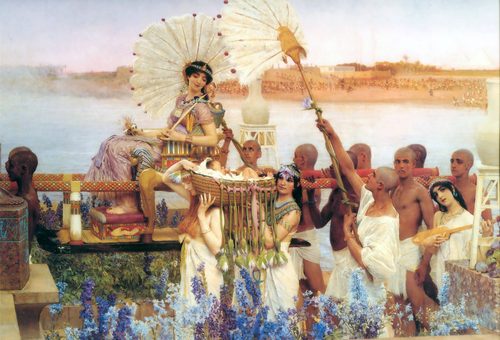
| The Finding of Moses | 1904 | A lavish Egyptian riverside scene that later sold for a record auction price. |
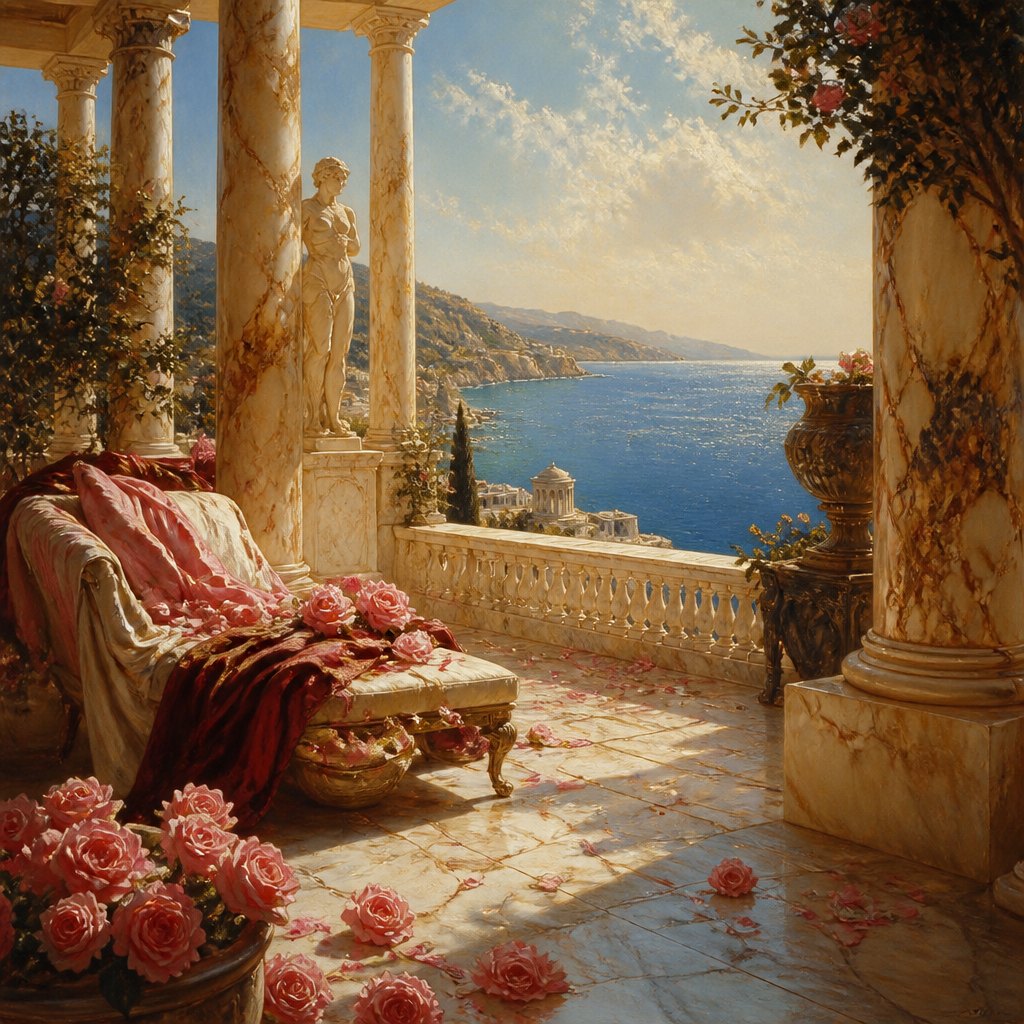 AI-generated
Create in the same spirit
Make Academic Art art of your own
This AI interpretation echoes the aesthetic world Lawrence Alma-Tadema worked in — it depicts no real artwork. Generate your own with the Academic Classical Art Style generator.
Open the Academic Classical Art Style generator →Legacy
Alma-Tadema's vision of antiquity as sunlit, marble-clad leisure shaped how generations imagined the ancient world, from stage and costume design to early Hollywood epics whose art directors studied his compositions directly. His reputation collapsed after his death as Victorian academic painting fell out of favor, and his works sold for a fraction of their original prices through much of the twentieth century. A major reassessment beginning in the 1960s restored his standing, and 'The Finding of Moses' later sold for over thirty-five million dollars, confirming a market rediscovery of the archaeological precision and craft his own era had prized.
Frequently asked questions
What is Lawrence Alma-Tadema famous for?
Alma-Tadema is famous for meticulously researched paintings of ancient Rome and Greece — marble terraces, flowers, and Mediterranean light — that made him Victorian Britain's leading painter of imagined classical antiquity.
Where can I see Alma-Tadema's paintings today?
The Guildhall Art Gallery and Tate Britain in London hold major Alma-Tadema works, and museums across the United States, including the Cleveland Museum of Art, have significant paintings.
What art movement did Alma-Tadema belong to?
Alma-Tadema worked within Victorian academic classicism, painting archaeologically detailed scenes of antiquity that made him one of the movement's most commercially successful figures.
How accurate were Alma-Tadema's ancient settings?
He researched furniture, architecture, and artifacts from real excavations and museum collections, giving his scenes documentary-level detail, even though the relaxed, leisurely moments he depicted were entirely imagined.