 Famous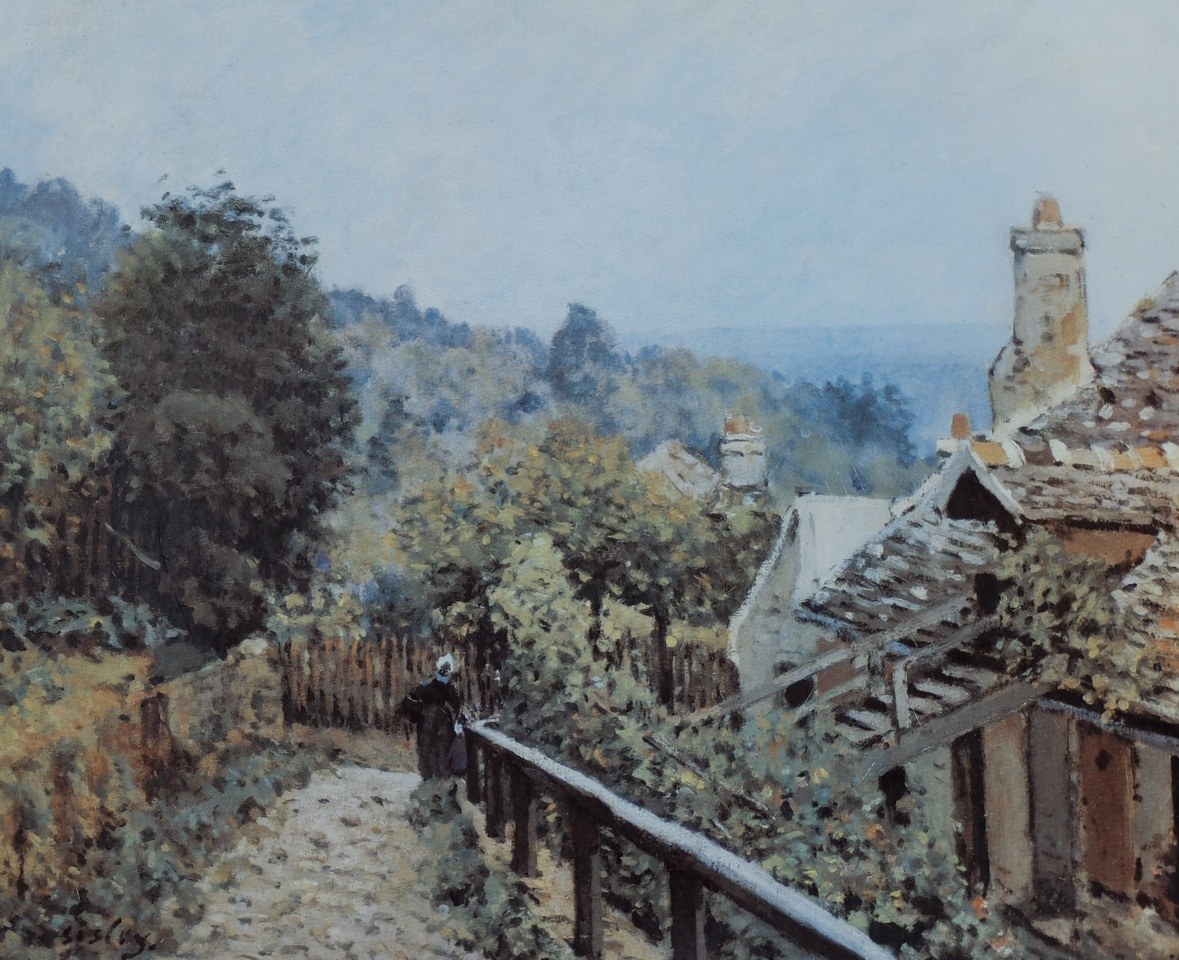
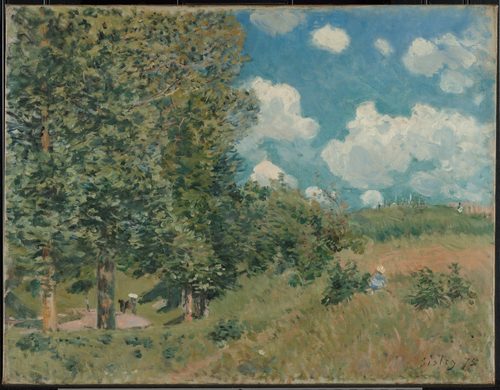
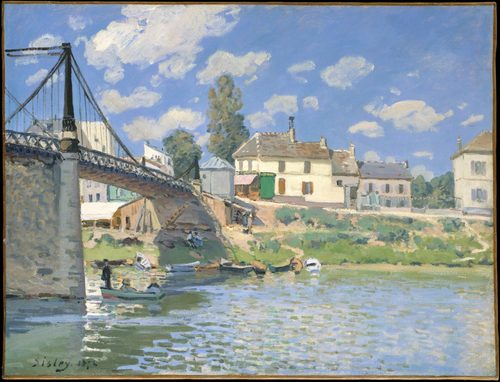
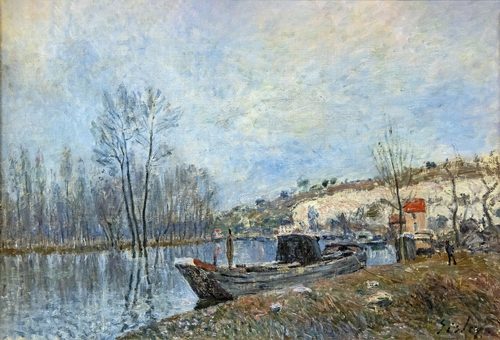
Alfred Sisley (1839–1899) was a British-French painter who devoted nearly his whole career to landscape, becoming, in the eyes of many critics, the most consistently Impressionist of the Impressionists. Born in Paris to English parents in the silk trade, he was meant for business but turned instead to painting, studying in Charles Gleyre's studio alongside Claude Monet, Pierre-Auguste Renoir, and Frédéric Bazille.
Where Monet chased spectacle and Renoir chased people, Sisley stayed with the modest villages along the Seine and Loing rivers — Louveciennes, Marly-le-Roi, Moret-sur-Loing — recording their bridges, floods, and snowfalls in a soft, silvery light. He rarely painted figures or grand set pieces; skies, water, and weather were subject enough.
The Franco-Prussian War destroyed his family's fortune in 1870, and he spent the rest of his life in real hardship, unlike his wealthier Impressionist friends. He exhibited with the group through the 1870s and 1880s but sold little and won scant recognition in his lifetime. He died in Moret-sur-Loing in 1899, having spent decades painting the same stretch of river with unwavering patience.
How to recognize a Sisley
Dominant, expressive skies
Sisley often gave two-thirds of a canvas to sky, building clouds in soft, worked layers so the weather itself becomes the picture's real subject, with the landscape below sitting quietly under shifting light.
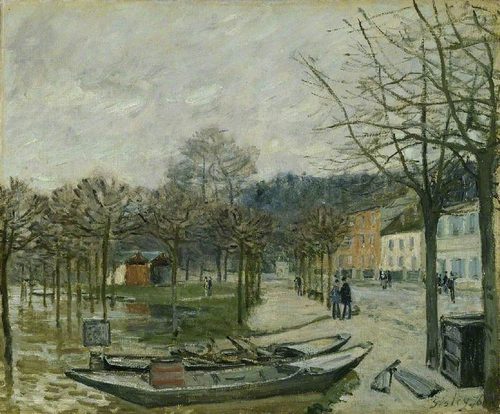
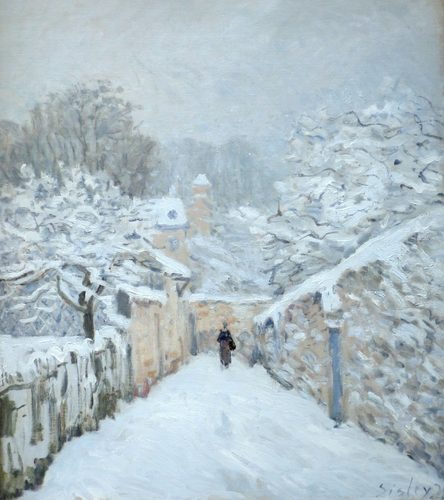
Snow and flood scenes
He returned again and again to snowfall and river floods, relishing how white ground or standing water scattered daylight into pale blues, violets, and warm grays across an otherwise ordinary village street.
Bridges and riverbanks
Stone bridges, towpaths, and poplar-lined banks recur throughout his work, painted from a modest eye level that puts the viewer standing right at the water's edge rather than looking down from above.
Muted, harmonious palette
Compared to Monet's high color, Sisley favored softer, closer-toned harmonies — dove grays, sage greens, chalky blues — that hold a whole canvas together in one gentle atmospheric mood and quiet balance.
Feathery, unlabored brushwork
His strokes are light and broken but never showy, built up in small dabs that read, from a normal viewing distance, as convincing weather rather than as visible, attention-seeking technique or flourish.
Empty of grand incident
He almost never painted crowds, cafes, or modern spectacle; his villages are usually still and near-empty, giving full attention to the light falling across roofs, water, and open sky above.
The life
Alfred Sisley was born in Paris in 1839 to English parents who ran a prosperous export business. Sent to London around 1857 to train for commerce, he spent more time in galleries than counting houses and returned to Paris in 1862 determined to paint. He enrolled in Charles Gleyre's studio, where he met Claude Monet, Pierre-Auguste Renoir, and Frédéric Bazille, and the four young painters began working outdoors together along the Seine.
Through the late 1860s Sisley absorbed the loose brushwork and outdoor practice that would define Impressionism, exhibiting at the Paris Salon before joining his friends' independent shows. The Franco-Prussian War of 1870 ruined his family's business, and he never regained financial security; from then on he painted to survive, moving frequently between villages west of Paris in search of cheaper rent and fresh views.
His strongest years came in the 1870s and 1880s, when he settled around Louveciennes, Marly-le-Roi, and finally Moret-sur-Loing, producing his celebrated flood and snow scenes. He showed in several of the Impressionist exhibitions but never matched his colleagues' sales. In his final years he kept painting the Loing river with quiet persistence, applied for French citizenship in 1898, and died in Moret-sur-Loing in January 1899 before it was granted.
Timeline
- 1839Born in Paris to English parents
- 1857Sent to London to train in business
- 1862Returns to Paris, enters Gleyre's studio
- 1870Family fortune lost in the Franco-Prussian War
- 1874Shows in the first Impressionist exhibition
- 1876Paints the Port-Marly flood series
- 1880Settles near Moret-sur-Loing
- 1897Paints the coast of Wales at Langland Bay
- 1899Dies in Moret-sur-Loing
Most famous works
| Work | Date | Why it matters |
|---|---|---|
| The Bridge at Villeneuve-la-Garenne | 1872 | An early masterwork of taut structure and clear river light that announced his mature style. |
| Flood at Port-Marly | 1876 | His best-known series, turning a real regional disaster into studies of still, silver-toned water. |
| Snow at Louveciennes | 1878 | One of many snow scenes prized for how white ground scatters color across a quiet street. |
| Regatta at Molesey | 1874 | Painted during a summer on the Thames in 1874, one of several working stays in Britain, alive with flags and reflected light on the Thames. |
| The Bridge at Moret | 1893 | A late, repeated subject near his final home, painted in shifting seasons and hours of light. |
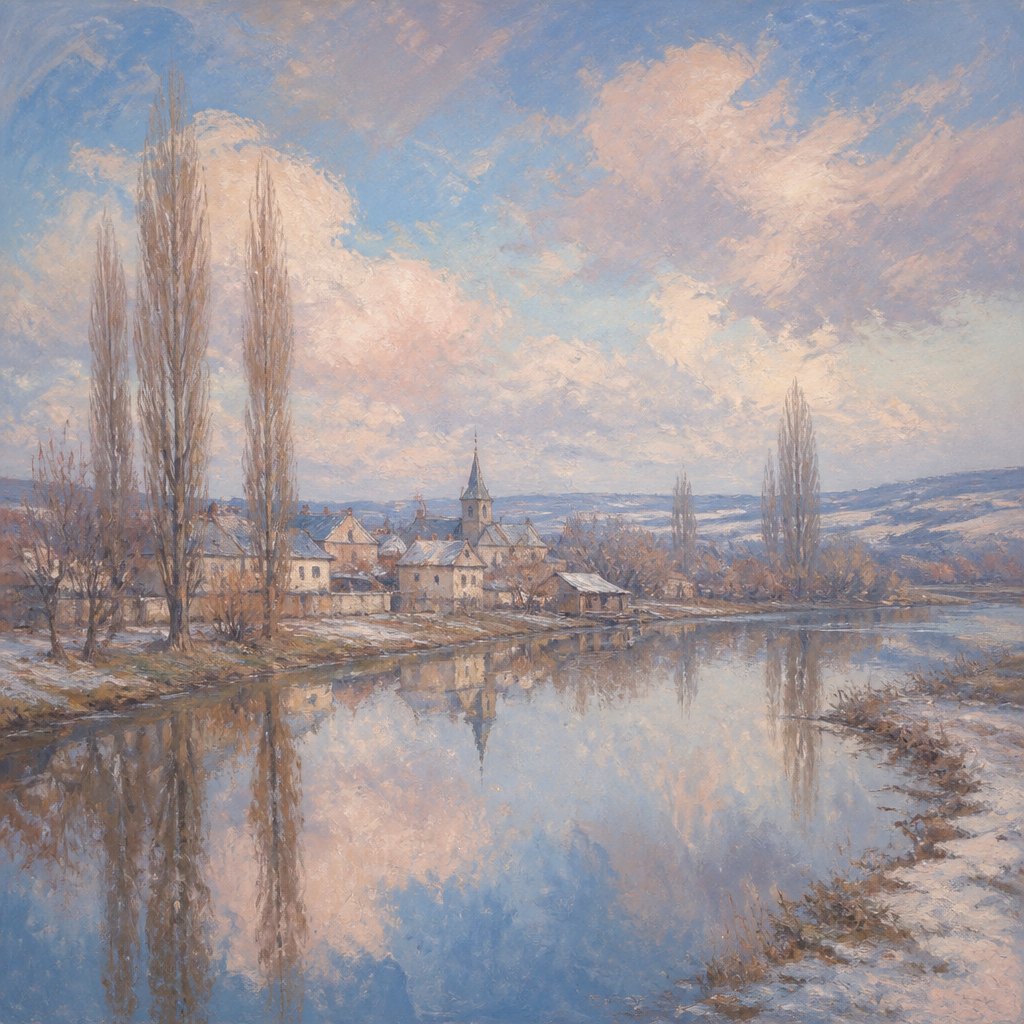 AI-generated
Create in the same spirit
Make Impressionism art of your own
This AI interpretation echoes the aesthetic world Alfred Sisley worked in — it depicts no real artwork. Generate your own with the Impressionism Art Style generator.
Open the Impressionism Art Style generator →Legacy
Sisley's reputation grew only after his death, when collectors and later art historians recognized him as Impressionism's most single-minded landscape painter — the one who never drifted toward portraiture, still life, or later experiments, and simply kept refining how to paint sky, water, and weather. His quiet, atmospheric scenes influenced how later plein-air painters approached ordinary rural subjects, proving that modest villages and repeated motifs could sustain a whole career. Museums now place him alongside Monet and Pissarro as one of the movement's founding figures, even though he died in poverty. Walk any riverside town under soft winter light and his particular attentiveness to sky is easy to recognize.
Frequently asked questions
What is Alfred Sisley famous for?
Sisley is famous for landscape paintings of villages and rivers near Paris, especially scenes of snow, floods, and bridges along the Seine and Loing, rendered with soft light and a devoted focus on weather and sky.
Where can I see Alfred Sisley's paintings?
Major examples hang at the Musée d'Orsay in Paris, the National Gallery and Courtauld Gallery in London, and the Metropolitan Museum of Art in New York, among other collections worldwide.
What art movement did Alfred Sisley belong to?
Sisley was a founding member of the Impressionist movement, showing alongside Monet, Renoir, Pissarro, and Degas in several of the independent Impressionist exhibitions held in Paris during the 1870s and 1880s.
Was Alfred Sisley French or British?
He was born in Paris to English parents and lived his entire life in France, painting French and occasionally English scenery, but he remained a British subject and only sought French citizenship shortly before he died in 1899.