 Famous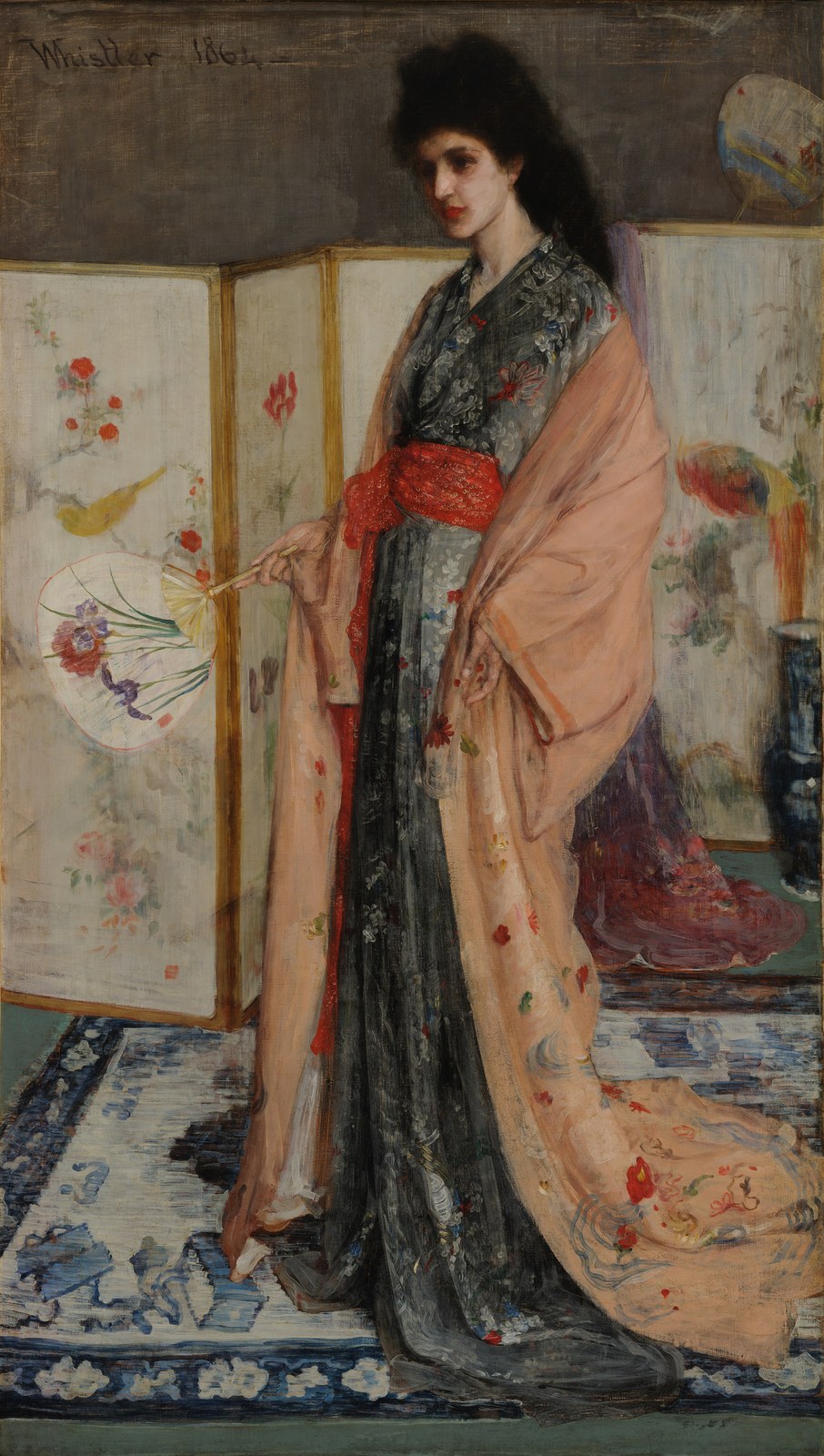
![Arrangement in Grey and Black No. 1[N 1] — James McNeill Whistler](https://media.famousartist.com/encyclopedia/james-mcneill-whistler/commons-1-thumb.jpg)
James McNeill Whistler (1834–1903) was an American-born painter and printmaker who spent most of his working life in Paris and London arguing that a painting's arrangement of color and tone mattered more than its subject. Dismissed from West Point for failing chemistry, he turned to art instead, training in Paris in the 1850s, where he absorbed French Realism and, later, the flattened space and asymmetry of Japanese woodblock prints. He gave his pictures musical titles — Symphony, Nocturne, Arrangement, Harmony — to insist that painting, like music, needed no story or moral to justify itself. His 1871 portrait of his mother, formally titled Arrangement in Grey and Black No. 1, became one of the most reproduced images in American art. In 1877 the critic John Ruskin accused him of "flinging a pot of paint in the public's face"; Whistler sued for libel, won only a farthing in damages, and was left bankrupt by the legal costs. He remained an elegant, combative presence in London's art world until his death, signing each canvas with a stylized butterfly.
How to recognize a Whistler
Musical titles
Whistler named paintings Nocturne, Symphony, Arrangement, and Harmony, treating subject matter as secondary to tone and composition — a deliberate challenge to Victorian audiences who expected every picture to tell a story or teach a lesson.
Close tonal harmonies
He worked in narrow ranges of grey, black, and silvery blue, thinning his oils into near-transparent washes so that figures and buildings seem to surface from fog rather than sit solidly on the canvas.
Japanese-influenced asymmetry
Drawing on his collection of Japanese woodblock prints, Whistler flattened pictorial space, pushed figures off-center, and left large passages of canvas nearly bare, favoring elegant imbalance over the built-up symmetry of academic composition.
Thames nocturnes
His night scenes of the London river reduce boats, bridges, and fireworks to soft smudges of color against near-black grounds, recording mood and atmosphere rather than a precise, measurable view of the city.
The butterfly signature
From the 1860s onward he signed his work with a stylized butterfly monogram, sometimes fitted with a stinger for combative pictures, turning his own vanity and wit into part of the finished composition.
Spare society portraits
In his formal portraits, Whistler dressed sitters in black or grey and set them against equally muted backgrounds, allowing a single pale face or hand to carry the entire composition's warmth and life.
The life
Whistler was born in Lowell, Massachusetts, in 1834, the son of a railway engineer whose work took the family to St. Petersburg, Russia, for much of his childhood. After a brief, unsuccessful stint at West Point, he left the United States for good in 1855, settling first in Paris, where he studied under Charles Gleyre and fell in with the circle around Gustave Courbet and the young Impressionists.
By 1859 he had moved to London, which remained his base for the rest of his life. Through the 1860s and 1870s he developed his mature style: tonal, musical in its titling, indebted to Japanese prints he collected obsessively. His 1871 portrait of his mother and his shimmering Thames nocturnes defined this period, but the nocturnes also drew the ire of critic John Ruskin, whose 1877 attack led to a libel suit that Whistler technically won but that emptied his bank account and forced the sale of his house.
He rebuilt his reputation through the 1880s with etchings, a triumphant Paris exhibition, and an increasingly public persona as a wit and dandy. He continued painting and writing — his lectures and letters were as sharp as his brush — until his death in London in 1903.
Timeline
- 1834Born in Lowell, Massachusetts
- 1843Family relocates to St. Petersburg, Russia
- 1855Leaves for Paris to study art
- 1859Settles permanently in London
- 1871Paints Arrangement in Grey and Black No. 1
- 1876Completes the Peacock Room for Frederick Leyland
- 1877Ruskin's attack leads to a ruinous libel trial
- 1903Dies in London
Most famous works
| Work | Date | Why it matters |
|---|---|---|
| Arrangement in Grey and Black No. 1 (Whistler's Mother) | 1871 | His portrait of his mother, painted in a narrow range of grey and black, became one of the most recognized images in American art. |
| Nocturne in Black and Gold: The Falling Rocket | 1875 | A fireworks display dissolved into abstract smears of color; it was this painting that provoked Ruskin's attack and the ensuing libel trial. |
| The Peacock Room | 1876–77 | An entire dining room repainted in blue-green and gold for shipping magnate Frederick Leyland, now reassembled at the Smithsonian's Freer Gallery. |
| Symphony in White, No. 1: The White Girl | 1862 | An early statement of his musical titling and pale, restrained palette, exhibited at the Salon des Refusés. |
| Arrangement in Grey and Black No. 2: Thomas Carlyle | 1872–73 | A companion portrait to his mother's, using the same austere tonal formula on the Scottish historian. |
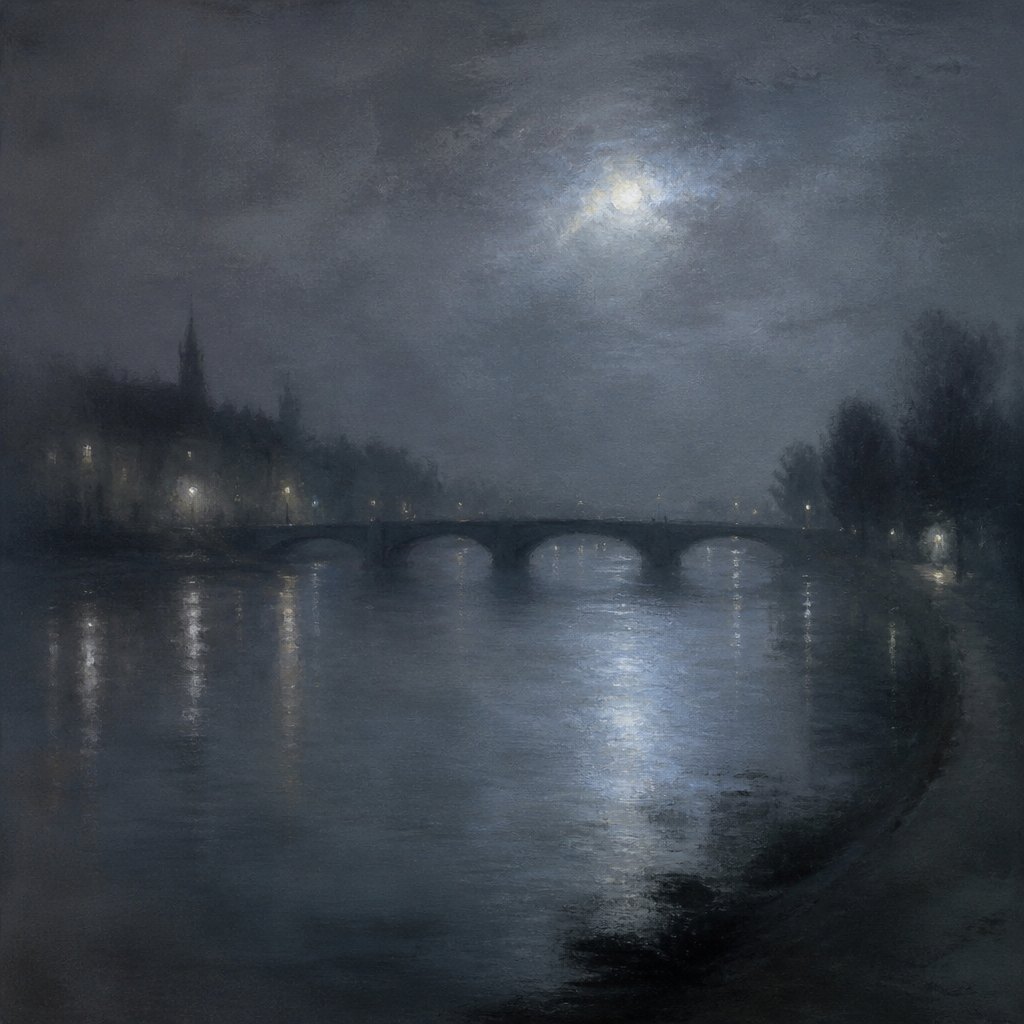 AI-generated
Create in the same spirit
Make Tonalism art of your own
This AI interpretation echoes the aesthetic world James McNeill Whistler worked in — it depicts no real artwork. Generate your own with the Tonalism Art Style generator.
Open the Tonalism Art Style generator →Legacy
Whistler's insistence that painting could be about arrangement and mood alone, without narrative or moral purpose, fed directly into twentieth-century abstraction and the broader idea of art for art's sake. His Thames nocturnes anticipated the tonal restraint later prized by photographers and filmmakers working in black and white. American Tonalist painters of the 1880s and 1890s took his muted palette as a starting point, and his combative public persona — equal parts aesthete and provocateur — set a template for the modern artist as celebrity. Today his work anchors the Freer Gallery in Washington, and his Peacock Room remains one of the few complete interiors by a major nineteenth-century painter still intact.
Frequently asked questions
What is James McNeill Whistler famous for?
He is best known for Arrangement in Grey and Black No. 1, popularly called Whistler's Mother, and for insisting that painting should be judged on tone and composition alone, like music, rather than on story or sentiment.
Where can I see Whistler's paintings today?
The Freer Gallery of Art in Washington, D.C. holds the largest Whistler collection, including the Peacock Room. Whistler's Mother hangs in the Musée d'Orsay in Paris, and the Art Institute of Chicago holds other major works.
What art movement was Whistler part of?
He is associated with Tonalism and the Aesthetic Movement, both built on his belief in art for art's sake, though he also absorbed French Realism and Japanese print design early in his career.
Why did Whistler sue John Ruskin?
Ruskin accused him of 'flinging a pot of paint in the public's face' after seeing a Nocturne. Whistler won the libel case but was awarded only a farthing and was bankrupted by legal costs.