 Famous
Albrecht Dürer (1471–1528) was a German painter, printmaker, and theorist from Nuremberg whose engravings and woodcuts brought Italian Renaissance ideas of proportion and perspective into Northern European art, while never losing a Gothic taste for exacting detail. Trained first as a goldsmith in his father's workshop, he apprenticed with the painter Michael Wolgemut before traveling to Italy, where he studied classical form and the mathematics of proportion. Dürer became the first Northern artist to achieve international fame primarily through prints; works like Melencolia I and the Apocalypse woodcut series circulated widely and made him wealthy independent of any single patron. He also painted portraits and altarpieces, produced watercolor studies of animals and landscapes remarkable for their naturalism, and wrote theoretical treatises on human proportion and geometry. As court painter to Holy Roman Emperors Maximilian I and Charles V, he balanced imperial commissions with his own restless experimentation. Dürer's self-portraits, unusually confident and formal for the period, present the artist as a figure of intellectual and social standing rather than a mere craftsman. He died in Nuremberg in 1528, having reshaped how Northern Europe understood the status of the artist.
How to recognize a Dürer
Engraved linear precision
Dürer's engravings use dense, controlled networks of fine lines to build tone, texture, and volume, achieving an almost photographic level of detail in metal and wood. No Northern printmaker before him matched this control.
Naturalist animal studies
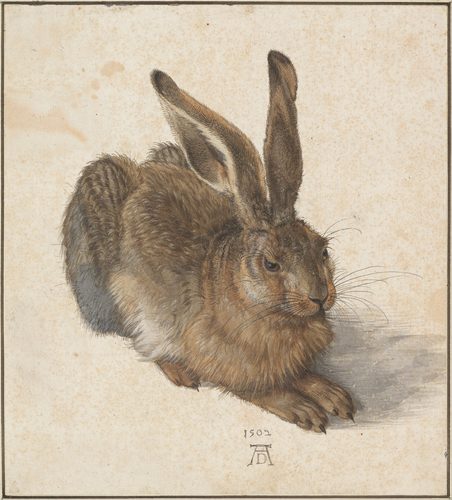
His watercolors of animals, from hares and beetles to a blue roller's wing, combine close observation with careful, almost scientific rendering of fur, feather, and skin texture, treating nature itself as worthy of sustained artistic study.
Gothic detail, classical proportion
Dürer fused the Northern European love of intricate ornament and surface texture with Italian ideas of mathematical proportion and idealized anatomy, producing figures that feel both meticulously detailed and carefully, geometrically measured throughout.
Confident formal self-portraits
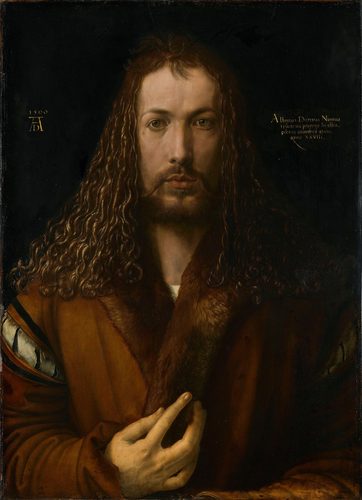
Dürer painted himself repeatedly and with unusual formality, at one point posing frontally in a manner traditionally reserved for depictions of Christ, asserting the dignity and status of the artist as intellectual.
Dramatic apocalyptic imagery
His woodcut series on the Book of Revelation staged cosmic destruction with swirling, energetic compositions of horsemen, angels, and falling bodies, setting a visual template for apocalyptic scenes for centuries after.
Meticulous drapery and hair
Dürer rendered fabric folds and individual strands of hair with obsessive linear clarity, using engraving's fine tools to differentiate textures that painters typically blended together, giving even small prints a tactile, almost sculptural sense of surface.
The life
Albrecht Dürer was born in Nuremberg in 1471, one of many children of a goldsmith who trained him in metalworking before apprenticing him to the painter Michael Wolgemut. After completing his apprenticeship, Dürer traveled through the Rhineland and, crucially, to Italy in the 1490s, where he encountered Renaissance ideas about proportion, perspective, and the status of the artist that were not yet widespread north of the Alps.
Returning to Nuremberg, he established an independent workshop and began producing the engravings and woodcuts that made his reputation, including the ambitious Apocalypse series of 1498. Unlike most Northern artists, who depended on singular commissions, Dürer built wealth and fame by selling prints in editions, distributed by agents across Europe. A second trip to Italy around 1505 deepened his engagement with Venetian color and Italian theory.
In his later career, Dürer served as court painter to Holy Roman Emperors Maximilian I and Charles V, produced influential treatises on human proportion and fortification, and traveled to the Netherlands documenting his journey in a detailed diary. He continued working until his death in Nuremberg in 1528, having done more than any other Northern artist to align printmaking with the status of fine art.
Timeline
- 1471Born in Nuremberg, Germany
- 1486Apprenticed to painter Michael Wolgemut
- 1494First journey to Italy
- 1498Publishes the Apocalypse woodcut series
- 1505Returns to Venice for a second Italian trip
- 1512Becomes court painter to Emperor Maximilian I
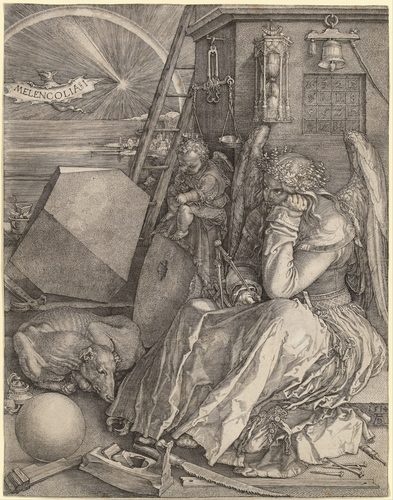
- 1514Engraves Melencolia I
- 1528Dies in Nuremberg
Most famous works
| Work | Date | Why it matters |
|---|---|---|
| Melencolia I | 1514 | A dense allegorical engraving on creative frustration and knowledge, among the most analyzed prints in art history. |
| Apocalypse | 1498 | Fifteen dramatic woodcuts illustrating the Book of Revelation, establishing Dürer's fame across Europe. |
| Young Hare | 1502 | A watercolor study prized for its uncannily lifelike rendering of fur and light. |
| Self-Portrait at 28 | 1500 | A frontal self-portrait echoing images of Christ, asserting the artist's dignity and intellectual status. |
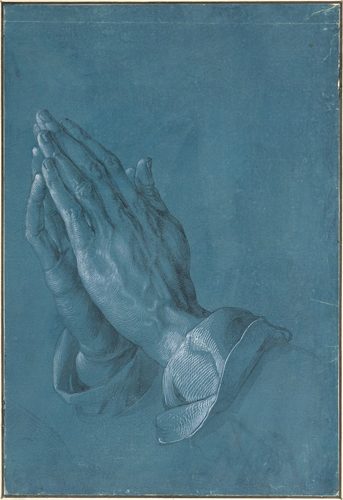
| Praying Hands | c. 1508 | A brush drawing of hands on blue paper, one of the most widely reproduced drawings in Western art. |
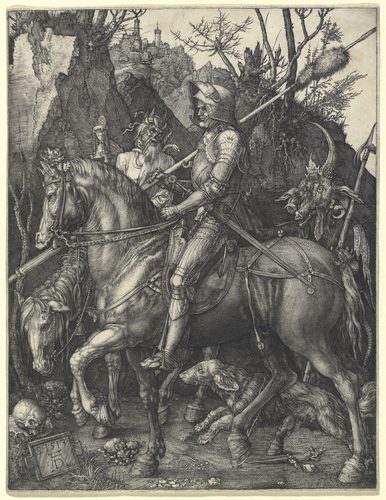
| Knight, Death and the Devil | 1513 | An engraving of a resolute knight riding past symbols of mortality and temptation. |
 AI-generated
Create in the same spirit
Make Northern Renaissance art of your own
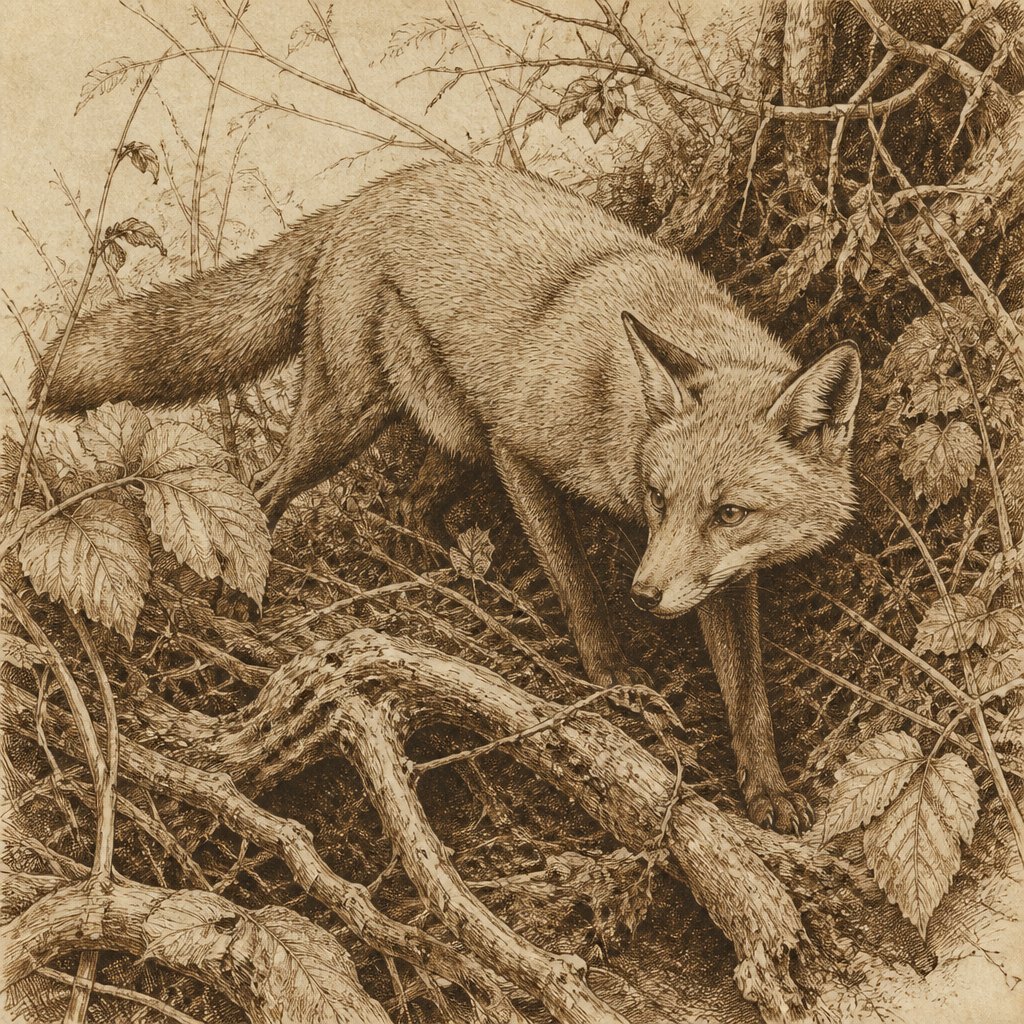
This AI interpretation echoes the aesthetic world Albrecht Dürer worked in — it depicts no real artwork. Generate your own with the Renaissance Portrait Art Style generator.
Open the Renaissance Portrait Art Style generator →Legacy
Dürer did more than any Northern European artist to make printmaking a vehicle for serious art, and his engravings circulated as far as Italy, where painters like Raphael are known to have studied and admired them. He established Nuremberg as a center of Renaissance humanism north of the Alps and left theoretical writings on proportion and geometry that influenced artists for generations. His animal and nature studies anticipated the observational rigor of later scientific illustration. Dürer's insistence on the artist's intellectual standing, expressed through his confident self-portraits, helped shift the perception of painters and printmakers from craftsmen to thinkers, a change felt throughout later European art.
Frequently asked questions
What is Albrecht Dürer famous for?
Dürer is famous for engravings and woodcuts like Melencolia I and the Apocalypse series, and for watercolor studies of animals and nature rendered with remarkable scientific precision.
Where can you see Albrecht Dürer's work?
Major collections are held at the Germanisches Nationalmuseum and Albrecht-Dürer-Haus in Nuremberg, the Albertina in Vienna, and print rooms including the British Museum and the Metropolitan Museum of Art.
How many works did Albrecht Dürer make?
Dürer produced roughly a hundred engravings, over two hundred woodcuts, and hundreds of drawings and watercolors, alongside a smaller number of paintings, making prints the core of his output.
What art movement was Albrecht Dürer part of?
Dürer belonged to the Northern Renaissance, blending Northern European detail and craftsmanship with Italian Renaissance ideas about proportion, perspective, and the artist's intellectual status.