 Famous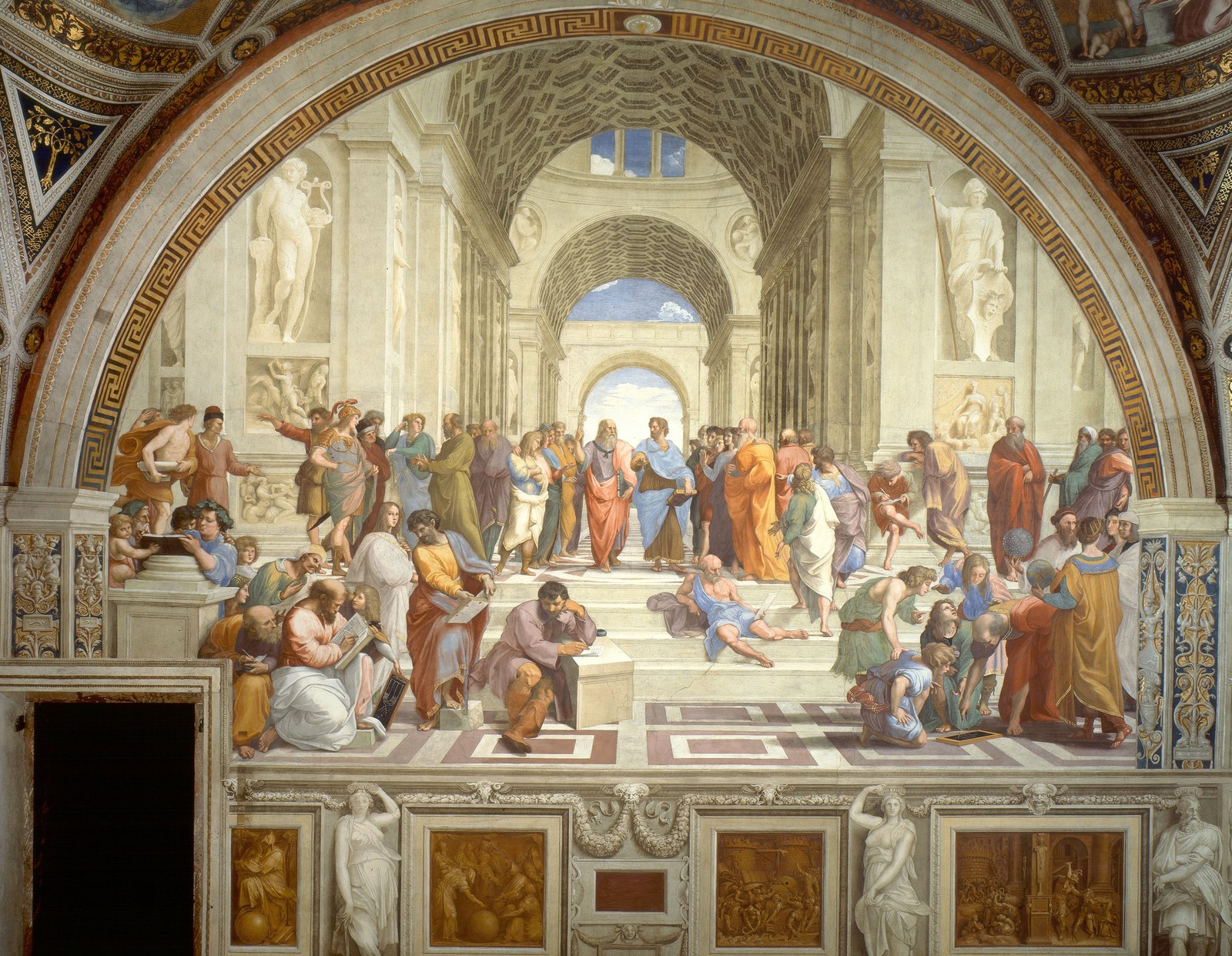
Raphael (1483–1520), born Raffaello Sanzio in Urbino, was an Italian painter whose serene, perfectly balanced compositions made him the era's model of harmonious grace, most famously in the frescoes of the Vatican's Stanza della Segnatura, including The School of Athens. The son of a court painter, he trained first in Urbino and then in Perugino's workshop in Perugia before absorbing, in Florence, the innovations of both Leonardo da Vinci and Michelangelo, whose work he studied intensively without simply imitating either. Summoned to Rome around 1508 by Pope Julius II, he spent the rest of his short career painting papal apartments, designing tapestry cartoons, and running one of the largest workshops of the Renaissance, staffed by assistants who helped him meet an enormous volume of commissions. Raphael's paintings favor clarity over drama: balanced compositions, gentle color, and idealized, calm figures, especially in his many Madonna paintings, which became touchstones of devotional grace for centuries. He also worked as an architect and antiquarian, overseeing archaeological surveys of ancient Rome. Raphael died suddenly in 1520, at just thirty-seven, cutting short a career already regarded as the era's most complete synthesis of Renaissance ideals.
How to recognize a Raphael
Balanced pyramidal compositions
Raphael organized figures into calm, stable groupings, often pyramidal or circular, that lead the eye smoothly across a scene without visual conflict, so the arrangements feel inevitable and unforced rather than deliberately constructed.
Gentle idealized Madonnas
His many paintings of the Madonna and Child use soft, rounded forms, tender gesture, and warm but restrained color to convey serene maternal devotion, a formula so admired it was endlessly copied afterward.
Clear, luminous color
Raphael favored clean, saturated color used sparingly and precisely, letting individual passages of red, blue, or gold stand out against more muted surroundings, a restraint that keeps even busy scenes feeling calm.
Synthesis of Renaissance masters
He absorbed Leonardo's soft modeling and Michelangelo's monumental figures without imitating either directly, blending both into his own calmer, more legible style that later academies treated as the Renaissance ideal.
Architectural spatial clarity
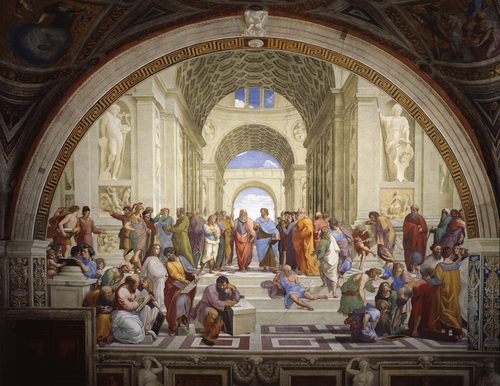
In works like The School of Athens, Raphael used precise linear perspective and grand classical architecture to organize dozens of figures into a single legible, airy space that feels both vast and orderly.
Individualized group portraiture
Even within large crowded frescoes, Raphael gave each figure a distinct pose, gesture, and implied personality, so that group scenes read as a gathering of real individuals rather than a repeated decorative type.
The life
Raphael was born in 1483 in Urbino, the son of Giovanni Santi, a painter at the ducal court, who gave him an early introduction to art and humanist culture before dying when Raphael was eleven. He trained afterward in the workshop of Pietro Perugino in Perugia, absorbing a gentle, harmonious style that shaped his own early work.
By 1504 Raphael was working in Florence, where he studied the paintings of Leonardo da Vinci and Michelangelo's muscular figure style, absorbing lessons in composition and anatomy that transformed his early Umbrian style into something more dynamic and monumental. Around 1508, Pope Julius II summoned him to Rome to fresco the papal apartments, beginning with the Stanza della Segnatura and its centerpiece, The School of Athens.
Raphael spent the rest of his career in Rome, becoming immensely successful and running a large workshop that produced altarpieces, portraits, tapestry designs, and architectural projects, including work on St. Peter's Basilica after Bramante's death. He also directed surveys of ancient Roman ruins for Pope Leo X. Raphael died unexpectedly in 1520, at thirty-seven, after a short illness, at the height of his fame.
Timeline
- 1483Born in Urbino, Italy
- 1494Father dies; continues training locally
- 1500Joins Pietro Perugino's workshop in Perugia
- 1504Moves to Florence, studies Leonardo and Michelangelo
- 1508Summoned to Rome by Pope Julius II
- 1509Begins The School of Athens fresco
- 1514Appointed architect of St. Peter's Basilica
- 1520Dies in Rome at thirty-seven
Most famous works
| Work | Date | Why it matters |
|---|---|---|
| The School of Athens | 1509–1511 | A vast fresco gathering ancient philosophers in one harmonious, architecturally grand space in the Vatican. |
| Sistine Madonna | 1512 | An altarpiece Madonna whose two cherubs at the base became endlessly reproduced icons in their own right. |
| The Transfiguration | 1516–1520 | Raphael's final, unfinished masterpiece, combining serene divine light with dramatic earthly chaos below. |
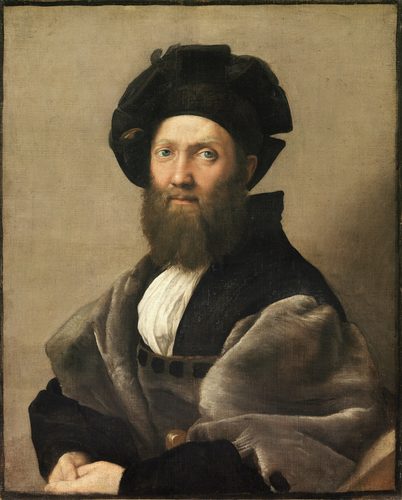
| Portrait of Baldassare Castiglione | c. 1514–1515 | A restrained, psychologically warm portrait of the diplomat and author of The Book of the Courtier. |
| Galatea | c. 1512 | A fresco of the sea nymph Galatea, praised for its graceful, idealized movement and mythological ease. |
| The Marriage of the Virgin | 1504 | An early Umbrian-period altarpiece showing Raphael's inherited harmony from Perugino before his Roman transformation. |
 AI-generated
Create in the same spirit
Make High Renaissance art of your own
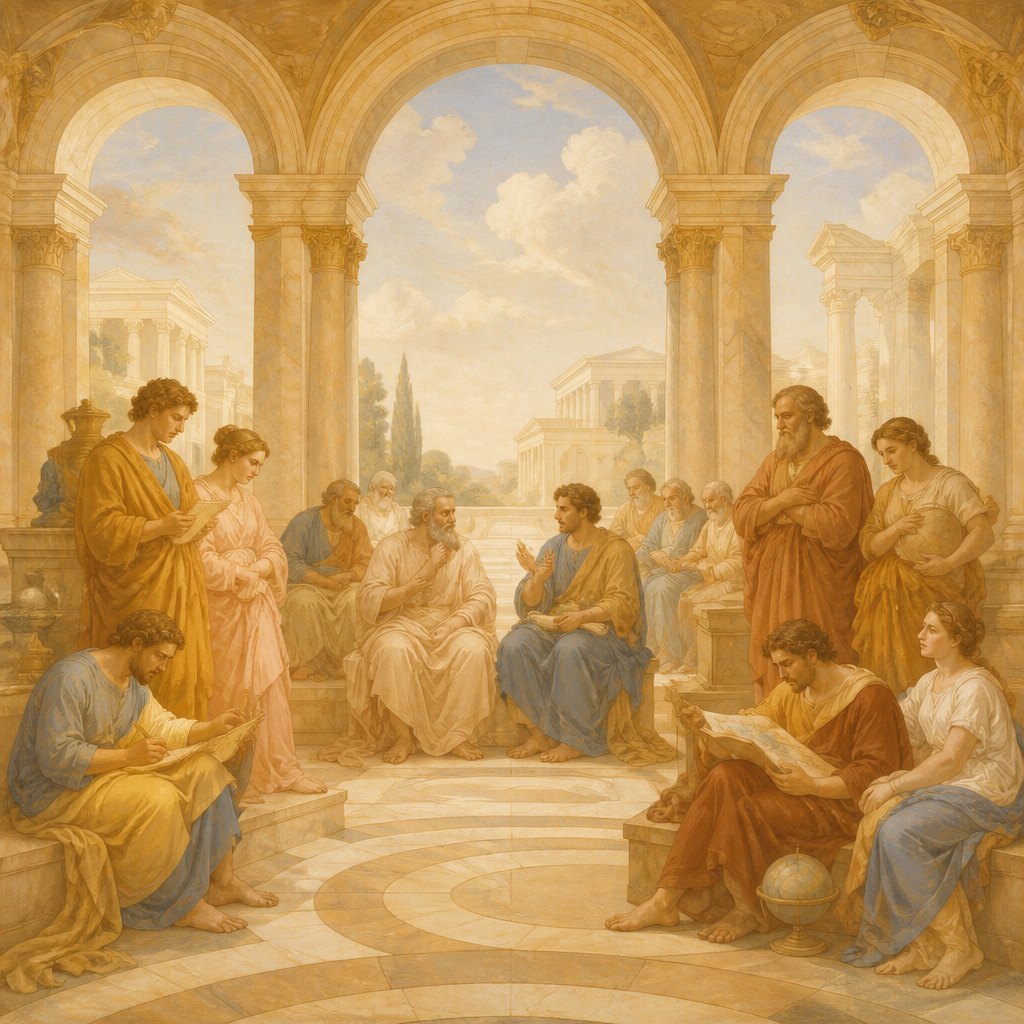
This AI interpretation echoes the aesthetic world Raphael worked in — it depicts no real artwork. Generate your own with the Renaissance Art Style generator.
Open the Renaissance Art Style generator →Legacy
Raphael's balanced, legible style became the default definition of "classical" painting for European academies for the next three centuries, taught as the standard against which later art was measured. His workshop trained a generation of assistants, including Giulio Romano, who carried his methods into Mannerism and beyond. Painters from Poussin to the eighteenth-century academic tradition looked to his compositions as models of clarity and grace. His Madonna paintings shaped devotional imagery well beyond Italy, and The School of Athens remains one of the most reproduced images of intellectual life ever painted. Even critics who prized raw originality over polish still measured themselves against his sense of order.
Frequently asked questions
What is Raphael famous for?
Raphael is famous for The School of Athens and other Vatican frescoes, along with numerous serene Madonna paintings admired for their balance, clarity, and graceful composition.
Where can you see Raphael's paintings?
The School of Athens and other major frescoes remain in the Vatican Museums in Rome. Further works are held in the Uffizi in Florence, the Louvre, and the National Gallery in London.
How many works did Raphael complete?
Raphael completed dozens of paintings personally and oversaw many more produced by his large workshop, since his short thirty-seven-year life relied heavily on skilled assistants to meet demand.
What art movement was Raphael part of?
Raphael was one of the three central masters of the Italian High Renaissance, alongside Leonardo da Vinci and Michelangelo, and his style became its most widely imitated model.