 Famous
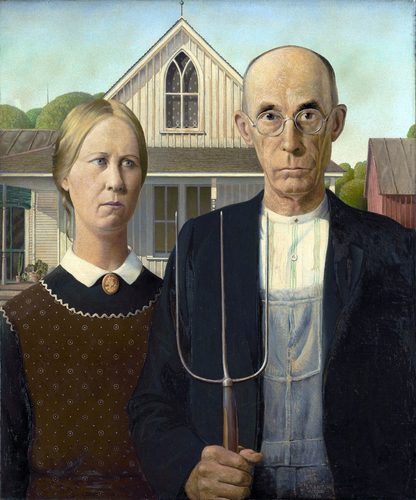
Grant Wood (1891–1942) was an American painter from Iowa best known for American Gothic, one of the most recognized images in American art, and for leading the Regionalist movement that turned away from European modernism toward stylized scenes of Midwestern rural life.
Raised on a farm and later in Cedar Rapids, he trained in local art schools and worked for years as a decorative craftsman and teacher before a 1928 trip to Munich, where studying Northern Renaissance painting sharpened his sense of precise, linear detail. Returning to Iowa, he combined that crisp technique with distinctly American subjects: farmhouses, plowed fields, and small-town figures rendered with smooth, sculptural clarity.
American Gothic, painted in 1930, brought him sudden national fame and controversy, with some Iowans reading it as mockery of rural life rather than tribute. Wood insisted it was an admiring, if wry, portrait of Midwestern character. He went on to paint Iowa's rolling farmland as stylized, patterned landscapes and taught painting at the University of Iowa.
He died of pancreatic cancer in 1942, a day before his fifty-first birthday.
How to recognize a Wood
Smooth, sculptural surfaces
He painted with a hard-edged, polished finish, modeling faces, fabric, and land in smooth, rounded forms almost like carved relief, a precision he developed studying Northern Renaissance painting in Germany.
Stylized, patterned farmland
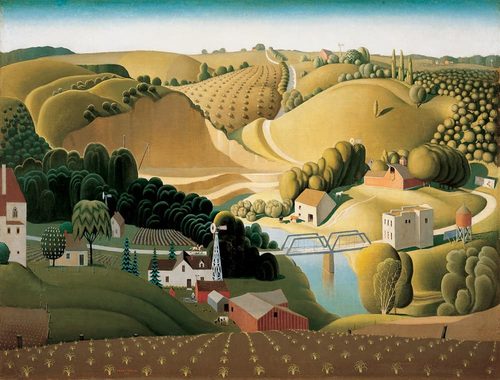
His landscapes flatten Iowa's rolling fields into rhythmic, quilt-like patterns of green and gold, treating plowed rows and rounded hills as decorative shapes rather than realistic topography seen from a passing car.
Stern, upright rural figures
His figures stand rigid and composed, often frontal and unsmiling, giving ordinary farmers and small-town residents a dignified, almost monumental solemnity usually reserved for formal portraiture of the wealthy or powerful.
Precise, linear detail
He rendered architectural and decorative details — Gothic windows, pitchforks, lace collars — with crisp, exact linework, giving his paintings a sharpness closer to illustration than to loose, painterly oil technique typical of the period.
Muted, earthy Midwest color
He favored soft greens, ochres, and browns drawn from farmland and small-town buildings, avoiding the brighter palettes of contemporaries in favor of a settled, native color range rooted in the Iowa landscape itself.
Wry, ambiguous tone
Beneath the careful realism sits a dry, sometimes satirical humor about small-town propriety and rural pride, leaving many of his best-known images open to reading as either tribute or gentle mockery.
The life
Grant Wood was born in 1891 on a farm near Anamosa, Iowa, and moved with his family to Cedar Rapids after his father's death. He studied at local art schools and in Minneapolis, then spent years working as a metalworker, teacher, and interior decorator while painting in a loose Impressionist style on the side.
Several trips to Europe in the 1920s, including study in Munich in 1928, exposed him to Northern Renaissance painting, whose precise detail and clarity reshaped his technique. Returning to Iowa, he abandoned his earlier looser style for the crisp, stylized realism that became his signature, applying it to distinctly American subjects rather than European ones.
In 1930 he painted American Gothic, depicting a farmer and his daughter in front of a Carpenter Gothic house; it won a prize at the Art Institute of Chicago and made him instantly, sometimes uncomfortably, famous. He became a leading voice of American Regionalism, alongside painters like Thomas Hart Benton, and taught painting at the University of Iowa from 1934 onward.
Wood died of pancreatic cancer in Iowa City in 1942, one day short of his fifty-first birthday.
Timeline
- 1891Born near Anamosa, Iowa
- 1910Studies art in Minneapolis
- 1916Moves to Cedar Rapids to work as a craftsman and teacher
- 1928Studies Northern Renaissance painting in Munich
- 1930Paints American Gothic
- 1932Helps found the Stone City Art Colony
- 1934Begins teaching at the University of Iowa
- 1942Dies in Iowa City
Most famous works
| Work | Date | Why it matters |
|---|---|---|
| American Gothic | 1930 | A farmer and his daughter standing before a Carpenter Gothic farmhouse, now one of the most reproduced and parodied images in American art. |
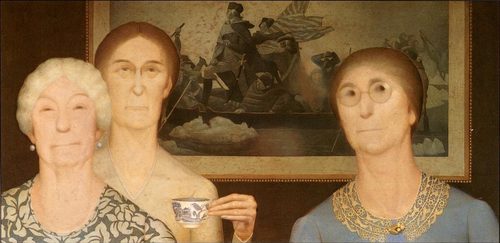
| Daughters of Revolution | 1932 | A satirical portrait of three society women, showing Wood's dry, critical side alongside his more affectionate rural scenes. |
| Young Corn | 1931 | A stylized, rolling Iowa landscape of patterned cornfields that became a template for his decorative treatment of farmland. |
| Parson Weems' Fable | 1939 | A theatrical, knowingly staged retelling of the cherry tree legend about George Washington, showing his playful late interest in American myth-making. |
| Stone City, Iowa | 1930 | A patterned, near-abstract patchwork of farms and hills painted the same year as American Gothic, showing his mature landscape style. |
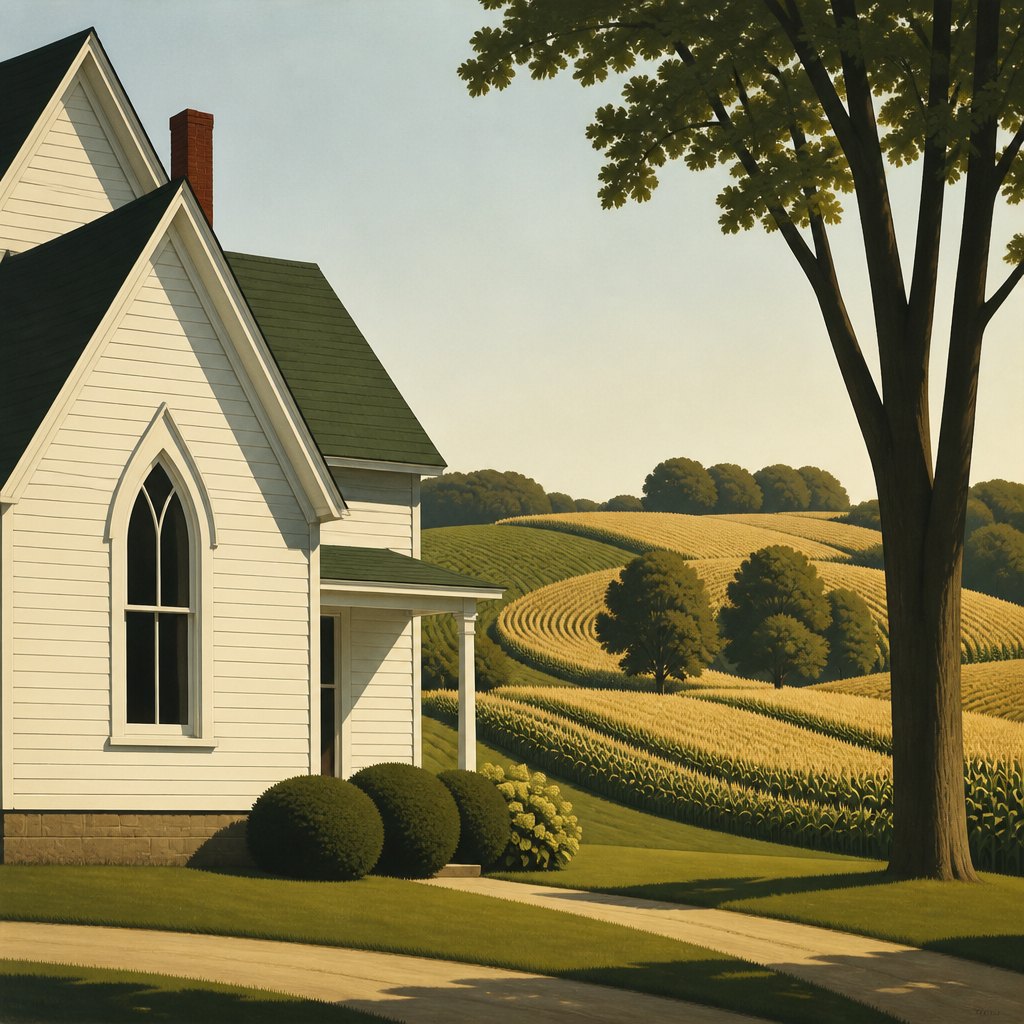 AI-generated
Create in the same spirit
Make American Regionalism art of your own
This AI interpretation echoes the aesthetic world Grant Wood worked in — it depicts no real artwork. Generate your own with the American Regionalism Art Style generator.
Open the American Regionalism Art Style generator →Legacy
Wood became the public face of American Regionalism, a Depression-era movement that argued American artists should paint American subjects rather than follow European modernism, and American Gothic remains one of the most referenced and parodied images in the country's visual culture. His precise, stylized approach to landscape influenced how the Midwest was pictured in American art for decades, and his teaching at the University of Iowa helped train a following generation of regional painters. Critics later debated whether his work was earnest tribute or quiet satire of small-town America, a tension that keeps his paintings, especially American Gothic, open to fresh interpretation nearly a century later.
Frequently asked questions
What is Grant Wood famous for?
He is famous for American Gothic, his 1930 painting of a farmer and his daughter before a farmhouse, and for leading the American Regionalist movement of the 1930s.
Where can you see Grant Wood's paintings?
American Gothic hangs at the Art Institute of Chicago; other major works are held at the Cedar Rapids Museum of Art and the Figge Art Museum in Davenport, Iowa.
Is American Gothic a real house?
Yes. The Carpenter Gothic house in the painting still stands in Eldon, Iowa; the two figures were modeled by Wood's sister and his dentist, not an actual married couple.
What art movement was Grant Wood part of?
He was a leading figure of American Regionalism, a 1930s movement that favored realistic, stylized depictions of American rural and small-town life over European modernist styles.