 Famous
Pierre-Auguste Renoir (1841–1919) was a French painter who made pleasure his lifelong subject, filling Impressionism's scenes with dancers, picnickers, and children caught in warm, dappled light. Born in Limoges to a tailor's family, he began his working life as a porcelain painter, hand-decorating china with delicate floral patterns before training formally in Paris, where he met Claude Monet, Alfred Sisley, and Frédéric Bazille in Charles Gleyre's studio.
Renoir exhibited with the Impressionists through the 1870s, producing crowd scenes like Bal du moulin de la Galette that captured Parisian leisure with unmatched warmth. A trip to Italy in 1881 unsettled his confidence in loose brushwork, and for several years he pursued a tighter, more classical style influenced by Renaissance painting and Ingres, before softening again into the fuller, rosier figures of his later career.
Severe rheumatoid arthritis crippled his hands from the 1890s onward, yet he kept painting almost daily, moving to the warmer south of France and producing luminous late nudes and landscapes until his death in Cagnes-sur-Mer in 1919.
How to recognize a Renoir
Dappled, sun-flecked light
Renoir loved crowds gathered under trees or striped awnings, breaking sunlight into small patches of color that scatter across faces, fabric, and grass so a whole outdoor scene shimmers with movement, warmth, and life.
Warm, rosy flesh tones
Skin in his figures glows with pink, gold, and soft red undertones rather than realistic gray shading, giving even ordinary sitters a healthy, sun-warmed radiance that flatters rather than strictly records what he saw.
Crowded social scenes
Dance halls, riverside cafés, and garden parties fill his canvases with overlapping figures caught mid-conversation or mid-motion, capturing the sociable, festive side of Parisian leisure that made his reputation as a painter of happiness.
Soft, blended brushwork
Especially in his later work, edges melt softly into one another; forms feel touched and caressed rather than drawn, built from layered, buttery strokes instead of crisp, hard outlines or sharp contour lines.
Children and family life
Mothers, daughters, and playing children recur throughout his long career, rendered with unguarded tenderness rather than stiff, formal posing, especially in his later decades after he started a family of his own.
Late, fuller nudes
In his final two decades his female figures grow rounder and more monumental, painted in hot oranges and pinks that push well past naturalistic color into something closer to pure sensation and warmth.
The life
Pierre-Auguste Renoir was born in Limoges in 1841 and moved with his family to Paris as a child. At thirteen he apprenticed as a porcelain painter, decorating china with flowers, a trade that trained his hand in delicate, fluid brushwork before he ever entered a formal studio. He later studied under Charles Gleyre in Paris, where he became close friends with Claude Monet, Alfred Sisley, and Frédéric Bazille, and the group began painting outdoors together.
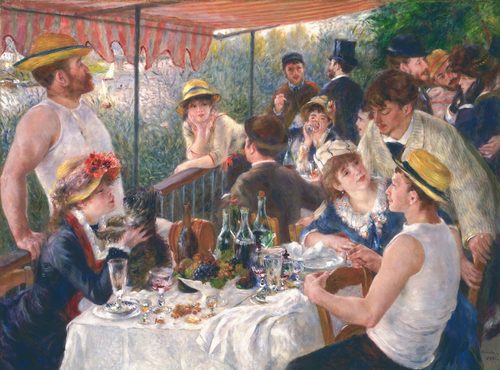
Through the 1870s Renoir became one of the Impressionists' most celebrated figure painters, exhibiting works like Bal du moulin de la Galette and Luncheon of the Boating Party that turned Parisian leisure into crowded, joyful set pieces. A journey to Italy in 1881 exposed him to Raphael and ancient frescoes, and he grew dissatisfied with Impressionist looseness, entering a more linear, classically influenced phase through the mid-1880s.
By the 1890s his style had softened again into fuller, warmer figures, even as rheumatoid arthritis began crippling his hands and joints. He relocated to the milder climate of the south of France and, despite worsening disability, continued painting almost every day, producing celebrated late nudes and landscapes until his death in Cagnes-sur-Mer in 1919.
Timeline
- 1841Born in Limoges
- 1854Apprenticed as a porcelain painter in Paris
- 1862Enters Charles Gleyre's studio, meets Monet
- 1874Exhibits in the first Impressionist show
- 1876Paints Bal du moulin de la Galette
- 1881Travels to Italy; style shifts toward classicism
- 1890Marries Aline Charigot
- 1892Rheumatoid arthritis begins affecting his hands
- 1919Dies in Cagnes-sur-Mer
Most famous works
| Work | Date | Why it matters |
|---|---|---|
| Bal du moulin de la Galette | 1876 | A crowded, sunlit dance-hall scene that remains Impressionism's most joyful group portrait of Parisian leisure. |
| Luncheon of the Boating Party | 1881 | A riverside gathering of friends and lovers, packed with warmth, gesture, and shimmering afternoon light. |
| Dance at Bougival | 1883 | A close, swirling portrait of a dancing couple that captures motion and flirtation in a single glance. |
| Two Sisters (On the Terrace) | 1881 | A tender, brightly colored double portrait painted during his renewed focus on the human figure. |
| Girl with a Watering Can | 1876 | A luminous portrait of a child in a garden, prized for its warmth and gentle detail. |
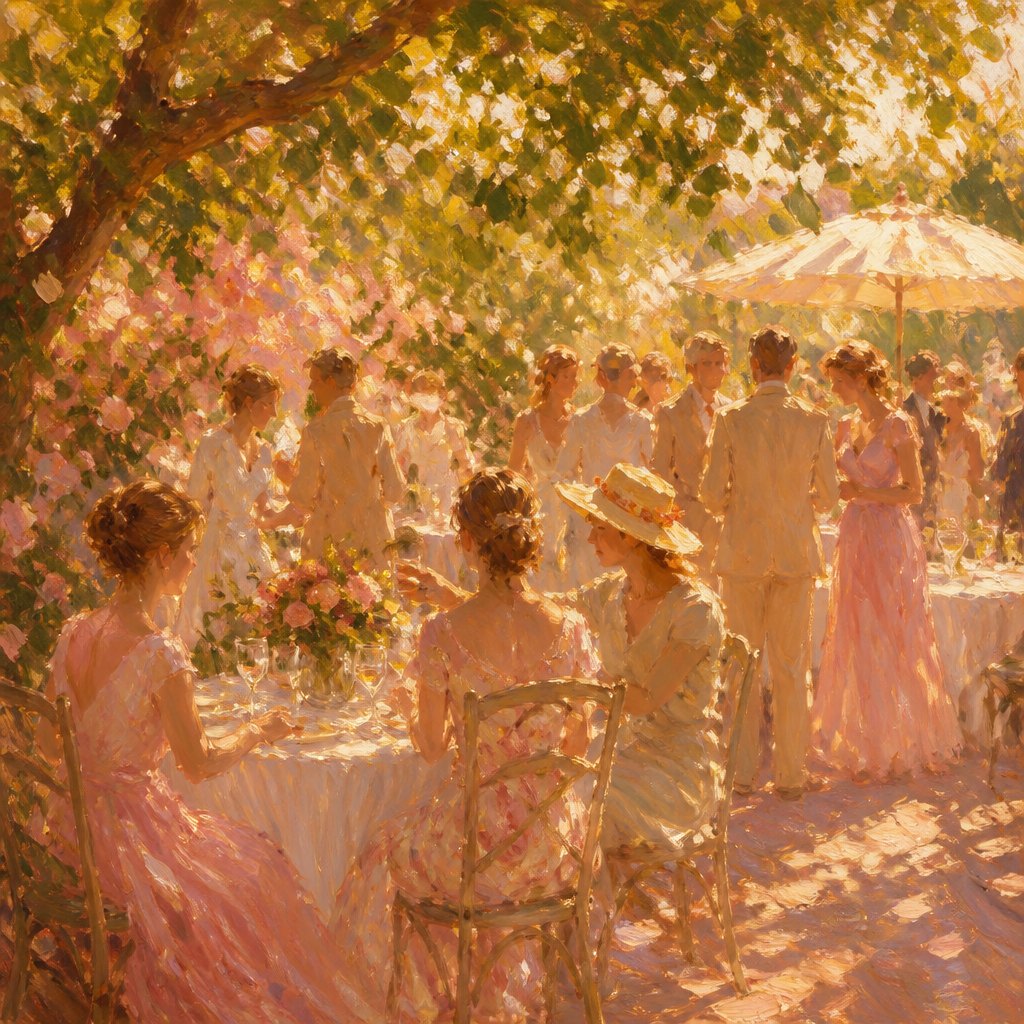 AI-generated
Create in the same spirit
Make Impressionism art of your own
This AI interpretation echoes the aesthetic world Pierre-Auguste Renoir worked in — it depicts no real artwork. Generate your own with the Impressionism Art Style generator.
Open the Impressionism Art Style generator →Legacy
Renoir proved that Impressionism could be a painting of people, not only landscape, and his warm, sociable scenes shaped how the movement is remembered in popular imagination. Later figurative painters inherited his interest in flesh rendered as light rather than anatomy, and his rosy, sensuous late nudes fed directly into early twentieth-century modernism. His son, the filmmaker Jean Renoir, carried a related sensibility for warmth and human detail into cinema. Wherever a painting tries to make a crowded, ordinary afternoon feel like happiness itself, Renoir's example is close behind it.
Frequently asked questions
What is Pierre-Auguste Renoir famous for?
Renoir is famous for warm, joyful Impressionist paintings of Parisian leisure, especially crowd scenes like Bal du moulin de la Galette and Luncheon of the Boating Party, and for his sensuous late nudes.
Where can I see Renoir's paintings?
His work hangs at the Musée d'Orsay in Paris, the Phillips Collection and National Gallery of Art in Washington, the Art Institute of Chicago, and the Metropolitan Museum of Art in New York.
What art movement was Renoir part of?
Renoir was a founding member of Impressionism, exhibiting with Monet, Sisley, Degas, and Morisot in several of the group's independent Paris shows before later developing his own more classical figure style.
Did arthritis stop Renoir from painting?
Severe rheumatoid arthritis crippled his hands from the 1890s onward, but he kept painting almost daily with the help of assistants, producing major work until shortly before his death in 1919.