 Famous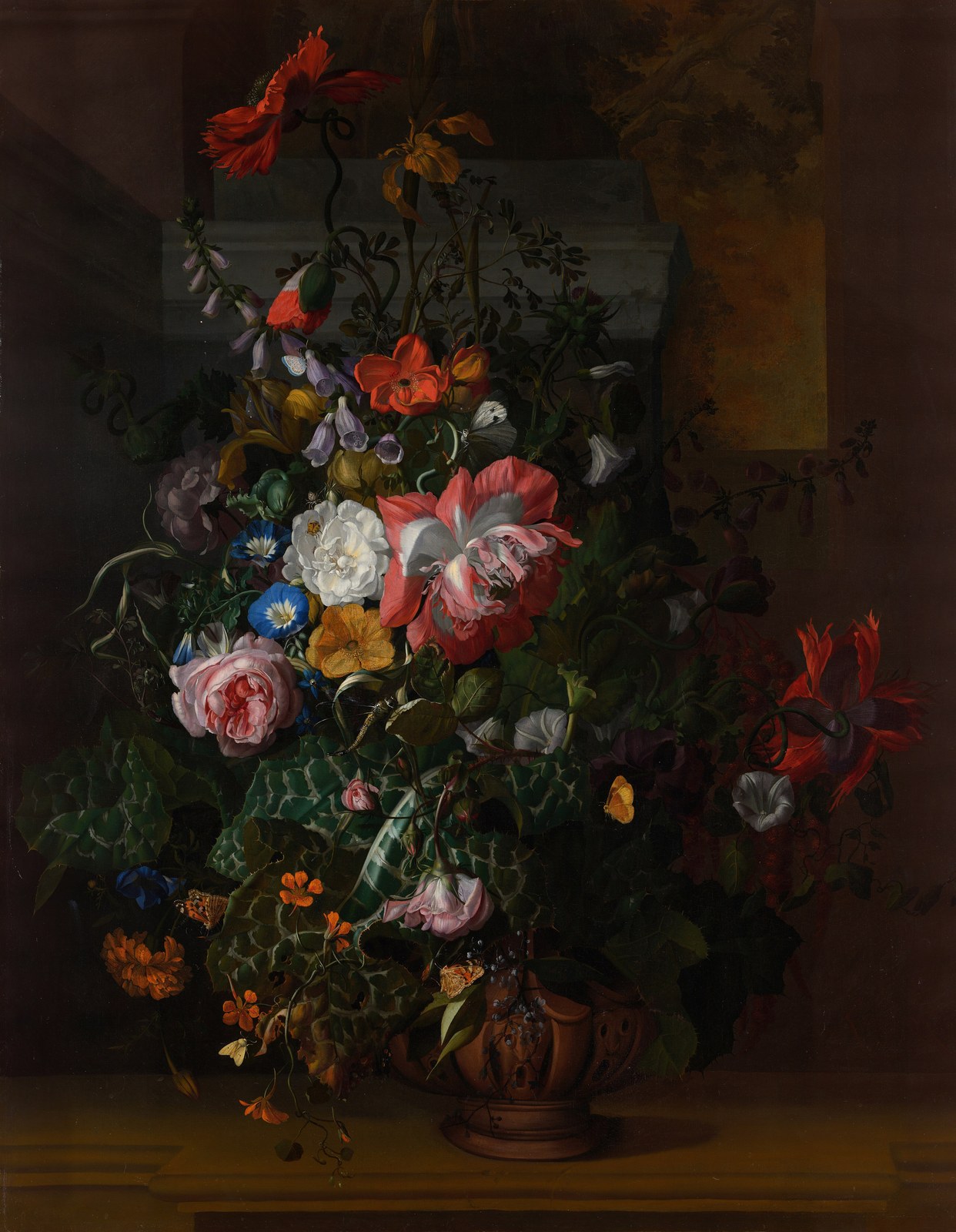
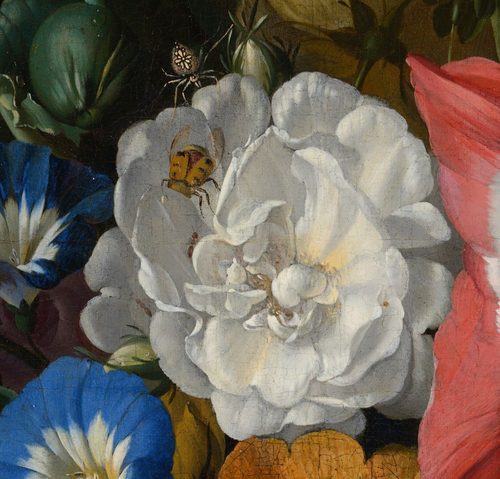
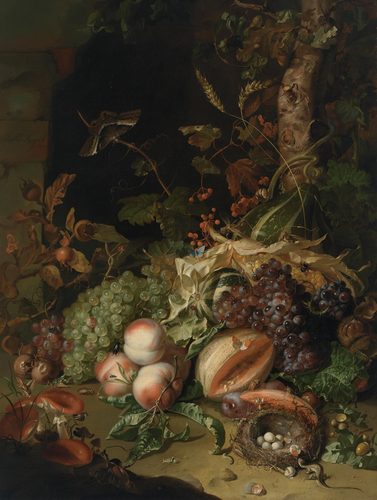
Rachel Ruysch (1664–1750) was a Dutch still-life painter whose flower bouquets, built on decades of botanical study, rank among the most technically accomplished paintings of the Dutch Golden Age's later years.
She grew up in Amsterdam surrounded by science: her father, the anatomist and botanist Frederik Ruysch, kept a celebrated cabinet of specimens that she drew from as a girl, and she apprenticed under the flower painter Willem van Aelst. That grounding shows in every canvas — species rendered with a precision few contemporaries matched, insects and dewdrops given the same close attention as the blooms.
Ruysch worked for more than six decades, an unusually long and steady career for any painter of her era. From 1708 she served as court painter to the Elector Palatine in Düsseldorf, one of very few women to hold such a position. She married the portrait painter Juriaen Pool, raised ten children, and continued to paint and sell work at prices among the highest commanded by any artist in the Dutch Republic.
She kept painting into her eighties, her late bouquets as exacting as her first.
How to recognize a Ruysch
Botanically exact species
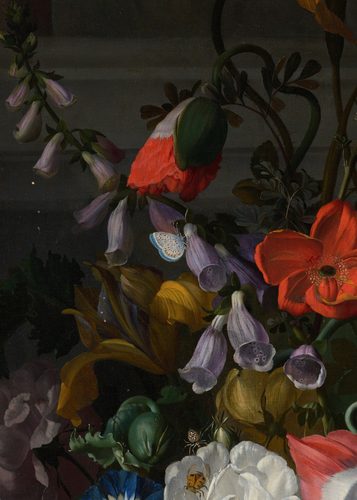
Ruysch trained on real specimens, and it shows: petals, leaves, and insects are drawn with a naturalist's accuracy, not a decorator's shorthand. Tulips, roses, and peonies keep their true structure even inside dense, swirling bouquets.
Dark, velvety backgrounds
Her bouquets typically emerge from near-black or deep brown backgrounds, a debt to earlier Dutch still-life painting that makes every petal and vein read with heightened clarity, almost lit from within.
Insects as co-stars
Butterflies, beetles, snails, and caterpillars appear throughout her canvases, not as filler but as small dramas of their own — a moth balanced on a leaf edge, an ant crossing a stem.
Asymmetrical, spiraling arrangements
Rather than stacking blooms in a pyramid, Ruysch let stems curve and cross in loose diagonal spirals, giving her bouquets a sense of motion and freshly gathered disorder rather than staged symmetry.
Mixed-season bouquets
Her flowers often could never have bloomed together in nature — spring tulips beside summer roses — since she worked from studies made across the year and combined them for painterly effect.
Luminous, controlled color
Ruysch balanced saturated reds and pinks against cool greens and near-black shadow, keeping her palette rich but never gaudy — a restraint that lets a single white bloom command the whole canvas.
The life
Rachel Ruysch was born in The Hague in 1664, the daughter of Frederik Ruysch, a prominent anatomist whose collection of botanical and biological specimens gave her early, close access to plant structure most painters never had. She apprenticed with the still-life painter Willem van Aelst in Amsterdam and by her teens was already producing accomplished flower pieces.
By her twenties she had built a reputation across the Dutch Republic and beyond. In 1701 she was admitted to the painters' confraternity in The Hague, a rare honor for a woman. Her marriage in 1693 to the portrait painter Juriaen Pool did not slow her output; the couple raised ten children while both continued to work as professional artists.
In 1708 the Elector Palatine Johann Wilhelm appointed Ruysch court painter in Düsseldorf, a post that brought steady patronage and international prestige. Even after the Elector's death in 1716 and her return to Amsterdam, her paintings continued to command some of the highest prices of any artist working in the Netherlands, male or female.
She continued painting into her final years, producing dated works past age eighty. She died in Amsterdam in 1750, having worked at a high level for roughly seven decades.
Timeline
- 1664Born in The Hague, daughter of anatomist Frederik Ruysch
- 1679Begins apprenticeship with flower painter Willem van Aelst
- 1693Marries portrait painter Juriaen Pool
- 1701Elected to The Hague's Confrerie Pictura painters' society
- 1708Appointed court painter to the Elector Palatine in Düsseldorf
- 1716Elector's death prompts her return to Amsterdam
- 1750Dies in Amsterdam after roughly seven decades painting
Most famous works
| Work | Date | Why it matters |
|---|---|---|
| Fruit and Insects | 1711 | Commissioned for Grand Duke Cosimo III de' Medici's Uffizi gallery, pairing ripe fruit with insects rendered in exacting detail. |
| Still Life with Flowers on a Marble Tabletop | 1716 | A mature bouquet built on a diagonal spiral against a dark ground, now in the Rijksmuseum in Amsterdam. |
| Roses, Convolvulus, and Poppies in a Vase | c. 1680s–90s | An early flower piece already showing the botanical exactness instilled by her father's specimen cabinet. |
| Flower Still Life with a Bird's Nest | c. 1700s | Typical of her mature work: abundant blooms with a small hidden narrative detail tucked among the stems. |
| Vase of Flowers | 1740s | A late-career painting showing her control of detail undiminished into her seventies and beyond. |
 AI-generated
Create in the same spirit
Make Dutch Golden Age art of your own
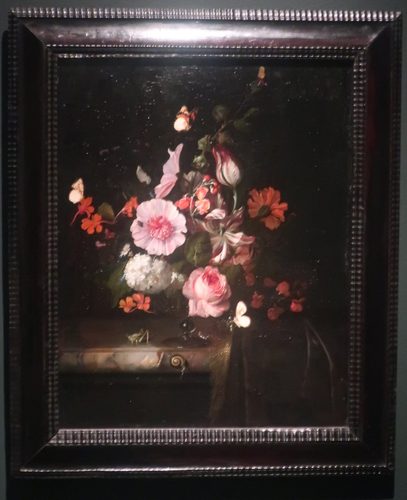
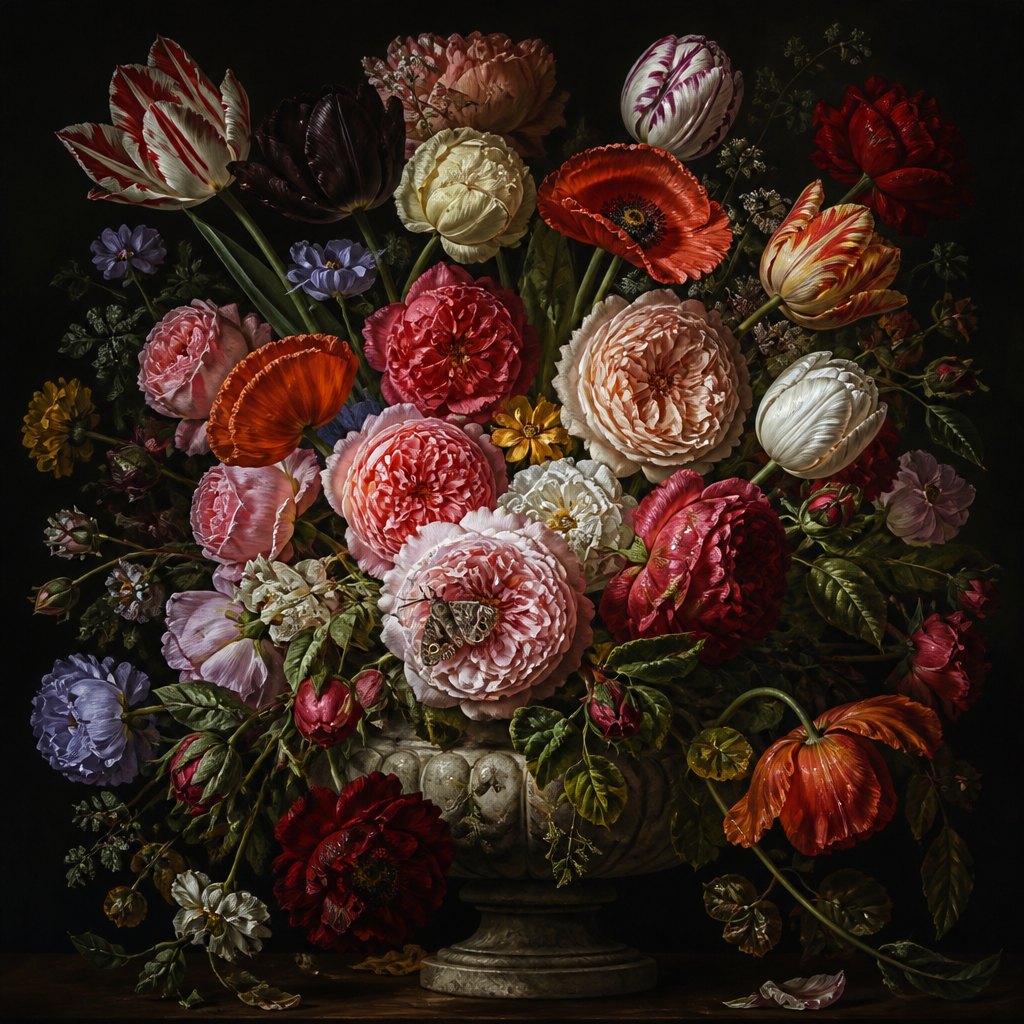
This AI interpretation echoes the aesthetic world Rachel Ruysch worked in — it depicts no real artwork. Generate your own with the Dutch Golden Age Still Life Art Style generator.
Open the Dutch Golden Age Still Life Art Style generator →Legacy
Rachel Ruysch's flower paintings set a standard of botanical accuracy that later still-life painters, and eventually scientific illustrators, measured themselves against. She proved that a woman could sustain a major, decades-long painting career, hold a princely court appointment, and still be counted among the highest-paid artists of her time — a combination almost no contemporary matched.
Her work remains a touchstone for anyone interested in Dutch flower painting's late, most technically refined phase: it is often the example curators reach for when explaining how far the genre could be pushed past simple decoration. Museums across Europe and the United States hold her canvases, and her bouquets still reward close, patient looking.
Frequently asked questions
What is Rachel Ruysch famous for?
Rachel Ruysch is famous for meticulously detailed flower still lifes that combine scientific botanical accuracy with dynamic, spiraling compositions. Trained on her anatomist father's specimen collection, she became one of the most sought-after and highly paid painters of the Dutch Golden Age's later generation.
Where can I see Rachel Ruysch's paintings?
Her work hangs in major museums including the Uffizi Gallery in Florence, the Rijksmuseum in Amsterdam, the Alte Pinakothek in Munich, and the Toledo Museum of Art, among other European and American collections of Dutch and Flemish painting.
What movement did Rachel Ruysch belong to?
Ruysch worked within the Dutch Golden Age tradition of still-life painting, specifically the flower-piece genre pioneered by earlier masters like her teacher Willem van Aelst. Her career extended that tradition into the early eighteenth century, well past its usual peak.
How long did Rachel Ruysch paint for?
Ruysch had an unusually long working life, producing dated paintings from her teenage years into her eighties — a professional career spanning roughly seven decades, one of the longest and most consistent of any Dutch Golden Age painter.