 Famous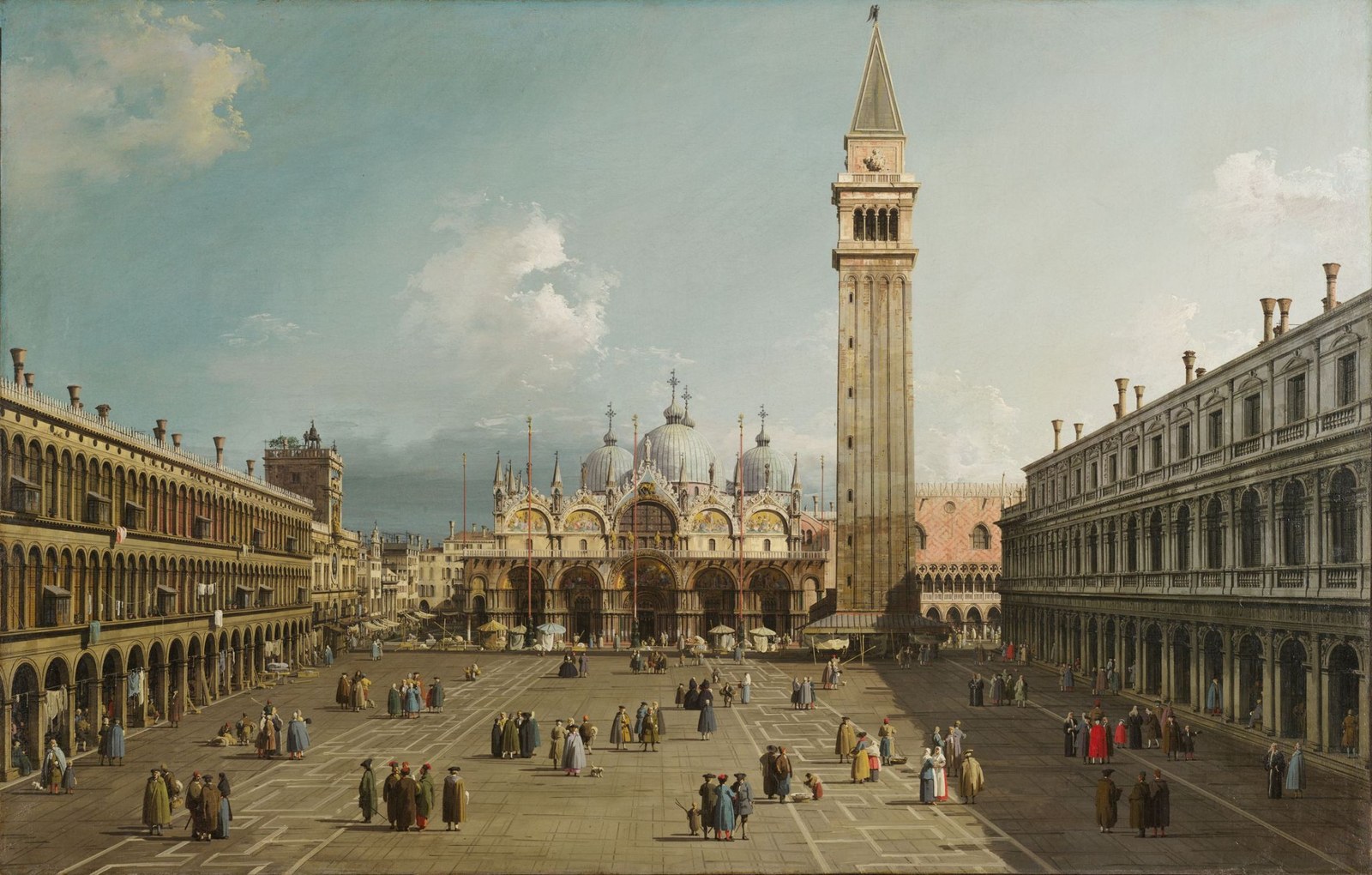
Canaletto (1697–1768), born Giovanni Antonio Canal in Venice, became the era's foremost painter of the city's canals, festivals, and skyline, turning topographical accuracy into a Grand Tour souvenir industry unmatched before or since.
He began as a theatrical scene painter alongside his father, Bernardo Canal, and worked briefly in Rome around 1720, where exposure to view painters sharpened his interest in architectural perspective. Back in Venice, he shifted to the vedute — meticulously observed cityscapes — that would define his career, often using a camera obscura to fix perspective before working the scene up with lively, freely brushed figures.
His fortunes rose alongside Joseph Smith, the British consul in Venice, who became his principal dealer and channeled a steady stream of English Grand Tour buyers to his studio; Smith's own collection was later bought by King George III. Between 1746 and the mid-1750s, Canaletto worked mainly in England, painting London and its patrons' country estates.
He returned to Venice, was finally admitted to the city's Academy in 1763, and continued painting until his death in 1768, having produced a body of work that remains one of the most complete visual records of eighteenth-century Venice.
How to recognize a Canaletto
Precise architectural perspective
Canaletto rendered facades, colonnades, and canal-side buildings with near-drafting accuracy, often aided by a camera obscura, so that his views work almost as topographic documents of the city.
Crisp Venetian light
His skies are typically high, pale, and clear, with sharp shadows raking across stone and water that give even crowded scenes a bright, legible clarity.
Lively incidental figures
Gondoliers, merchants, and strolling nobility populate his canvases in small, quick brushstrokes — a lively human bustle set against the stillness of stone and water.
Silvery water reflections
Canal water is built from short, broken horizontal strokes that catch light and mirror the buildings above, animating what could otherwise be static architectural views.
Grand Canal vantage points
He favored elevated or slightly distant viewpoints along the Grand Canal and Bacino di San Marco, framing the city's great set pieces the way a stage designer frames a scene.
Festival-day crowds
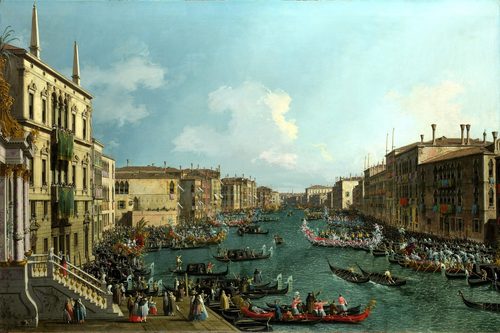
Regattas, religious processions, and ceremonial gatherings recur throughout his work, letting him paint Venice not just as architecture but as a city that performed for its own pleasure.
The life
Giovanni Antonio Canal was born in Venice in 1697, the son of the theatrical scene painter Bernardo Canal, alongside whom he trained and worked on stage sets for opera productions in his early career. Around 1719–20 he traveled to Rome, where the city's view painters and its ancient architecture pushed his interest toward precise, observed perspective rather than theatrical invention.
Back in Venice by the early 1720s, he turned decisively to painting the city itself — its canals, piazzas, and festivals — for a market increasingly filled with wealthy foreign visitors on the Grand Tour. His relationship with Joseph Smith, the British consul in Venice, proved decisive: Smith acted as his agent, supplying a steady English clientele and eventually selling his own large Canaletto holdings to King George III.
As the War of the Austrian Succession disrupted Grand Tour travel, Canaletto followed his market to England, working there for most of the period between 1746 and 1755, painting views of London and English country houses. Some patrons reportedly doubted paintings of this quality could still be his own hand, prompting him to paint demonstration pieces to prove his skill.
He returned permanently to Venice, was elected to the city's Academy in 1763, and continued working until his death in 1768.
Timeline
- 1697Born in Venice, son of theatrical scene painter Bernardo Canal
- 1719Travels to Rome, encounters view painting and ancient ruins
- 1725Paints The Stonemason's Yard, an early Venetian masterpiece
- 1746Travels to England, working mainly in London for years
- 1755Returns to Venice after his extended English period
- 1763Elected to the Venetian Academy
- 1768Dies in Venice
Most famous works
| Work | Date | Why it matters |
|---|---|---|
| The Stonemason's Yard | c. 1725 | An unusually intimate, informal view of a Venetian campo under repair, now in London's National Gallery. |
| The Basin of San Marco on Ascension Day | c. 1730s | A grand festival view crowded with ceremonial barges, showcasing his skill at large, populated set pieces. |
| Venice: The Upper Reaches of the Grand Canal with S. Simeone Piccolo | c. 1740 | A luminous, architecturally precise canal view prized for its clarity and calm composition. |
| Old Walton Bridge | 1754 | Painted during his English years, applying his Venetian eye for structure and light to the River Thames. |
| Piazza San Marco | various | He painted the square repeatedly across his career, each version a study in crowd, light, and architecture. |
 AI-generated
Create in the same spirit
Make Rococo art of your own
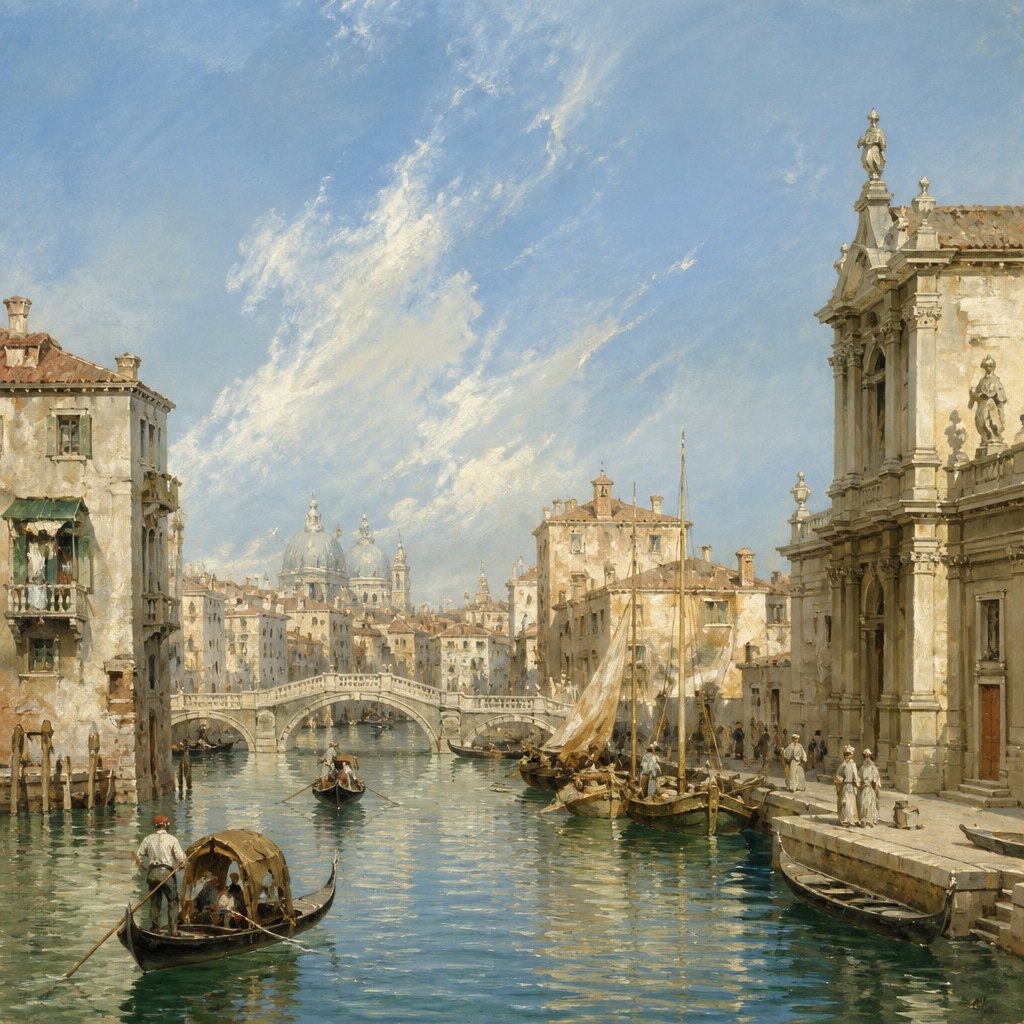
This AI interpretation echoes the aesthetic world Canaletto worked in — it depicts no real artwork. Generate your own with the Rococo Art Style generator.
Open the Rococo Art Style generator →Legacy
Canaletto essentially invented the market for the topographical city view as fine art, and his example shaped an entire genre — vedutismo — that included his own nephew and pupil, Bernardo Bellotto, who carried a version of the style across Northern Europe. His paintings became the eighteenth century's most desirable travel souvenir, and thanks to Joseph Smith's collection, later purchased by the British crown, the Royal Collection today holds more Canalettos than any institution in the world.
Beyond the market he built, his views remain historically valuable: architectural historians still consult his canvases to understand buildings altered or lost since the eighteenth century. He set a standard for combining documentary precision with real visual pleasure that view painters after him rarely matched.
Frequently asked questions
What is Canaletto famous for?
Canaletto is famous for meticulously detailed paintings of Venice — its canals, palazzos, and festivals — rendered with near-topographic accuracy. His views became the era's most sought-after souvenirs for British aristocrats visiting Venice on the Grand Tour.
Where can I see Canaletto's paintings?
The Royal Collection in the United Kingdom holds the largest group, assembled by his patron Joseph Smith. Major examples also hang in London's National Gallery, the Metropolitan Museum in New York, and museums in Venice, Milan, and Washington, D.C.
How many Canaletto paintings survive?
Several hundred paintings are attributed to Canaletto, alongside numerous drawings and etchings, though the exact number is debated because his workshop, followers, and his nephew Bernardo Bellotto produced closely related work that scholars continue to sort out.
What art movement did Canaletto belong to?
Canaletto worked within vedutismo, the eighteenth-century Italian tradition of precise, detailed city-view painting, closely tied to the rococo era and the rise of the Grand Tour, which created demand for accurate pictorial souvenirs of famous places.