 Famous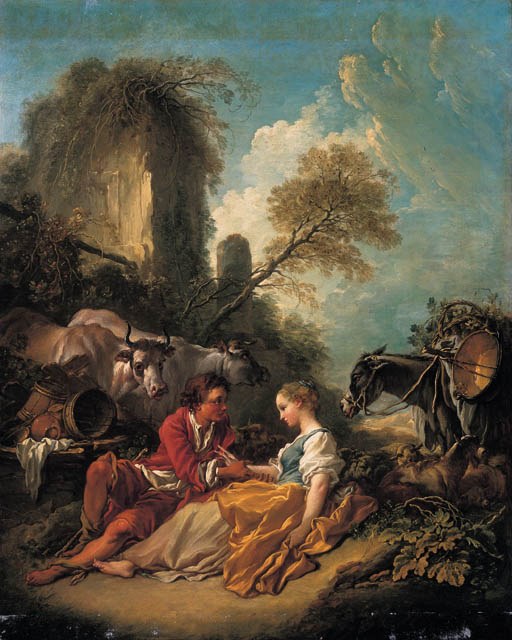

François Boucher (1703–1770) was the leading decorative painter of Louis XV's court, whose mythological scenes, pastoral fantasies, and portraits defined French rococo taste at its most polished and pleasure-seeking.
Born in Paris, the son of a minor designer, Boucher trained briefly under François Lemoyne and won the Prix de Rome in 1723, which took him to Italy from 1728 to 1731. There he studied earlier Italian masters and encountered the light, airy decorative painting of Giovanni Battista Tiepolo, an influence visible in his later ceiling and mythological work.
Back in Paris, Boucher rose quickly through royal patronage, becoming closely associated with Madame de Pompadour, Louis XV's influential chief mistress, who commissioned numerous portraits and championed his career at court. He worked across an unusually wide range of media — oil painting, tapestry design for the Gobelins and Beauvais manufactories, porcelain design for Sèvres, and set and costume design for the opera.
He was appointed director of the Gobelins manufactory, then director of the Académie Royale, and finally First Painter to the King in 1765. Later critics, notably Denis Diderot, attacked his work as artificial and frivolous, but Boucher's technical fluency and decorative imagination made him rococo's defining figure until his death in Paris in 1770.
How to recognize a Boucher
Pink-and-blue color scheme
Boucher built compositions around a signature palette of rose pinks, powder blues, and cream, giving his mythological and pastoral scenes a light, confectionery brightness.
Mythological love scenes
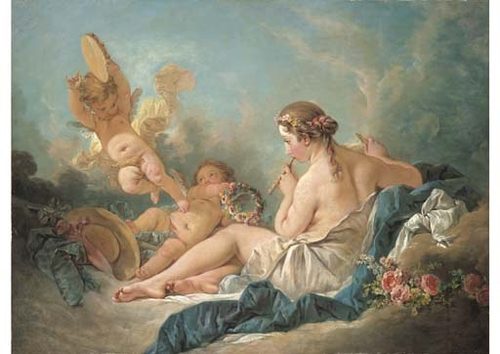
Venus, nymphs, and attendant figures recur constantly, staged in soft clouds or leafy groves, treating classical mythology as an occasion for decorative charm rather than solemn narrative.
Pastoral shepherdesses
Idealized shepherds and shepherdesses in ribbon-trimmed silk, tending impossibly clean sheep amid flowering landscapes, turned rural labor into aristocratic daydream.
Swirling, asymmetrical composition
Figures, drapery, and clouds curve and cascade in loose diagonal rhythms rather than static balance, giving even calm scenes a sense of gentle, ongoing motion.
Porcelain-smooth flesh tones
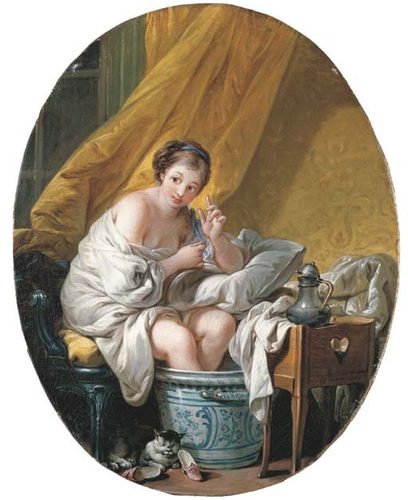
Skin is rendered soft, pale, and evenly lit, with almost no harsh shadow, an idealized smoothness that matched contemporary taste in porcelain and portraiture alike.
Elaborate decorative surfaces
Silk, lace, garlands, and gilt ornament fill his compositions edge to edge, reflecting his parallel career designing tapestries, porcelain, and stage sets for the court.
The life
François Boucher was born in Paris in 1703, the son of a designer of embroidery patterns who gave him his first training. He studied briefly under the history painter François Lemoyne and worked as an engraver reproducing Antoine Watteau's drawings, absorbing the older master's decorative elegance at close range.
Winning the Prix de Rome in 1723 secured him a period of study in Italy from 1728 to 1731, where he examined Renaissance and Baroque masters and, notably, the light-filled decorative ceilings of Giovanni Battista Tiepolo, whose influence would surface later in his own large-scale work.
Back in Paris, Boucher's career accelerated through royal and aristocratic patronage. His association with Madame de Pompadour, the King's influential companion, proved especially important; she sat for numerous portraits and supported his advancement at court and within the Académie. Boucher worked prolifically across media, supplying designs to the Gobelins and Beauvais tapestry workshops and the Sèvres porcelain manufactory alongside his painting.
He rose through the Académie's ranks to become its director, and in 1765 was named First Painter to the King, the highest official post available to a French artist. Even as critics like Diderot began attacking his work as shallow, Boucher continued working prolifically until his death in Paris in 1770.
Timeline
- 1703Born in Paris, son of an embroidery designer
- 1723Wins the Prix de Rome
- 1728Travels to Italy for further study, staying until 1731
- 1734Elected to the Académie Royale with Rinaldo and Armida
- 1755Appointed director of the Gobelins tapestry manufactory
- 1765Named First Painter to the King
- 1770Dies in Paris
Most famous works
| Work | Date | Why it matters |
|---|---|---|
| Rinaldo and Armida | 1734 | His Académie reception piece, a mythological love scene that announced his mature decorative style. |
| The Triumph of Venus | 1740 | A luminous mythological composition showing the influence of Tiepolo's light-filled Italian ceilings. |
| Diana Resting after Her Bath | 1742 | A mythological scene admired for its silvery light and delicate handling of fabric and landscape. |
| Madame de Pompadour | 1756 | An iconic portrait of his most important patron, surrounded by books and the trappings of cultivated taste. |
| The Toilet of Venus | 1751 | A showcase of his decorative mythological style, commissioned for a private royal residence. |
 AI-generated
Create in the same spirit
Make Rococo art of your own
This AI interpretation echoes the aesthetic world François Boucher worked in — it depicts no real artwork. Generate your own with the Rococo Art Style generator.
Open the Rococo Art Style generator →Legacy
Boucher's decorative fluency shaped an entire generation of French art and design, from painting into tapestry, porcelain, and theater. His most direct pupil, Jean-Honoré Fragonard, carried rococo pleasure-seeking to its final, most virtuosic phase before the style collapsed under neoclassical reaction.
That reaction was swift and harsh: by the 1760s, critics like Diderot were already treating Boucher as a symbol of aristocratic frivolity, and the following generation largely rejected him. His reputation recovered in the nineteenth century, when collectors and later art historians came to value his technical brilliance and decorative imagination on their own terms, and his mythological scenes remain among the era's most recognizable images.
Frequently asked questions
What is François Boucher famous for?
Boucher is famous for mythological and pastoral paintings in a light pink-and-blue palette, along with portraits of Madame de Pompadour, Louis XV's influential companion and his most important patron. He became First Painter to the King in 1765.
Where can I see Boucher's paintings?
His work hangs in the Louvre in Paris, the Wallace Collection in London, the Metropolitan Museum in New York, the Alte Pinakothek in Munich, and the Nationalmuseum in Stockholm, among other major collections of French eighteenth-century art.
What art movement did Boucher belong to?
Boucher was rococo's leading French exponent, the movement's official painter under Louis XV. His decorative, pleasure-focused style epitomized rococo taste before neoclassicism swept it aside in the later eighteenth century.
Who was Boucher's most important patron?
Madame de Pompadour, Louis XV's chief companion and a powerful cultural tastemaker, was Boucher's most important patron. She commissioned numerous portraits from him and helped advance his career at court and within the French Académie Royale.