 Famous

Piet Mondrian (1872–1944) was a Dutch painter who progressively stripped his art of everything but horizontal and vertical black lines and flat blocks of red, yellow, blue, white, and gray, arriving at one of the most instantly recognizable styles in modern art and a defining language of geometric abstraction.
Mondrian began as a conventional landscape painter working in Dutch naturalist and Impressionist styles before encountering Cubism in Paris around 1912, which pushed him to break subjects into fragmented, near-abstract planes. Returning to the Netherlands during World War I, he co-founded the De Stijl movement and journal with Theo van Doesburg, developing 'Neoplasticism': a strict visual language limited to primary colors, black, white, and right-angled lines, meant to express universal harmony beyond individual objects.
From the 1920s, working mainly in Paris, Mondrian refined this grid-based style across hundreds of canvases, adjusting line weight and color placement with meticulous care. Fleeing wartime Europe, he moved to London and then New York in 1940, where the city's energy inspired looser, more syncopated late works before his death in 1944.
How to recognize a Mondrian
Black grid framework
Mondrian built his mature paintings from thick, ruler-straight black lines running only horizontally and vertically, dividing the canvas into an asymmetrical grid whose proportions never repeat a single module exactly, however simple it looks.
Primary color blocks
Only red, yellow, and blue appear as solid fills within the grid, each block flat and unmodulated, balanced against white and gray fields so no single color dominates the composition's overall harmony.
Asymmetrical balance
Mondrian avoided symmetry entirely, weighting one side of a canvas with a dense color block against an open expanse of white elsewhere, achieving equilibrium through careful proportion rather than mirrored repetition.
No curves, no diagonals
Every line in his mature work meets at a right angle; curves, diagonals, and modeled form disappear entirely, a self-imposed restriction Mondrian believed revealed a more universal order beneath surface appearances.
Evolution from nature to grid
Earlier tree and dune paintings show Mondrian flattening natural forms into intersecting lines step by step, a visible bridge between his naturalist training and the pure grid abstraction he eventually reached.
Syncopated late rhythm
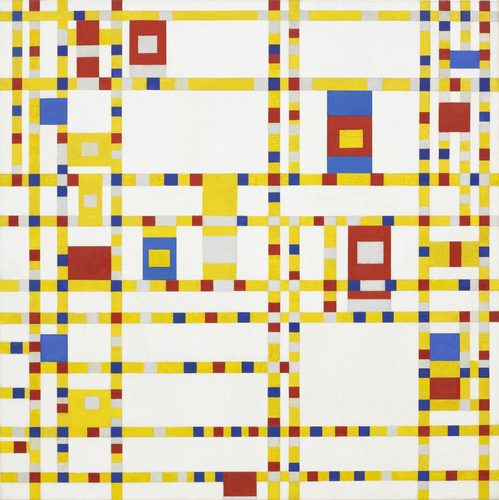
In his final New York paintings, Mondrian replaced solid black lines with small colored squares set along the grid, giving the compositions a flickering, rhythmic pulse inspired by the city and jazz.
The life
Piet Mondrian was born in Amersfoort, the Netherlands, in 1872 and trained at the Rijksakademie in Amsterdam, initially painting realistic Dutch landscapes, windmills, and church facades in a traditional style. His early work shifted through Impressionist and Symbolist influences before a 1911 move to Paris exposed him directly to Cubism, which he began adapting toward increasingly fragmented, near-abstract compositions.
World War I stranded Mondrian in the Netherlands, where he co-founded the De Stijl group and magazine with Theo van Doesburg in 1917. There he formulated Neoplasticism, a theory calling for painting reduced to horizontal and vertical black lines and flat planes of primary color, which he believed expressed a universal harmony beyond individual objects or emotions.
Mondrian spent much of the 1920s and 1930s in Paris, refining this grid-based style across a long, patient series of canvases. Rising fascism forced him to London in 1938 and then to New York in 1940, where the city's grid streets and jazz rhythms energized a looser, more syncopated late style, seen in 'Broadway Boogie Woogie.' He died in New York in 1944, having spent decades distilling painting down to its barest, most balanced elements.
Timeline
- 1872Born in Amersfoort, the Netherlands
- 1892Enrolls at the Rijksakademie in Amsterdam
- 1911Moves to Paris and encounters Cubism
- 1917Co-founds the De Stijl movement and journal
- 1920Publishes his Neoplasticism manifesto
- 1938Relocates to London as war approaches
- 1940Emigrates to New York City
- 1944Dies in New York, leaving 'Victory Boogie Woogie' unfinished
Most famous works
| Work | Date | Why it matters |
|---|---|---|
| Composition with Red, Blue and Yellow | 1930 | A defining example of his mature grid style, with bold primary blocks set against black lines and white space. |
| Broadway Boogie Woogie | 1942-43 | A late New York work replacing solid black lines with vibrating colored squares evoking city grids and jazz rhythm. |
| Gray Tree | 1911 | A transitional Cubist-influenced painting showing a tree dissolving into intersecting gray lines and planes. |
| Tableau I | 1921 | An early fully Neoplastic composition establishing his signature black-grid, primary-color vocabulary. |
| Victory Boogie Woogie | 1942-44 | His unfinished final painting, a diamond-format canvas left incomplete at his death. |
 AI-generated
Create in the same spirit
Make de Stijl art of your own
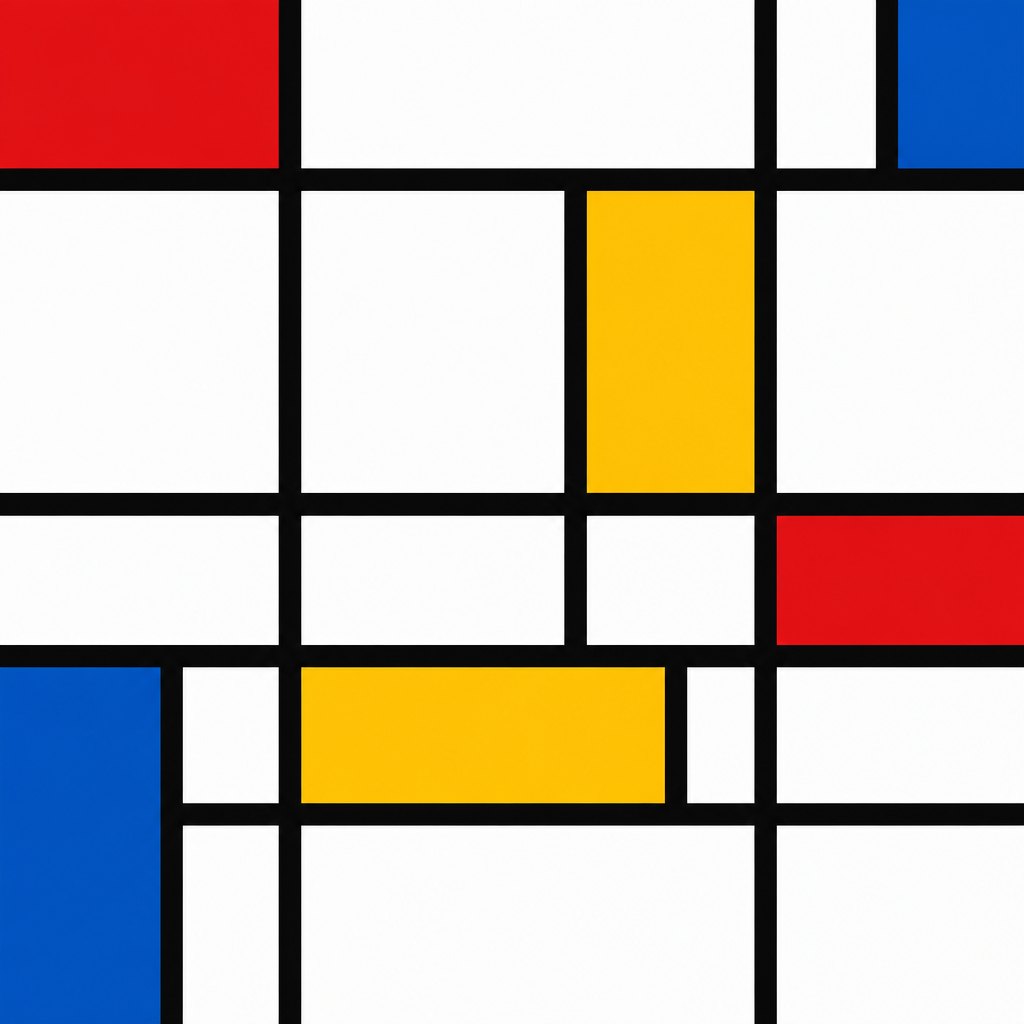
This AI interpretation echoes the aesthetic world Piet Mondrian worked in — it depicts no real artwork. Generate your own with the De Stijl Art Style generator.
Open the De Stijl Art Style generator →Legacy
Mondrian's reduction of painting to grid, line, and primary color became one of the most widely borrowed visual languages of the twentieth century, echoed in architecture, furniture, fashion, and graphic design far beyond fine art. De Stijl's ideas fed directly into the Bauhaus and international modernist design, shaping how architects and designers thought about proportion and abstraction in everyday objects. Yves Saint Laurent's 1965 'Mondrian' dresses and countless later homages show how completely his grid entered popular visual culture, a rare case of an austere, theory-driven abstraction becoming genuinely, widely beloved rather than merely respected.
Frequently asked questions
What is Piet Mondrian famous for?
Mondrian is famous for reducing painting to black grid lines and flat blocks of red, yellow, and blue, a style called Neoplasticism that became one of modern art's most recognizable visual languages.
Where can you see Piet Mondrian's paintings?
The Museum of Modern Art in New York, the Kunstmuseum Den Haag, and Tate in London all hold major collections of his work.
What is Neoplasticism?
Neoplasticism was Mondrian's theory that painting should be reduced to horizontal and vertical lines and the primary colors plus black, white, and gray, expressing a universal harmony beyond individual objects or emotion.
What art movement is Piet Mondrian associated with?
Mondrian co-founded De Stijl and developed Neoplasticism within it; his work is considered a foundational pillar of geometric abstraction in twentieth-century art.