 Famous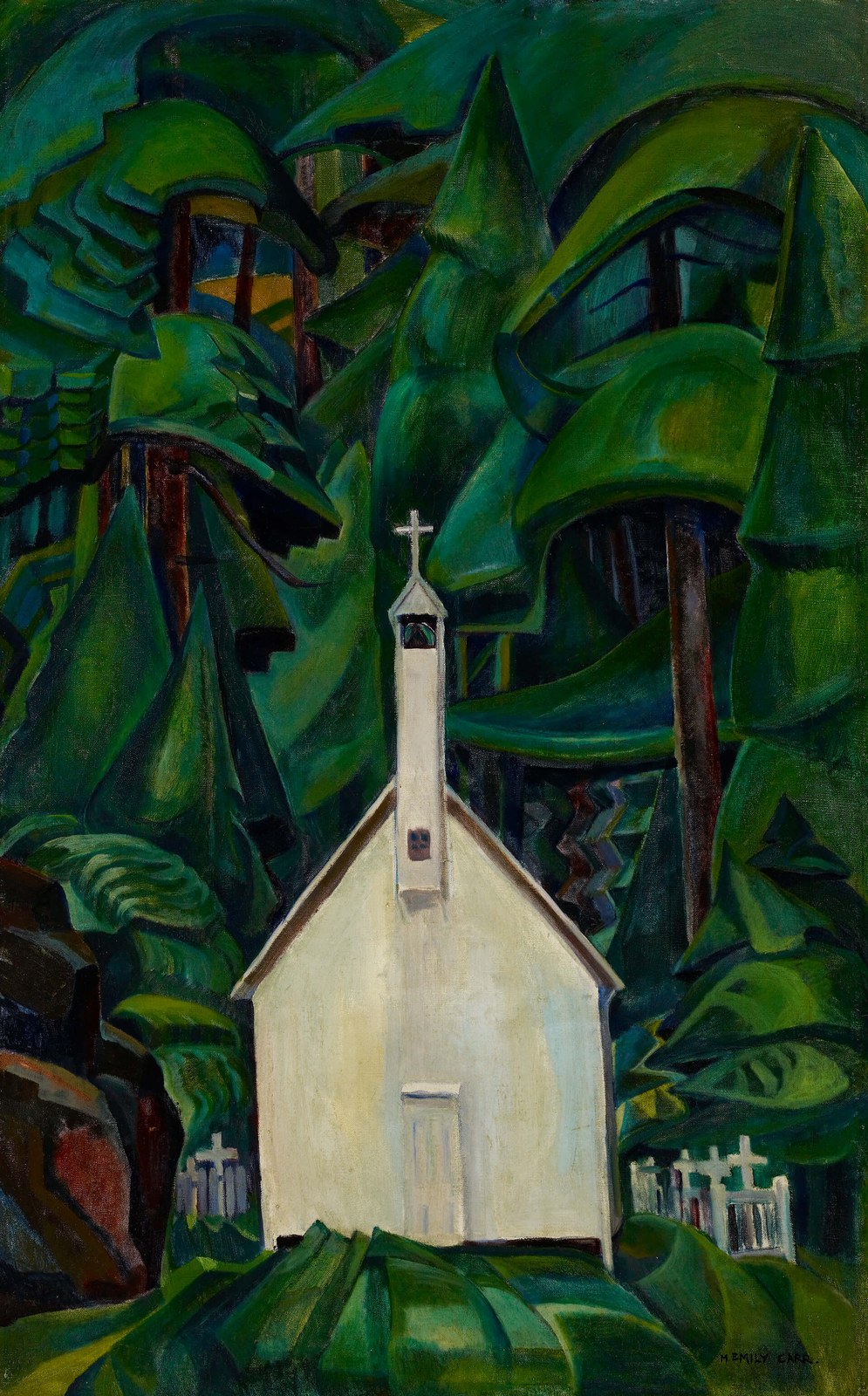
Emily Carr (1871–1945) was a Canadian painter and writer who became the first major artist to capture the rainforests and Indigenous villages of British Columbia's coast, developing a swirling, rhythmic style that made her a key figure in Canadian modernism.
Trained in San Francisco, London, and briefly in Paris, she absorbed Post-Impressionist and Fauvist color before returning home, where for years she found little support and largely stopped painting, running a boarding house in Victoria to survive. A pivotal 1927 exhibition connected her with the Group of Seven, whose painter Lawren Harris became a lasting influence and encouraged her return to serious work.
From the late 1920s onward she painted the totem poles, longhouses, and old-growth forests of coastal British Columbia with increasing abstraction, using rhythmic, spiraling brushwork to suggest movement and presence in the trees themselves. She also wrote acclaimed memoirs of her travels and life as an artist.
Ill health slowed her painting in her final years, though she kept writing. She died in Victoria in 1945, having reshaped how Canadians saw their own western landscape.
How to recognize a Carr
Swirling, rhythmic brushwork
She painted trees and skies in sweeping, spiral strokes that suggest movement and living energy, turning static forest scenes into charged, almost animate compositions rather than still, documentary views of the coastal landscape.
Deep forest greens and browns
Her mature palette leans into dense, saturated greens, browns, and blue-greys, evoking the wet, shadowed interior of old-growth coastal rainforest rather than sunlit, picturesque nature scenes typical of earlier Canadian landscape painting.
Totem poles and Indigenous villages
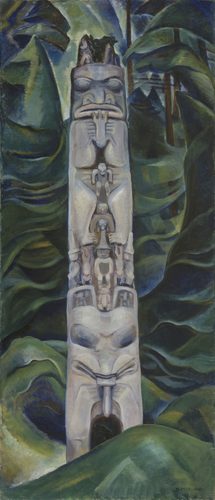
Her early and middle career work documented totem poles and longhouses of coastal First Nations communities, painted with respect for their scale and presence rather than as picturesque backdrop for a settler landscape.
Simplified, monumental tree trunks
She rendered individual trees as massive, simplified vertical forms filling the canvas, giving even a single trunk the weight and presence of a monument or standing figure in the surrounding forest.
Radiating, layered skies
Her skies often swirl outward in concentric bands of light and cloud, suggesting an animating force moving through both forest and sky rather than a fixed, naturalistic atmosphere above the trees.
Oil-on-paper thinned washes
In her later, prolific years she often used oil paint thinned with gasoline on manila paper, letting her work faster and looser to keep pace with her swirling, expressive vision.
The life
Emily Carr was born in 1871 in Victoria, British Columbia, and studied art in San Francisco, then in London, and later in France, where she encountered Post-Impressionist and Fauvist color that reshaped her palette. She returned to Victoria determined to paint the Indigenous villages and totem poles of the British Columbia coast, traveling to remote communities to record what she saw as a rapidly changing way of life.
For years her ambitious, modern style found little audience, and financially she ran a boarding house, largely setting painting aside. A turning point came in 1927, when the National Gallery of Canada included her work in an exhibition that connected her with the Group of Seven; painter Lawren Harris became a close correspondent and pushed her toward bolder abstraction.
Reenergized, she spent the late 1920s and 1930s painting the coastal rainforest with increasing intensity, developing the swirling, rhythmic style now most associated with her name. She also became a respected writer, publishing memoirs of her travels and artistic life, including Klee Wyck, which won the Governor General's Award.
Heart trouble limited her painting in her last years. She died in Victoria in 1945.
Timeline
- 1871Born in Victoria, British Columbia
- 1890Begins art studies in San Francisco
- 1899First travels to paint Indigenous coastal villages
- 1910Studies in Paris, absorbs Post-Impressionist color
- 1927Exhibits with the Group of Seven in Ottawa
- 1937Suffers a serious heart attack
- 1941Publishes the memoir Klee Wyck
- 1945Dies in Victoria
Most famous works
| Work | Date | Why it matters |
|---|---|---|
| Big Raven | 1931 | A monumental totem raven set against swirling sky and forest, showing her mature fusion of Indigenous subject and expressive abstraction. |
| Forest, British Columbia | 1932 | A dense, rhythmic tangle of tree trunks and light that exemplifies her swirling, charged forest style. |
| Indian Church | 1929 | A simplified white church rising among dark coastal forest, one of her most reproduced and widely recognized images. |
| Scorned as Timber, Beloved of the Sky | 1935 | A lone surviving tree trunk in a clear-cut landscape, an early, striking image of environmental loss. |
| Totem Walk at Sitka | c. 1907 | An early documentary-style watercolor recording totem poles, part of her long project of painting Indigenous coastal villages. |
 AI-generated
Create in the same spirit
Make Post Impressionism art of your own
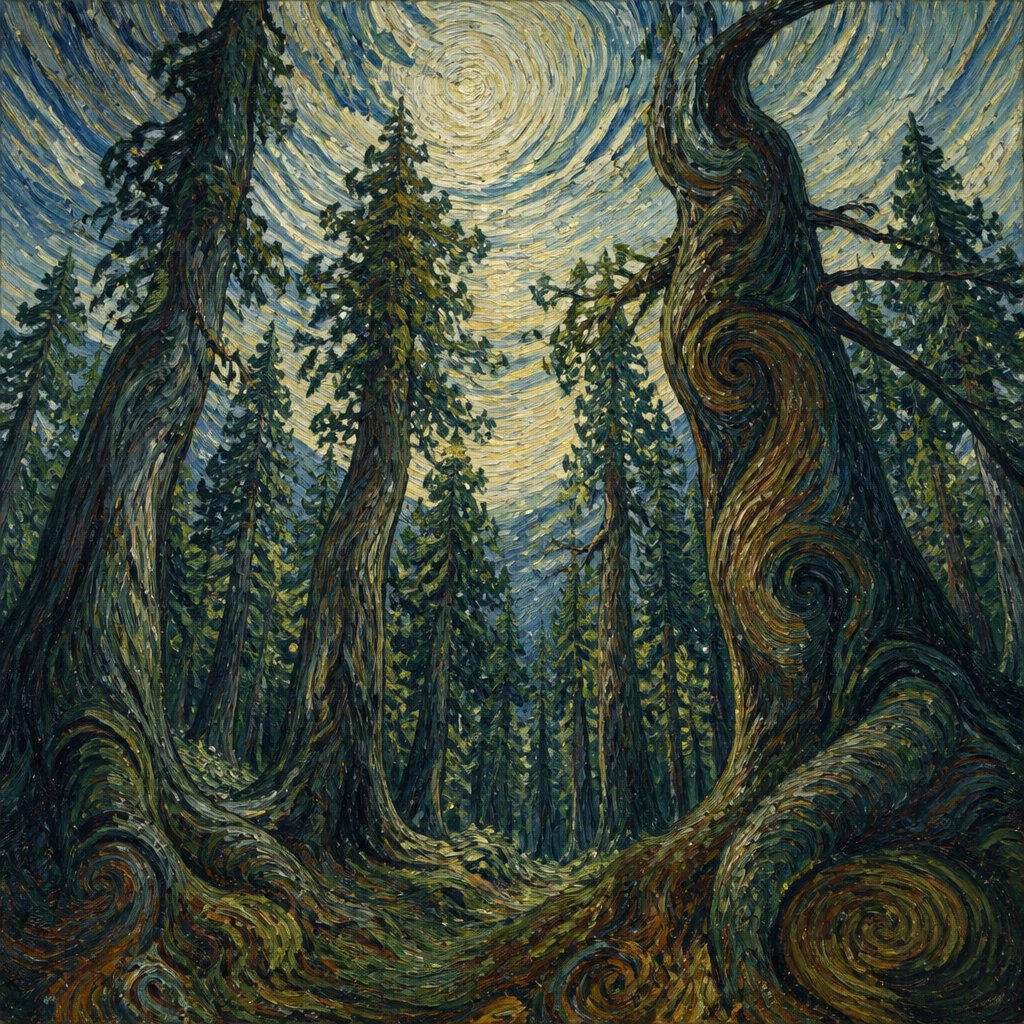
This AI interpretation echoes the aesthetic world Emily Carr worked in — it depicts no real artwork. Generate your own with the Post-Impressionism Art Style generator.
Open the Post-Impressionism Art Style generator →Legacy
Carr is now considered the first major artist to translate the British Columbia coast — its forests, weather, and Indigenous architecture — into a modern visual language, opening a path later followed by generations of Canadian landscape painters. Her friendship with the Group of Seven linked west coast painting to the national modernist project centered in Toronto, while her own late, spiraling style remains distinct from theirs. She is also remembered as a skilled writer, and Klee Wyck remains a standard text on early twentieth-century Indigenous-settler encounters on the coast. Vancouver's Emily Carr University of Art and Design carries her name, and her paintings anchor major Canadian museum collections.
Frequently asked questions
What is Emily Carr famous for?
She is known for swirling, expressive paintings of British Columbia's coastal rainforest and Indigenous totem poles and villages, and for helping shape twentieth-century Canadian landscape painting.
Where can you see Emily Carr's paintings?
The Vancouver Art Gallery holds the largest collection of her work, with additional major holdings at the National Gallery of Canada in Ottawa and the Royal BC Museum in Victoria.
Was Emily Carr connected to the Group of Seven?
Yes. A 1927 National Gallery exhibition introduced her to the group, and painter Lawren Harris became a close friend and influence, though Carr developed a distinct, more swirling style of her own.
What art movement was Emily Carr part of?
She is generally classified as a Post-Impressionist, having absorbed French Post-Impressionist and Fauvist color in Paris before applying it to Canadian west coast subjects.