 Famous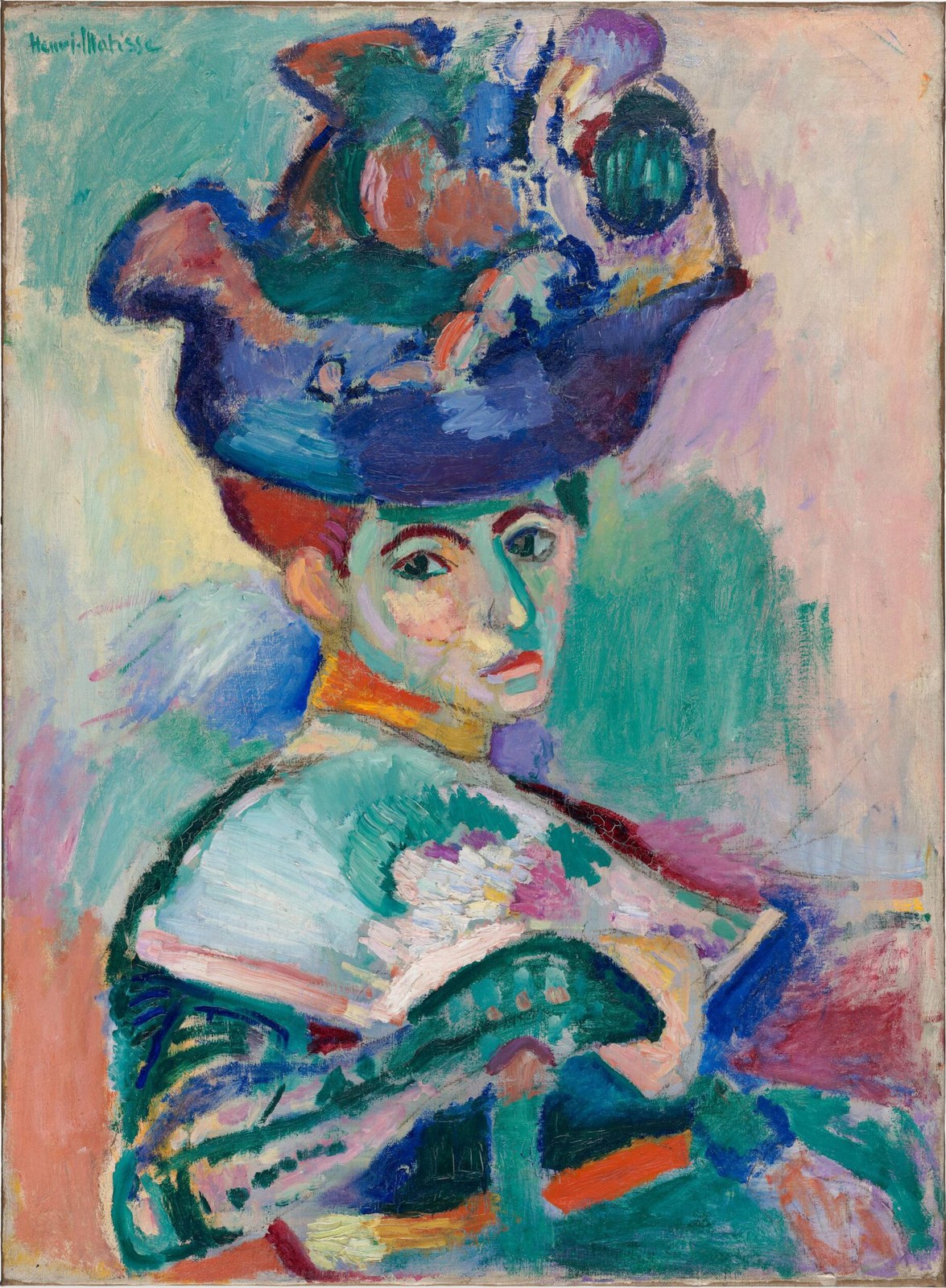
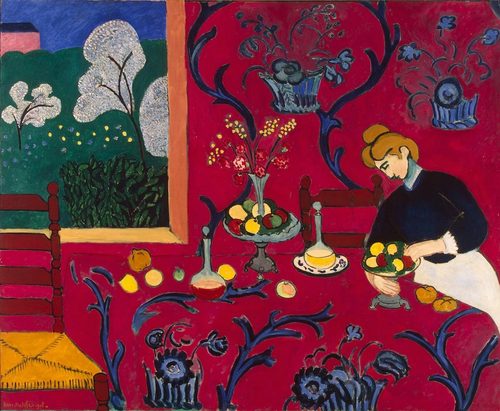
Henri Matisse (1869–1954) was a French painter, sculptor, and printmaker who spent five decades pursuing color as an independent expressive force, becoming one of the twentieth century's most influential artists. Trained in law before turning to painting in his early twenties, he led the short-lived Fauvist movement of 1905, whose jarring, unmixed color shocked Paris critics into coining the name "wild beasts." Over the following decades he refined that boldness into a calmer, more decorative language of flattened pattern, odalisques, interiors, and dancing figures, always searching for what he called an art of balance and repose, something like a good armchair for a tired mind. Rivalry and mutual respect with Pablo Picasso shaped much of his career, the two men trading ideas while pursuing opposite temperaments. Late in life, largely confined to bed or wheelchair after abdominal surgery, he reinvented himself again with gouache-painted paper cut into sweeping shapes, a technique he called "drawing with scissors" that produced some of his most beloved late work, including the Vence chapel he designed almost entirely himself.
How to recognize a Matisse
Unmixed, flat color
Matisse applies color straight from the tube in broad flat passages rather than blended tones, letting a single bold orange or emerald carry a whole area of canvas with almost no shading.
Decorative pattern everywhere
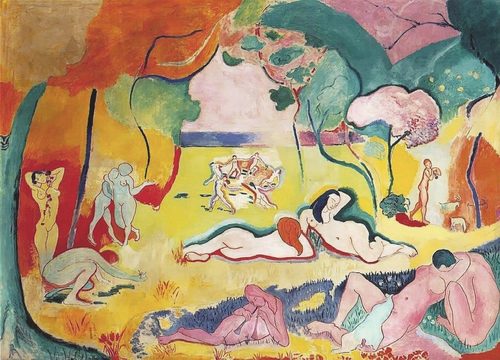
Wallpaper, fabric, and rugs crowd his interiors with competing patterns, flattening the sense of depth so the whole canvas reads as one continuous woven surface rather than a window onto a room.
Simplified, calligraphic drawing
Figures and objects are reduced to a few fluid, confident lines, especially in his late drawings and cut-outs, prioritizing rhythm and gesture over anatomical detail, as if the whole body were dancing.
Odalisques and interiors
Reclining figures in patterned rooms, often in Nice hotel interiors, recur throughout his middle career, treated less as individual likenesses than as arrangements of color, cloth, and light within a decorated room.
Paper cut-outs, late career
In his final decade he cut painted paper into bold organic shapes — leaves, algae, dancing figures — composed directly onto the wall, a technique born from illness that became a whole new medium.
Dance and rhythm as subject
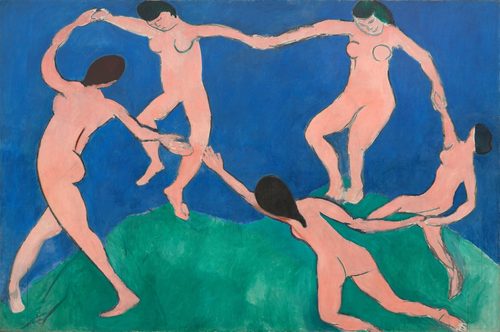
Circles of dancing or embracing figures recur across his career, rendered in a few sweeping curves that turn the human body into pure rhythmic motion, color standing in for anatomical detail entirely.
The life
Matisse was born in Le Cateau-Cambrésis in northern France and trained first for the law, working as a court administrator before a bout of appendicitis and a gift of paints from his mother redirected his life. He studied under Gustave Moreau in Paris, absorbing a respect for color that would define his career, and by 1905 he was leading a loose group of painters — Derain among them — whose canvases at the Salon d'Automne were so raw in color that a critic dubbed them "les fauves," the wild beasts.
Fauvism itself lasted only a few years, but Matisse spent the following decades refining its lessons into a calmer, more decorative art of pattern, odalisques, and interiors, developed partly in Nice, where he settled for much of his later life. Financial success came steadily from the 1920s on, alongside a long, competitive friendship with Picasso that both men treated as a kind of ongoing dialogue.
Abdominal cancer surgery in 1941 left him largely bedbound or in a wheelchair for his last thirteen years. Rather than stop working, he turned to gouache-painted paper cut into shapes, directing assistants to pin them into vast compositions, and designed the Chapelle du Rosaire in Vence almost single-handedly. He died in Nice in 1954.
Timeline
- 1869Born in Le Cateau-Cambrésis, France
- 1891Abandons law to study painting in Paris
- 1905Leads the Fauvist scandal at the Salon d'Automne
- 1917Settles for much of the year in Nice
- 1941Abdominal surgery leaves him largely bedbound
- 1947Publishes Jazz, a book of cut-out prints
- 1951Completes the Chapelle du Rosaire in Vence
- 1954Dies in Nice, France
Most famous works
| Work | Date | Why it matters |
|---|---|---|
| Woman with a Hat | 1905 | The Fauvist portrait of his wife whose wild, unnatural color shocked the 1905 Salon d'Automne into naming the movement. |
| The Dance | 1910 | A mural-scale ring of dancing red figures on flat blue and green, among his most reproduced images of pure rhythmic joy. |
| The Red Studio | 1911 | His own studio dissolved into a single field of red, furniture and paintings indicated only by outline, a landmark of flattened space. |
| Odalisque with Red Trousers | 1921 | A patterned Nice interior scene typical of his 1920s odalisque paintings, prized for its dense decorative color. |
| Blue Nude II | 1952 | A late paper cut-out reducing the figure to a few sweeping blue shapes, made after illness confined him to bed. |
| Chapelle du Rosaire | 1951 | A small chapel in Vence whose windows, murals, and vestments he designed in full, calling it his masterpiece. |
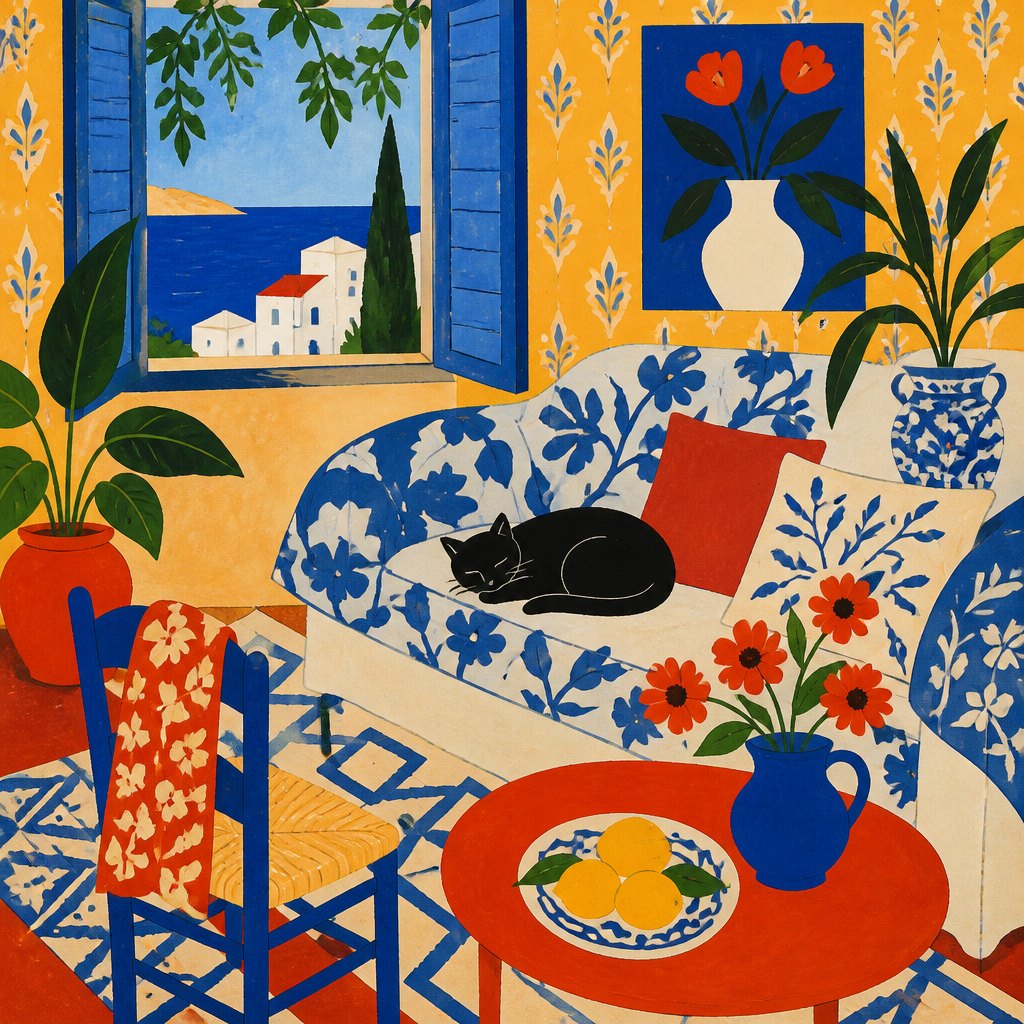 AI-generated
Create in the same spirit
Make Fauvism art of your own
This AI interpretation echoes the aesthetic world Henri Matisse worked in — it depicts no real artwork. Generate your own with the Fauvism Art Style generator.
Open the Fauvism Art Style generator →Legacy
Matisse's conviction that color could carry emotion on its own, independent of drawing or subject, opened the door for abstraction and shaped nearly every later movement built on pure color, from color-field painting to graphic design's flat planes. His late cut-outs, born from necessity, are now cited constantly by designers and illustrators as proof that simplification can be more expressive than detail. Alongside Picasso, he remains one of the two poles around which twentieth-century painting is often measured — Picasso for structure and fracture, Matisse for color and ease. You feel him now in any image that trusts a bold flat color to do the emotional work a careful gradient might otherwise attempt.
Frequently asked questions
What is Henri Matisse famous for?
Matisse is famous for pioneering Fauvism's raw, unmixed color in 1905, then spending decades refining a decorative art of pattern and pure color that culminated in his late paper cut-outs.
Where can I see Matisse's paintings?
The Musée Matisse in Nice and Le Cateau-Cambrésis hold major collections, alongside significant works at MoMA in New York, the Centre Pompidou, and the Hermitage.
How many works did Matisse create?
Matisse was highly prolific across seven decades, producing thousands of paintings, drawings, prints, and sculptures, plus the late cut-outs that became a whole new medium.
What art movement was Henri Matisse part of?
Matisse founded and led Fauvism in 1905, then developed his own decorative, color-driven style that outlasted the movement itself by nearly fifty years.