 Famous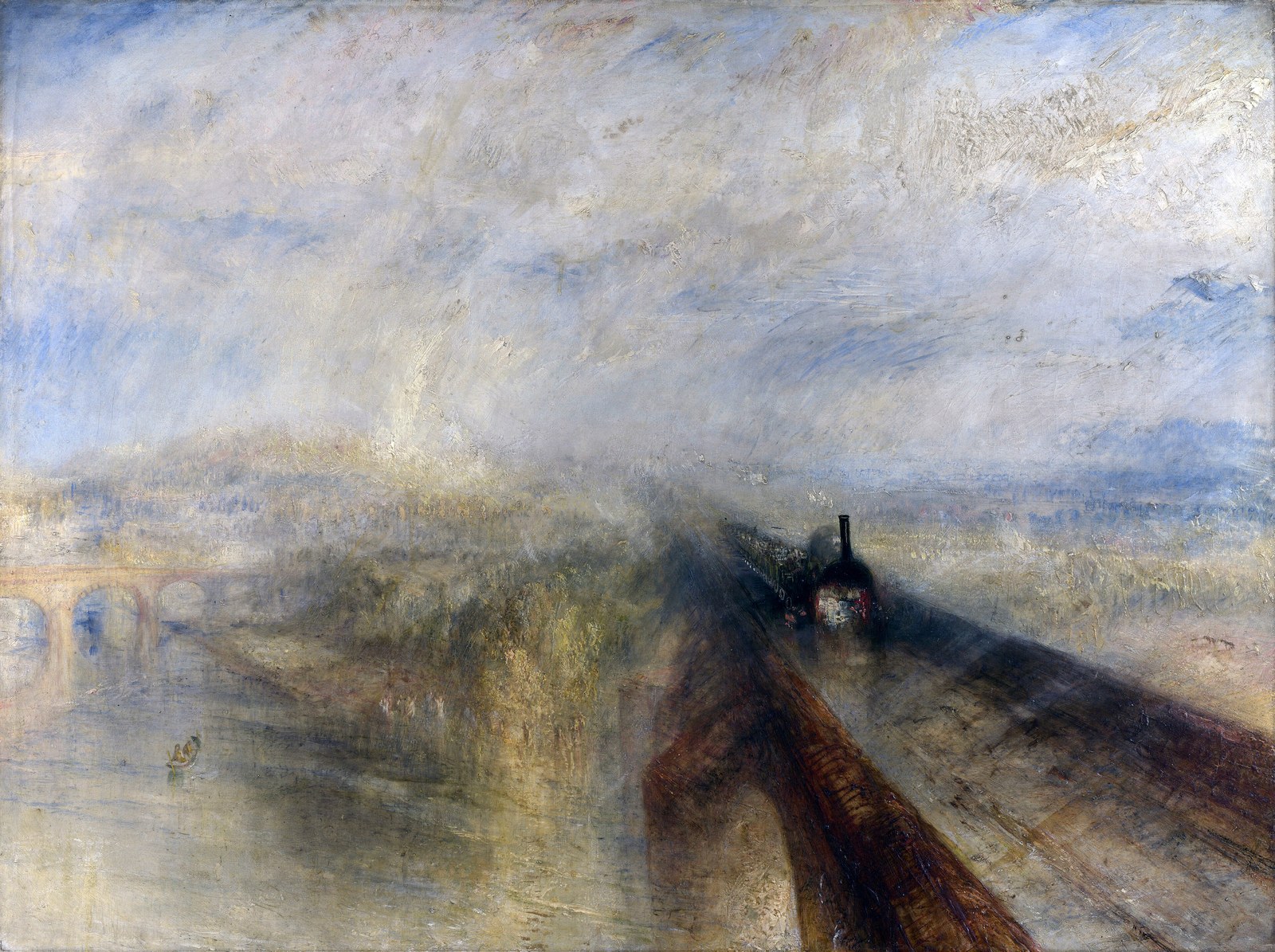
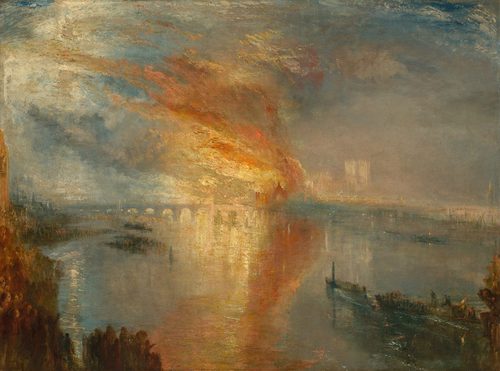
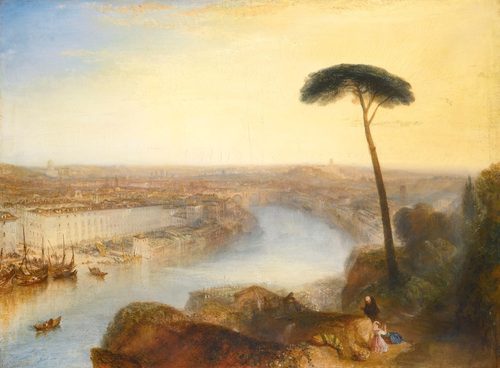
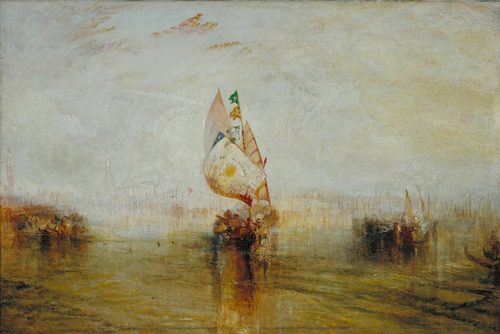
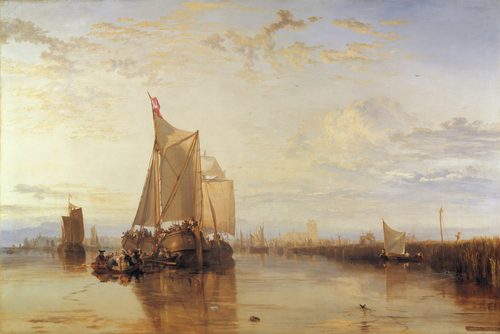
Joseph Mallord William Turner (1775–1851) was an English Romantic painter who spent his career chasing light, weather, and motion until they overtook his subjects entirely, becoming one of the most radical landscape painters of the nineteenth century. Born in London to a barber, he entered the Royal Academy Schools at fourteen and was a full Academician by twenty-six, an unusually fast rise for someone with no aristocratic patron. He built his early reputation on precise topographical watercolors of Britain's abbeys, castles, and coastlines, then spent decades dissolving that precision into something looser and more elemental. Storms, sunsets, fires, and steam became his real subjects; ships and figures often blur into the atmosphere around them. He traveled constantly across Britain and the Continent, filling sketchbooks that fed finished paintings for years. Financially shrewd and fiercely private about his methods, he reworked canvases in public during the Royal Academy's "varnishing days," building up glowing surfaces from thin, translucent layers of paint. He never married, exhibited almost every year of his adult life, and left the contents of his studio to the British nation.
How to recognize a Turner
Dissolving Horizons
Turner blurs the line between sea and sky until a storm becomes a single churning field of color; ships, cliffs, and clouds lose their edges and seem to be made of the same restless weather.
Built-Up Light
He layered thin glazes of oil or watercolor wash over wash, so a sunset seems to glow from inside the canvas rather than sit on top of it, gold bleeding into rose and pale gray.
Steam and Industry
Locomotives, paddle steamers, and factory smoke appear alongside sailing ships and half-ruined abbeys, industrial modernity folded into the same sublime haze that once belonged only to nature and ancient history, old world and new dissolving together.
Turbulent Seas
Shipwrecks, whalers, and storm-tossed vessels recur throughout his work, painted with thick, whipped brushwork that mimics spray and churning wind rather than carefully describing hull, rigging, or deck, so the sea itself becomes the true, overwhelming subject.
Golden, Smoky Palette
His late paintings favor a narrow, radiant range of yellows, oranges, and warm whites, with darker forms, figures, boats, buildings, reduced to smudges of umber or gray against the glow.
Vertiginous Scale
Mountains, waterfalls, and open sea dwarf the human figures scattered through his compositions, who often appear as small, anonymous marks, little more than flecks of paint, caught inside forces of weather and geology far larger than themselves.
The life
Turner was born in 1775 above his father's barbershop in Covent Garden, London. He showed talent early, entering the Royal Academy Schools at fourteen and exhibiting his first watercolor there the following year. By his mid-twenties he was already a full Royal Academician, having built a following for meticulous topographical views of English abbeys, castles, and rivers sold as prints to a growing middle-class market.
The Peace of Amiens in 1802 let him travel to the Continent for the first time, and the Alps changed his sense of scale permanently; storms and mountains began crowding out picturesque ruins in his exhibited work. Over the following decades he returned again and again to Italy, painting Venice's water and light with an intensity that startled contemporaries used to firmer outlines. He worked in oil and watercolor side by side, often reworking exhibited canvases at the Royal Academy itself, adding glazes in public during the notorious "varnishing days" that other painters came to watch.
In his final years Turner grew reclusive, living for periods under an assumed name in Chelsea with his companion Sophia Booth, while his paintings grew ever more abstract, reduced almost to pure color and light. He died there in 1851, leaving the contents of his studio, several hundred paintings and tens of thousands of drawings, to the nation, a bequest that still anchors Tate's collection today.
Timeline
- 1775Born in Covent Garden, London.
- 1789Enters the Royal Academy Schools at fourteen.
- 1799Elected Associate of the Royal Academy.
- 1802Becomes a full Royal Academician; first tour of the Alps.
- 1819Makes his first trip to Venice.
- 1840Paints Slavers Throwing overboard the Dead and Dying.
- 1844Exhibits Rain, Steam and Speed.
- 1851Dies in Chelsea, London.
Most famous works
| Work | Date | Why it matters |
|---|---|---|
| Snow Storm: Hannibal and His Army Crossing the Alps | 1812 | An early sign of his lifelong pull toward storm, scale, and near-total atmospheric chaos. |
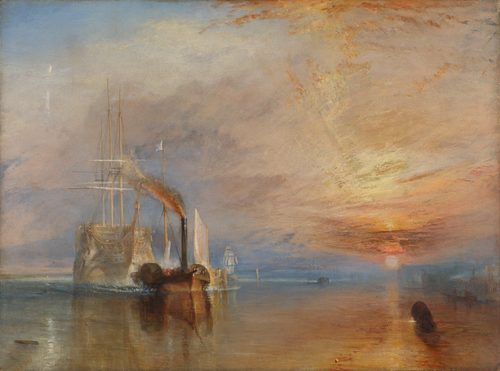
| The Fighting Temeraire | 1839 | A veteran warship towed to scrap by a steam tug, painted as an elegy for sail. |
| Slavers Throwing overboard the Dead and Dying | 1840 | A searing marine painting confronting the transatlantic slave trade through storm and color. |
| Rain, Steam and Speed | 1844 | A train crossing a bridge dissolves into weather, one of his boldest late experiments. |
| Norham Castle, Sunrise | c. 1845 | A near-abstract late work where castle and river barely emerge from pure light. |
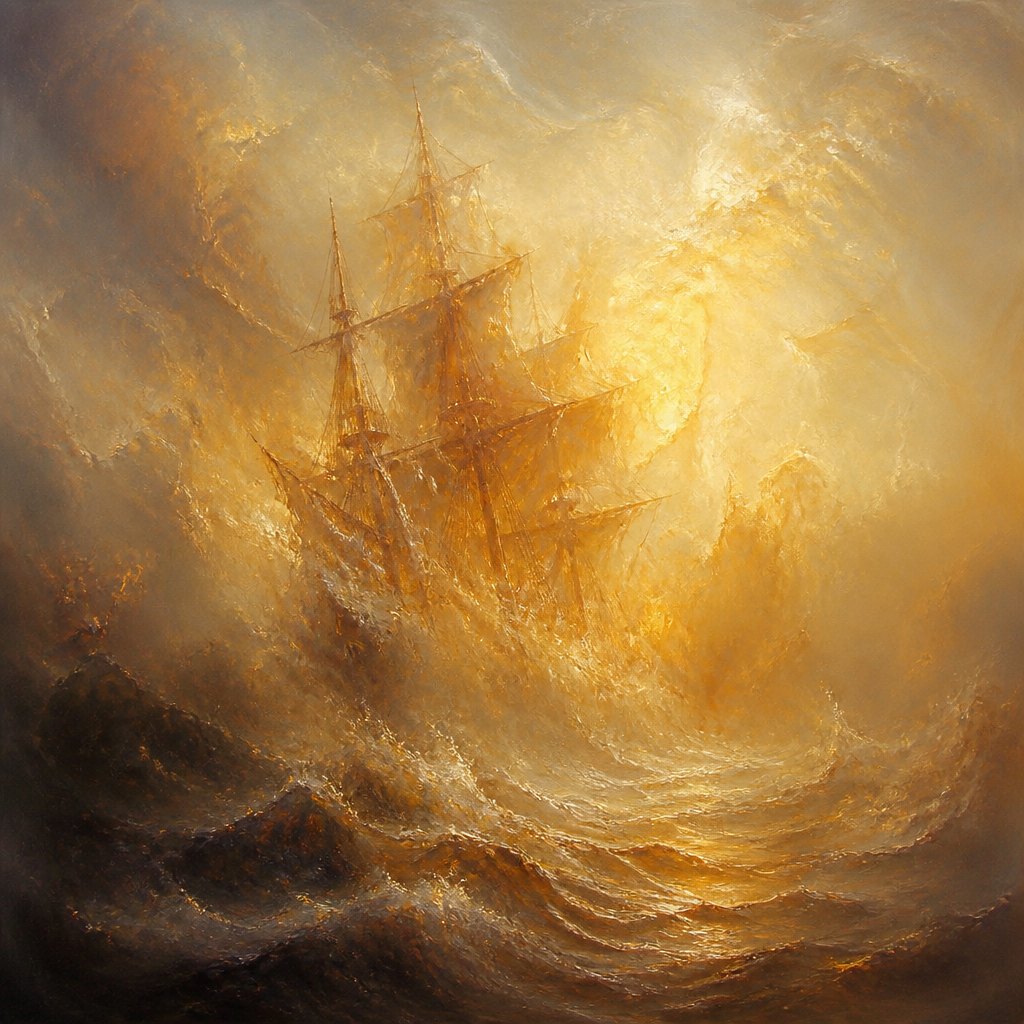 AI-generated
Create in the same spirit
Make Romanticism art of your own
This AI interpretation echoes the aesthetic world J.M.W. Turner worked in — it depicts no real artwork. Generate your own with the Romanticism Art Style generator.
Open the Romanticism Art Style generator →Legacy
Turner's late canvases, dismissed by some contemporaries as unfinished or unintelligible, are now seen as a hinge between Romantic landscape and modern abstraction, and critics have traced a line from his dissolving forms to Impressionism and beyond. Claude Monet studied his London paintings closely, and Mark Rothko's veils of color owe something to his example. His insistence that a landscape could be built from atmosphere and feeling rather than topographical fact helped free later painters from strict description. Britain's leading contemporary art prize carries his name. Walk into a gallery hung with his late seascapes, or watch fog swallow a bridge on a gray morning, and his particular way of seeing is still doing its work.
Frequently asked questions
What is J.M.W. Turner famous for?
Turner is famous for Romantic landscapes and seascapes that push light, weather, and atmosphere to the edge of abstraction, including The Fighting Temeraire and Rain, Steam and Speed.
Where can I see Turner's paintings?
The largest collection is the Turner Bequest at Tate Britain in London, which holds hundreds of his paintings and thousands of sketches; other major works hang at the National Gallery, London.
What art movement was Turner part of?
Turner is classed as a Romantic painter, though his late, almost abstract handling of light and color also anticipates Impressionism and twentieth-century abstraction.
How many works did Turner leave behind?
His studio bequest to Britain included roughly 300 paintings and around 30,000 works on paper, now held mainly by Tate, making him one of the best-documented painters of his era.