 Famous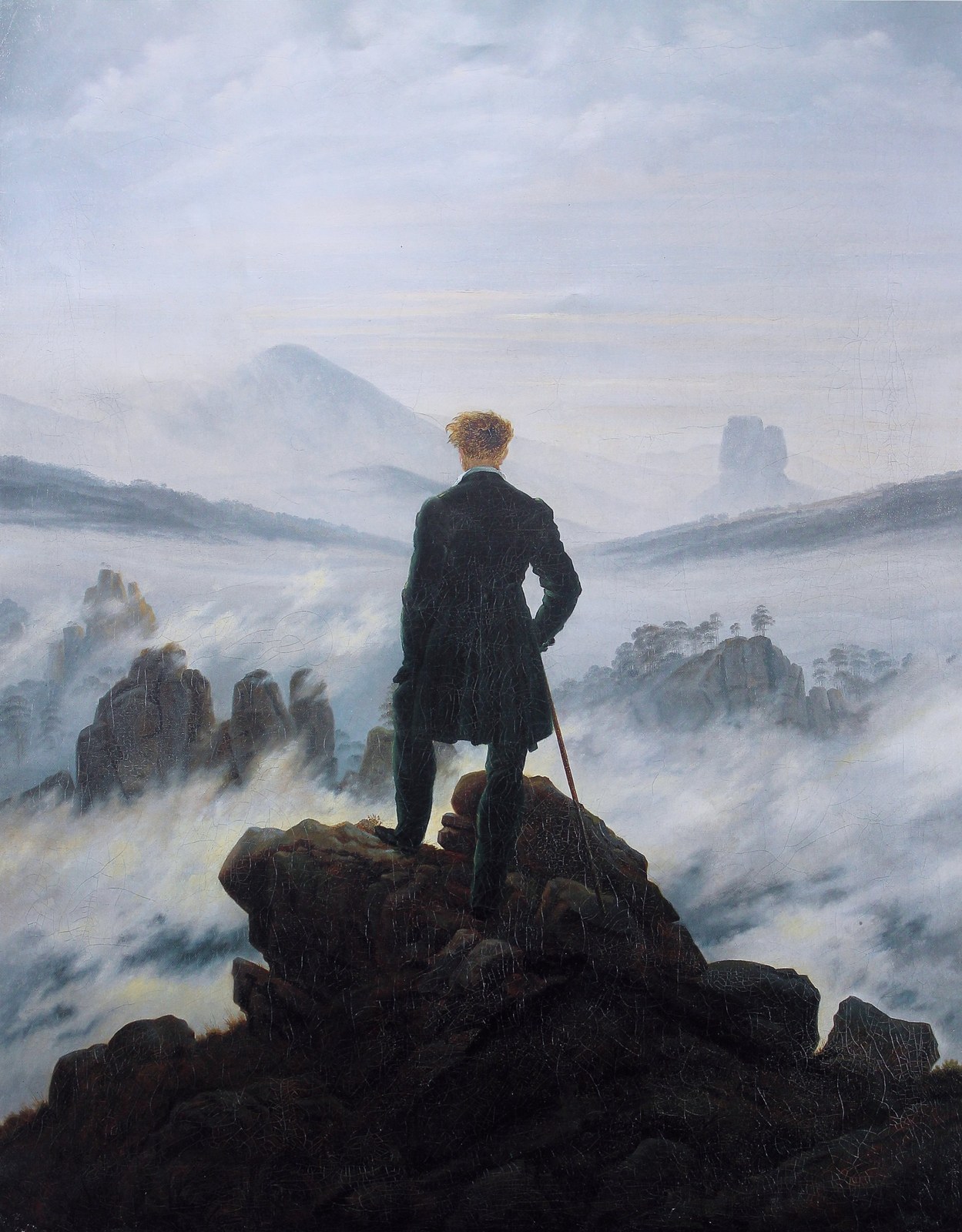
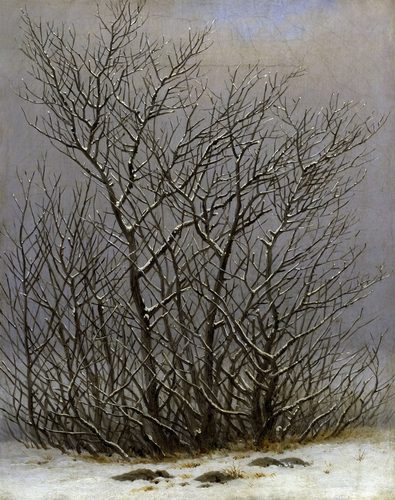
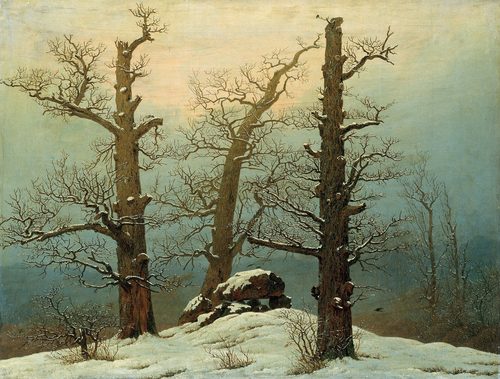
Caspar David Friedrich (1774–1840) was a German painter who became the leading figure of Romantic landscape art, transforming forests, mountains, and coastlines into meditations on solitude, mortality, and the sublime. Born in the Baltic town of Greifswald, he lost his mother and several siblings in childhood, including a brother who drowned saving him, losses that scholars link to the somber, reflective tone of his later work. He trained at the Copenhagen Academy before settling in Dresden, where he developed his signature compositions: a lone figure or small group, seen from behind, standing before an overwhelming expanse of sky, sea, or mountain. This device, later called Rückenfigur, invited viewers to project their own contemplation onto the scene rather than simply observe a view. His breakthrough painting, The Cross in the Mountains, scandalized critics by treating a landscape with the reverence normally reserved for religious altarpieces. Friedrich achieved recognition in Dresden and Berlin, was admitted to the Prussian Academy, and befriended fellow Romantic figures, but his intensely personal, melancholic style fell out of critical favor in his later decades. A stroke in 1835 curtailed his ability to paint in oil, and he died in Dresden in relative poverty and obscurity, his reputation only recovering in the twentieth century.
How to recognize a Friedrich
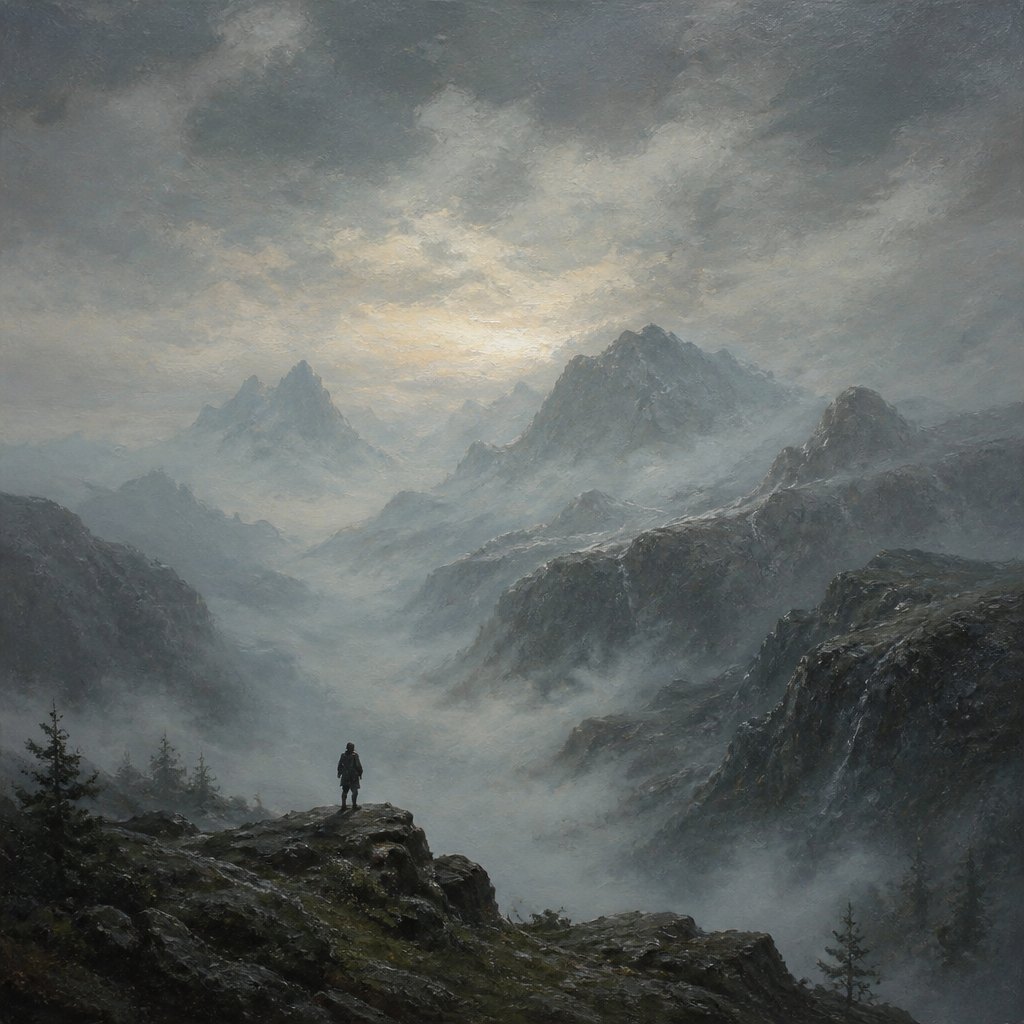
Figure seen from behind
Friedrich's recurring Rückenfigur shows a solitary person facing away from the viewer into a landscape, inviting quiet identification rather than narrative explanation of who they are or what they see.
Vast, dominant skies
Sky and atmosphere often occupy most of the canvas, reducing land and figures to a narrow band below, so weather and light carry the painting's emotional weight, from luminous dawn calm to the heavy gray of an approaching storm.
Muted, wintry palette
Friedrich favored cool grays, muted greens, and pale golds over bright color, giving even sunrise scenes a hushed, contemplative rather than celebratory feeling, as though the whole landscape were holding its breath alongside the solitary viewer within it.
Fog, mist, and distance
Layered fog and haze soften distant mountains and forests into near-abstraction, creating a sense of infinite, unreachable space beyond the foreground, a technique borrowed partly from his careful study of atmospheric perspective and northern coastal weather.
Nature as spiritual subject
Crosses, ruined abbeys, and bare trees appear within landscapes, treating natural scenery with a solemnity usually reserved for religious painting, blurring the two and suggesting that the divine could be encountered as readily in a forest as in a church.
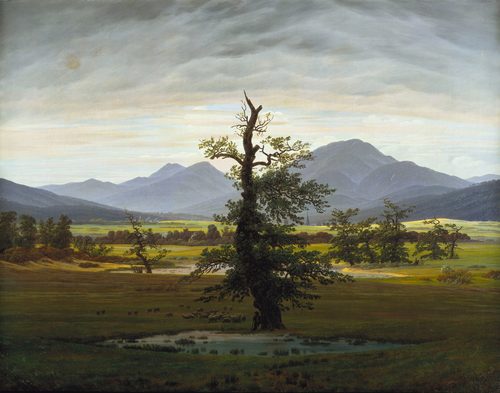
Stark, isolated trees and ruins
Dead or twisted trees, gothic ruins, and bare rock recur as symbols of mortality and time, planted deliberately within otherwise serene, expansive views, quiet reminders that even the calmest landscape carries a memory of loss and decay.
The life
Caspar David Friedrich was born in the Baltic port town of Greifswald in 1774. His childhood was marked by loss, including the death of his mother and, in 1787, his brother Johann Christoffer, who drowned attempting to save him after Friedrich fell through ice on a frozen pond. He studied at the Copenhagen Academy of Art in the mid-1790s before settling permanently in Dresden in 1798, then a center of German Romantic thought.
Friedrich's breakthrough came with The Cross in the Mountains around 1807–1808, an altarpiece-format landscape that scandalized contemporaries by treating a mountain scene with religious reverence. Through the 1810s he developed his mature style, centered on solitary figures viewed from behind against vast natural expanses, producing his best-known works including Wanderer above the Sea of Fog and The Monk by the Sea. He was elected to the Prussian Academy of Arts in 1810 and married Caroline Bommer in 1818.
Friedrich's intensely personal, melancholic vision fell out of critical fashion in the 1820s and 1830s as taste shifted toward more conventional landscape painting. A stroke in 1835 left him unable to work in oil, restricting him mostly to watercolor and sepia drawings. He died in Dresden in 1840 in relative poverty, and his reputation was largely forgotten until its revival by German Symbolists and art historians in the early twentieth century.
Timeline
- 1774Born in Greifswald, northern Germany
- 1787His brother drowns saving him from a fall through ice
- 1794Enrolls at the Copenhagen Academy of Art
- 1798Settles in Dresden, his home for the rest of his life
- 1808Exhibits The Cross in the Mountains, sparking controversy
- 1810Elected to the Prussian Academy of Arts
- 1818Marries Caroline Bommer
- 1835Suffers a stroke that limits his painting
- 1840Dies in Dresden
Most famous works
| Work | Date | Why it matters |
|---|---|---|
| Wanderer above the Sea of Fog | c. 1818 | A lone figure surveys a mist-filled mountain landscape, the defining image of Romantic contemplation. |
| The Monk by the Sea | 1808–1810 | A tiny solitary figure before an immense sky and sea, radical in its near-total emptiness for its time. |
| Abbey among Oak Trees | 1809–1810 | A ruined gothic abbey and funeral procession set among bare trees, meditating on death and time. |
| The Cross in the Mountains | 1807–1808 | A mountaintop crucifix bathed in sunset light, controversial for treating landscape with religious reverence. |
| Chalk Cliffs on Rügen | 1818 | A dizzying view over white cliffs, painted during his honeymoon, balancing vertigo with serene color. |
 AI-generated
Create in the same spirit
Make Romanticism art of your own
This AI interpretation echoes the aesthetic world Caspar David Friedrich worked in — it depicts no real artwork. Generate your own with the Romanticism Art Style generator.
Open the Romanticism Art Style generator →Legacy
Friedrich gave landscape painting a new purpose: not topographical record but a vehicle for solitude, longing, and spiritual searching. His compositions, especially the solitary figure facing a vast view, became a template Romantic painters across Europe absorbed, and his influence resurfaces in later art and film whenever a lone silhouette confronts an overwhelming horizon. Largely forgotten by the late nineteenth century, he was rediscovered by German Symbolists and later Surrealists, who recognized a kindred interest in mood over description. Today his paintings hang in Berlin's Alte Nationalgalerie and Dresden's Albertinum, still stopping visitors mid-step with their quiet, expansive stillness.
Frequently asked questions
What is Caspar David Friedrich famous for?
He is famous for Wanderer above the Sea of Fog and for pioneering German Romantic landscape painting, using solitary figures and vast natural scenery to evoke contemplation and the sublime.
Where can I see Caspar David Friedrich's paintings?
The Alte Nationalgalerie in Berlin and the Albertinum in Dresden hold his major works, with others at the Hamburger Kunsthalle and the Hermitage in St. Petersburg.
What movement did Friedrich belong to?
Friedrich was the leading painter of German Romanticism, a movement that emphasized emotion, nature, and the sublime over the reason and order of Neoclassicism.
Was Caspar David Friedrich famous during his lifetime?
He achieved real recognition in Dresden and Berlin during his middle years, but his melancholic style fell out of fashion later in life, and he died in relative obscurity.