 Famous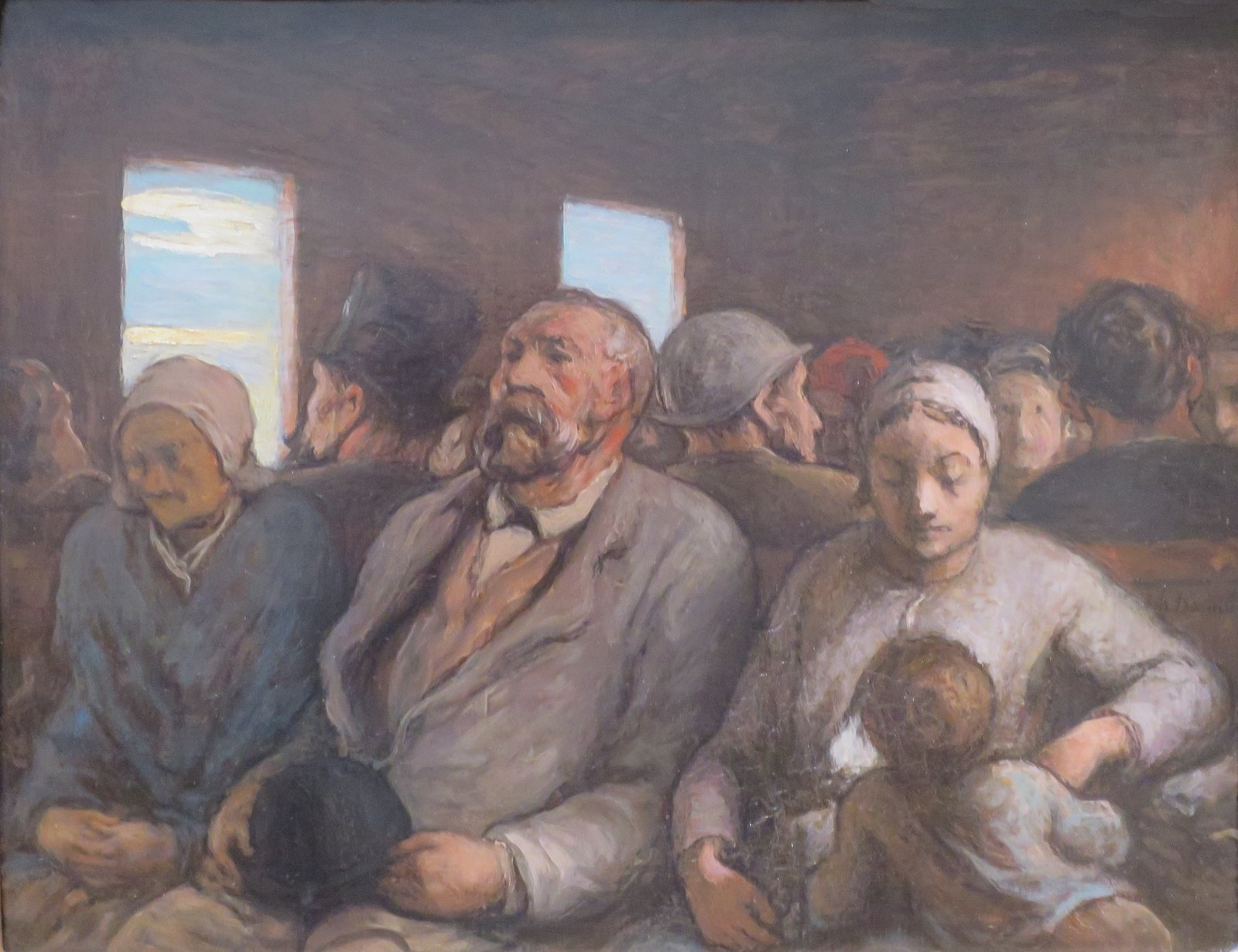
Honoré Daumier (1808–1879) was a French caricaturist, printmaker, and painter whose satirical lithographs made him one of the sharpest visual commentators on nineteenth-century Parisian life. Born in Marseille, he moved with his family to Paris as a child and began working for satirical journals in his twenties, producing an estimated four thousand lithographs over his career for publications including La Caricature and Le Charivari.
His 1831 lithograph Gargantua, depicting King Louis-Philippe as a giant gorging on the wealth of the poor, led to a six-month prison sentence for insulting the monarchy. Undeterred, Daumier spent decades skewering lawyers, politicians, and the Parisian bourgeoisie with a caricaturist's precision, while also depicting ordinary crowds — laundresses, theatergoers, third-class train passengers — with unexpected tenderness.
Throughout his career Daumier also painted, working in a loose, dark-toned, expressive style, but he rarely exhibited these canvases and they earned little recognition in his lifetime. Going blind and impoverished in old age, he was reportedly given a house in Valmondois by his friend Camille Corot. Daumier died there in 1879, his paintings only fully appreciated by later generations who saw in them a forerunner of modern expressive brushwork.
How to recognize a Daumier
biting political caricature
Daumier's lithographs exaggerate physical features into pointed, recognizable social types — bloated bourgeois jowls, sly lawyerly smirks, self-important political postures — using distortion as precise social commentary and diagnosis rather than simple mockery for its own sake.
crowd as subject
Many works depict anonymous Parisian crowds — train cars, courtroom galleries, theater audiences — treating the collective mass of ordinary people as worthy of the same attention as any individual portrait.
loose, dark-toned painting
His paintings use a somber, restricted palette and rapid, visible brushwork, prioritizing gesture, weight, and mood over polished finish, working in a loose manner decades ahead of when such visible looseness became critically fashionable or acceptable.
lawyers and the legal world
A recurring cast of pompous, self-satisfied lawyers and judges appears throughout his lithographs, each drawn with an insider's sharp eye for the theater, vanity, and quiet hypocrisy of the nineteenth-century French courtroom.
Don Quixote as recurring figure
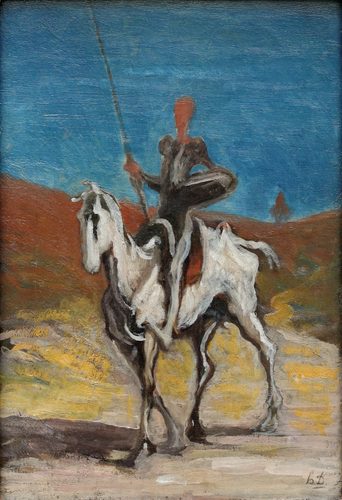
In his paintings, the gaunt silhouette of Don Quixote appears repeatedly, a lone idealist tilting against an indifferent world — a theme Daumier returned to obsessively, across roughly thirty separate canvases, in his final working years.
dramatic light and shadow
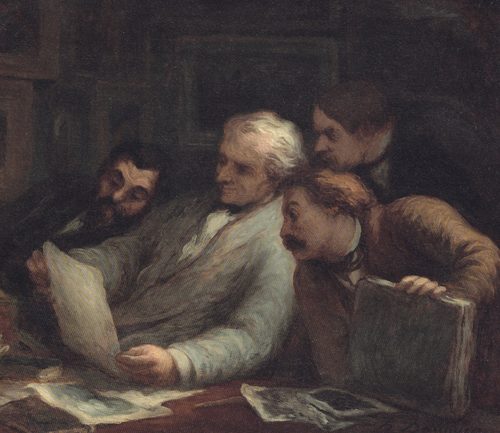
Daumier's paintings often use strong, theatrical contrasts of light and dark, isolating a single figure or gesture from a murky, undefined surrounding space, lending even quiet, ordinary scenes an unexpected sense of drama and weight.
The life
Daumier was born in Marseille in 1808, the son of a glazier who also wrote poetry and hoped for a literary career in Paris. The family relocated to the capital in 1816, and by his early twenties Daumier was working as a lithographer for the satirical press, quickly developing a gift for pointed political caricature.
His 1831 print Gargantua, showing King Louis-Philippe as a monstrous glutton devouring tax revenue from the poor, was judged an insult to the crown and earned him six months in prison. He continued producing sharp political and social caricature for decades afterward, particularly for the journal Le Charivari, becoming one of the most widely recognized satirists in France even as censorship periodically restricted his political targets.
Alongside this prolific print career, Daumier painted steadily but privately, rarely submitting work to the Salon and selling little. His canvases of laundresses, train passengers, and Don Quixote went largely unnoticed by contemporaries focused on his prints. In failing health and nearly blind by the 1870s, he faced real poverty; his friend Camille Corot reportedly purchased a house for him in Valmondois, north of Paris, where Daumier died in February 1879.
Timeline
- 1808Born in Marseille, France
- 1816Family relocates to Paris
- 1830Begins working as a lithographer for satirical journals
- 1831Publishes Gargantua; jailed six months the following year
- 1848Turns increasingly toward painting during a freer press era
- 1863Rejoins Le Charivari after a three-year dismissal
- 1878A retrospective exhibition of his work is held in Paris
- 1879Dies nearly blind in Valmondois, north of Paris
Most famous works
| Work | Date | Why it matters |
|---|---|---|
| Gargantua | 1831 | A lithograph of King Louis-Philippe as a monstrous glutton that earned Daumier a prison sentence. |
| The Legislative Belly | 1834 | A satirical group portrait of bloated, self-satisfied parliamentary deputies lined up on a bench. |
| The Third-Class Carriage | c. 1862–64 | A tender, unglamorous painting of ordinary train passengers, now among his most admired canvases. |
| Rue Transnonain | 1834 | A stark lithograph documenting a civilian massacre, among the most powerful political prints of its era. |
| Don Quixote and Sancho Panza | c. 1868 | One of roughly thirty paintings of the gaunt idealist, showing Daumier's loose, expressive late style. |
 AI-generated
Create in the same spirit
Make Realism art of your own
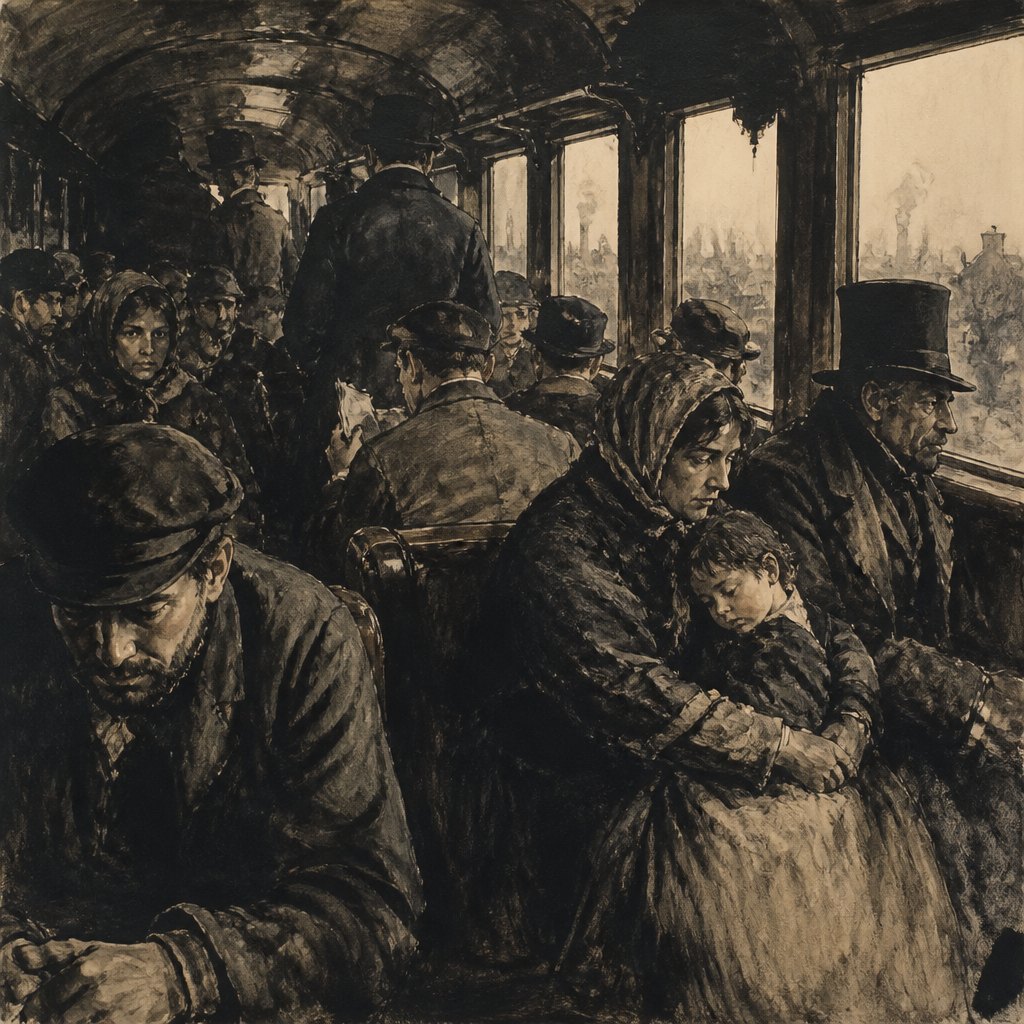
This AI interpretation echoes the aesthetic world Honoré Daumier worked in — it depicts no real artwork. Generate your own with the Realism Art Style generator.
Open the Realism Art Style generator →Legacy
Daumier proved that caricature could carry the moral seriousness of history painting, influencing generations of political cartoonists and satirists who followed him. His paintings, largely unseen in his lifetime, were later recognized by artists including Degas and Van Gogh as forerunners of a looser, more expressive kind of modern brushwork. His close observation of crowds and ordinary Parisian life fed directly into later Realist and Impressionist interest in modern urban subjects. You feel him now in any political cartoon with real bite, or any painting that finds real dignity in an anonymous face in a crowd.
Frequently asked questions
What is Honoré Daumier famous for?
Daumier is famous for biting political and social caricatures published as lithographs, especially Gargantua, and for expressive paintings of Parisian crowds that gained wide recognition only after his death.
Where can I see Daumier's work?
The Musée d'Orsay in Paris holds The Third-Class Carriage and other paintings. The Metropolitan Museum of Art and the National Gallery of Art in Washington also hold significant prints and paintings.
Why was Daumier imprisoned?
In 1832 he was sentenced to six months in prison after publishing Gargantua, a lithograph depicting King Louis-Philippe as a giant devouring the wealth of the poor, judged an insult to the monarchy.
What movement did Daumier belong to?
Daumier is generally classed with Realism for his unsentimental depictions of ordinary Parisian life, though his prolific caricature career also places him at the roots of modern political cartooning.