 Famous
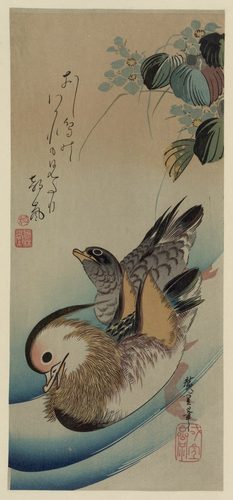
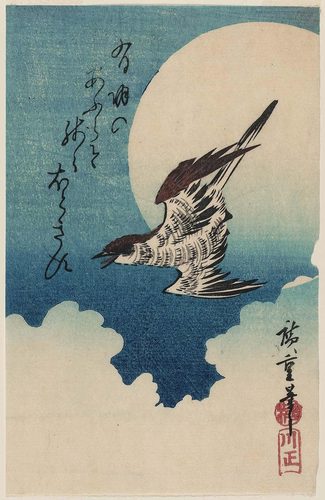
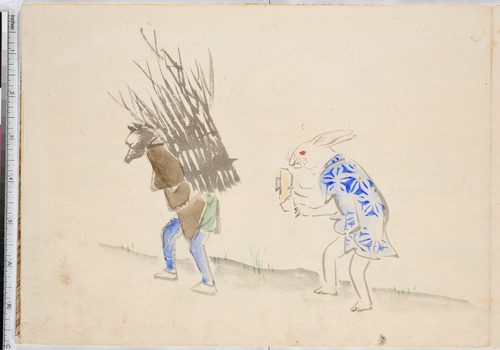
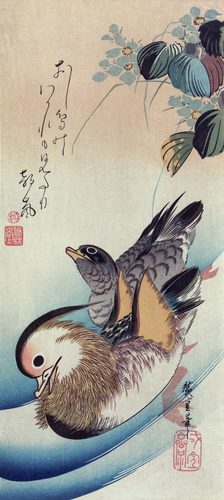
Utagawa Hiroshige (1797–1858) was a Japanese ukiyo-e artist whose atmospheric landscape prints, especially The Fifty-three Stations of the Tōkaidō, made weather and travel into the genre's defining subjects and shaped how later artists, including Van Gogh, pictured Japan.
Born in Edo, the son of a fire warden, he inherited his father's post at twelve and soon after trained in painting under Utagawa Toyohiro, joining the prolific Utagawa print school. His early work followed the school's usual output of actor and beauty prints, but he found his subject in landscape and travel scenes during the 1830s.
In 1832 he reportedly traveled the Tōkaidō road between Edo and Kyoto as part of an official procession, sketching the fifty-three post stations along the route; the resulting print series, published from 1833, made his reputation and became one of the best-selling print sets of the era. He followed it with other travel series and, in his final years, the ambitious One Hundred Famous Views of Edo, capturing the city season by season.
Hiroshige died in 1858 during a cholera epidemic that swept Edo, having completed the Views of Edo series only shortly before.
How to recognize a Hiroshige
Atmospheric rain and snow
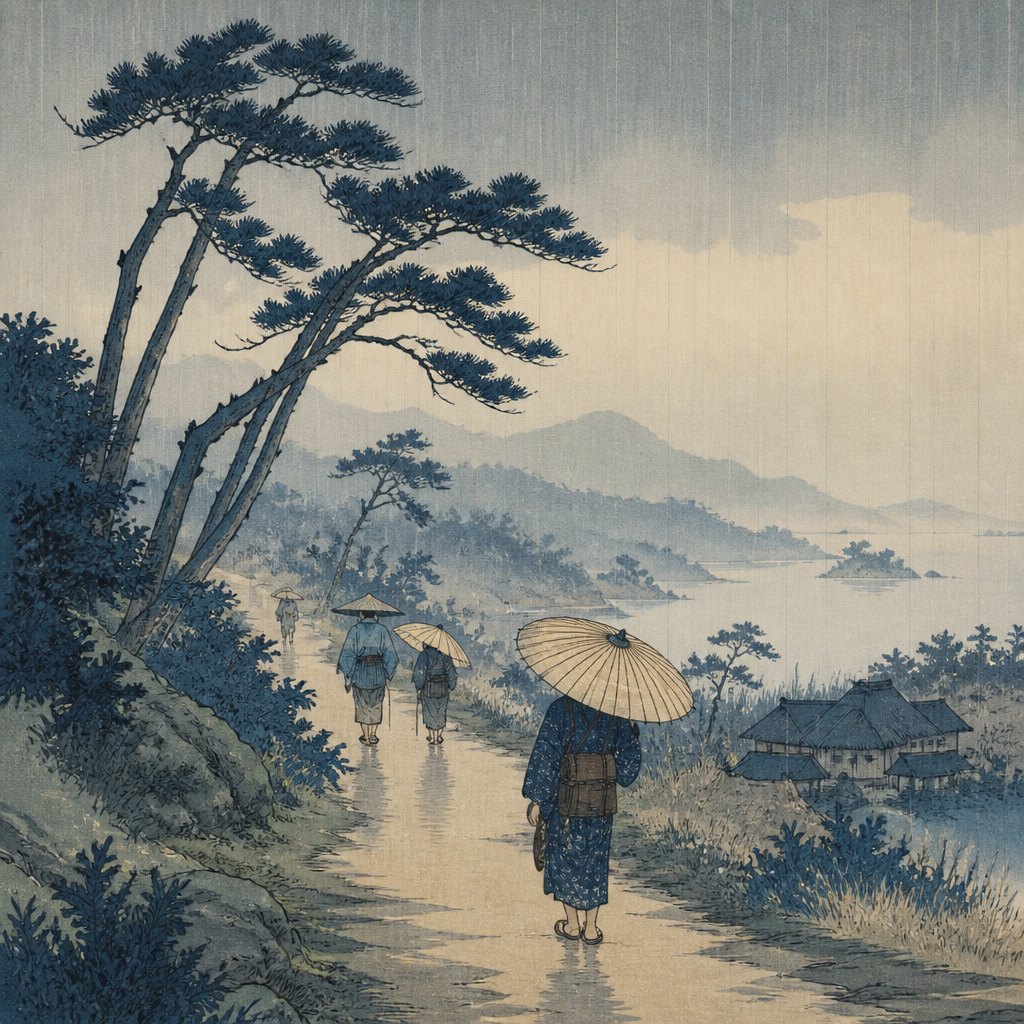
Hiroshige built entire compositions around weather — slanting rain rendered as fine parallel lines, snow as soft white dots on dark roofs — treating atmosphere itself as the print's real subject.
Deep, layered perspective
He staged scenes with a strong foreground element — a branch, a fence, a traveler's shoulder — set against a plunging middle distance and a soft, flat horizon, pulling the eye deep into the print.
Bokashi gradient skies
His skies and water often shift through soft, wiped color gradients called bokashi, moving from deep blue through pink to pale cream, giving a single moment of day its own mood.
Travelers on the road
Small figures — porters, pilgrims, palanquin bearers, peddlers — move through his landscapes going about their ordinary journeys, giving even his grandest views a sense of lived, everyday travel and passing time.
Bridges, rivers, and stations
Bridges arching over rivers, ferry crossings, and the gates of post towns recur throughout his work, markers of a nation crisscrossed by the very roads and waterways that his prints made famous.
Seasonal, diary-like scenes
His late series arrange Edo's neighborhoods and landmarks by season, from spring cherry blossoms to snow-capped winter bridges, reading almost like an illustrated calendar of the city's slowly passing year.
The life
Hiroshige was born Andō Tokutarō in Edo in 1797, the son of a low-ranking fire warden attached to the shogun's castle guard. Both his parents died when he was a child, and he inherited his father's fire-warden post at the age of twelve while pursuing painting on the side, training under Utagawa Toyohiro and taking the name Hiroshige around 1812.
For roughly two decades he worked within the crowded field of Utagawa-school printmaking, producing conventional actor portraits and beauty prints without particular distinction. His turn came in the early 1830s, when he shifted decisively toward landscape.
In 1832 Hiroshige is said to have traveled the Tōkaidō, the great coastal road linking Edo and Kyoto, as part of an official delegation, sketching its fifty-three post stations along the way. The resulting series, The Fifty-three Stations of the Tōkaidō, published from 1833, was an immediate popular success and established him as a leading landscape print designer, working alongside and eventually rivaling Hokusai in that genre.
He spent his final decades producing further travel series and, from 1856, the ambitious One Hundred Famous Views of Edo, a season-by-season portrait of his home city. Hiroshige died in 1858 during a major cholera outbreak, shortly after taking Buddhist vows.
Timeline
- 1797Born in Edo, son of a fire warden
- 1811Begins training under Utagawa Toyohiro
- 1823Hands the fire-warden post to his son to paint full time
- 1832Travels the Tōkaidō road, sketching its post stations
- 1833Publishes The Fifty-three Stations of the Tōkaidō
- 1856Begins One Hundred Famous Views of Edo
- 1858Dies in Edo during a cholera epidemic
Most famous works
| Work | Date | Why it matters |
|---|---|---|
| Fifty-three Stations of the Tōkaidō (series) | 1833–1834 | His breakthrough travel series, following the great road from Edo to Kyoto station by station through shifting weather and light. |
| Sudden Shower over Shin-Ōhashi Bridge and Atake | 1857 | A print from One Hundred Famous Views of Edo showing rain as fine slanting lines over a bridge full of hurrying travelers; later copied in paint by Van Gogh. |
| One Hundred Famous Views of Edo (series) | 1856–1858 | A late, season-spanning portrait of the city's neighborhoods, bridges, and festivals, left unfinished at his death. |
| Evening Snow at Kanbara | 1833 | One of the Tōkaidō series' most admired prints, a hushed snow scene built almost entirely from silhouette and white space. |
| Naruto Whirlpools, Awa Province | c. 1855 | A striking seascape reducing a famous whirlpool strait to interlocking curves of blue and white. |
 AI-generated
Create in the same spirit
Make Ukiyo E art of your own
This AI interpretation echoes the aesthetic world Utagawa Hiroshige worked in — it depicts no real artwork. Generate your own with the Ukiyo-e Art Style generator.
Open the Ukiyo-e Art Style generator →Legacy
Hiroshige's weather-drenched landscapes gave Western artists their clearest window into Japanese design once prints reached Europe after the 1850s. Van Gogh directly copied two of his Edo views in oil, and Whistler, Monet, and other artists absorbed his flattened space, cropped compositions, and confident use of color gradients. Within Japan he remains, alongside Hokusai, a defining landscape print artist of the ukiyo-e tradition, and the Tōkaidō series is still treated as the genre's benchmark travelogue. His rain and snow effects, in particular, set a visual vocabulary for depicting weather that print designers and illustrators continue to draw from today.
Frequently asked questions
What is Utagawa Hiroshige famous for?
Hiroshige is famous for atmospheric ukiyo-e landscapes, especially The Fifty-three Stations of the Tōkaidō and One Hundred Famous Views of Edo, known for their rendering of rain, snow, and travel.
Where can you see Hiroshige's prints today?
His prints are held by major museums worldwide, including the Brooklyn Museum, the British Museum, and the Ota Memorial Museum of Art in Tokyo, which specializes in ukiyo-e.
Did Van Gogh copy Hiroshige's work?
Yes. Van Gogh painted close copies in oil of two Hiroshige prints from One Hundred Famous Views of Edo, part of his broader enthusiasm for Japanese prints.
What art movement did Hiroshige belong to?
He worked within ukiyo-e, the Edo-period 'floating world' print tradition, specializing in landscape and travel scenes within the Utagawa school.