 Famous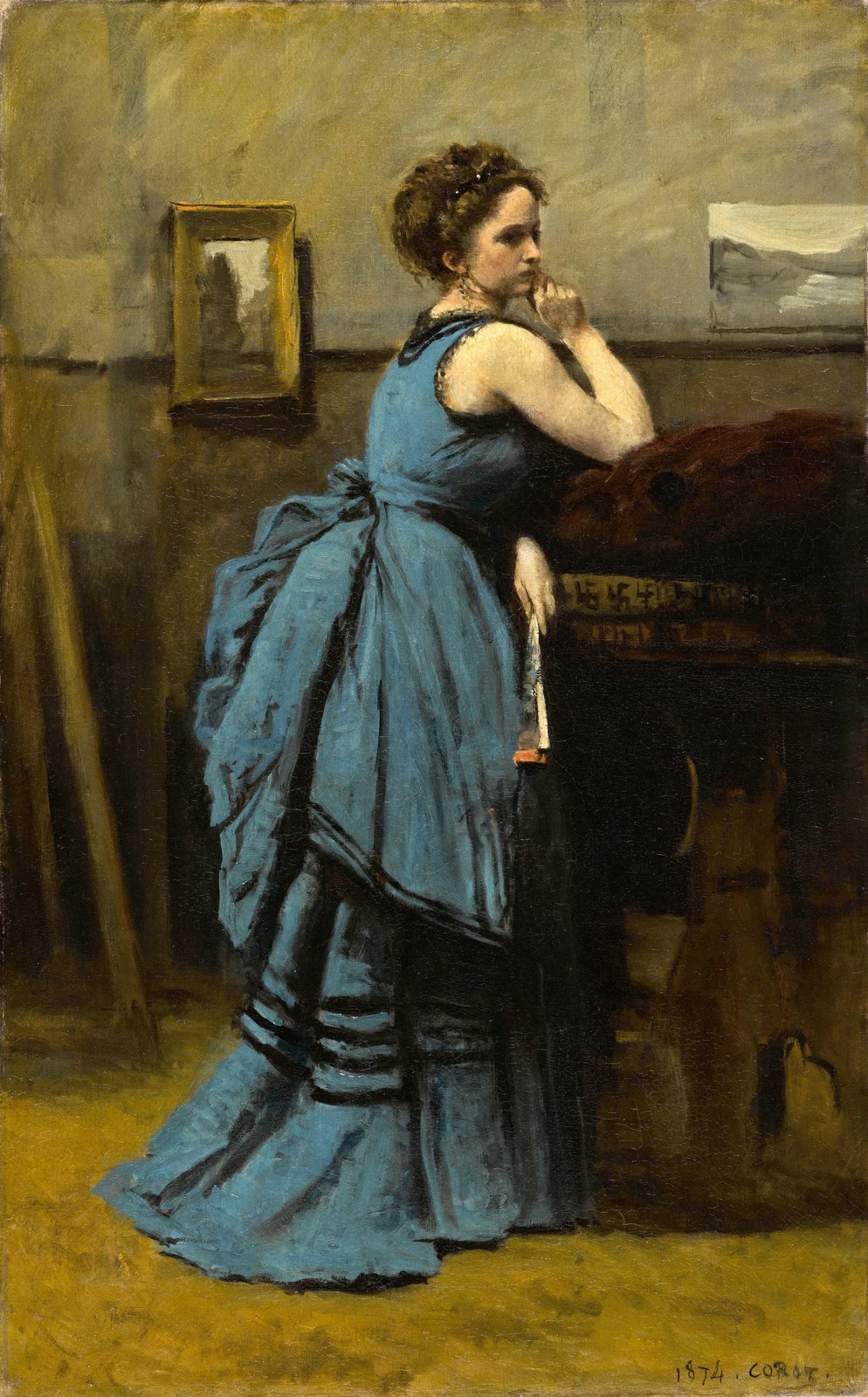
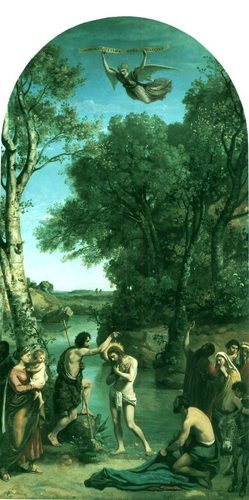
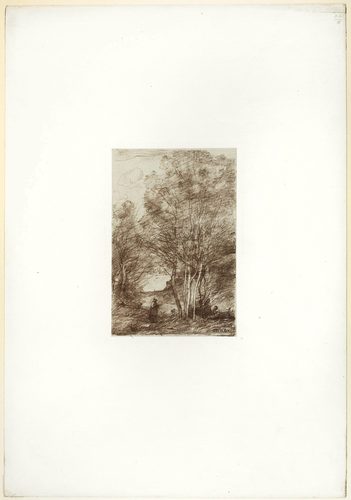
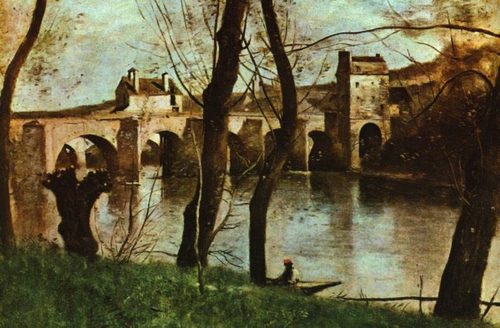
Jean-Baptiste-Camille Corot (1796–1875) was a French landscape painter who spent his career turning observed light into memory, opening a door the Impressionists would later walk through. Born to a comfortable Paris shopkeeping family, he trained under the academic landscapists Achille-Etna Michallon and Jean-Victor Bertin before making the first of three long stays in Italy, where he painted small, direct oil studies of the Roman countryside — pictures now prized for a freshness his own era considered merely preparatory.
For decades Corot ran two practices side by side: polished, mythologically staffed landscapes built for the Salon, and looser studies made outdoors. By the 1850s the two had merged into his mature style — silvery, feathery, softly composed "souvenir" landscapes recalled rather than copied from nature, which made him prosperous and widely loved. Known as "Père Corot" for his generosity, he quietly supported struggling colleagues, reportedly buying Honoré Daumier a house in his blind old age, and mentored the young Berthe Morisot. He never married. When he died in Paris in 1875, an entire generation of painters he had shaped, without ever meaning to found a school, mourned him.
How to recognize a Corot
silvery tonal harmony
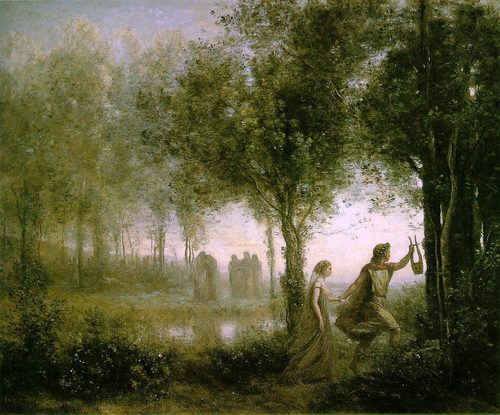
Corot builds his mature landscapes from a narrow scale of silver-greens and pearl-greys, letting a single warm accent — a red cap, a patch of gold light — carry the whole canvas's color interest.
feathery, tremulous foliage
Trees dissolve into soft, dabbed masses rather than individual leaves, their outlines trembling as if caught in a light breeze — a signature touch later painters tried and failed to imitate exactly.
plein air oil studies
His Italian sketches, painted directly before the motif in under an hour, favor plain geometric masses of architecture and land bathed in clear, even midday light, with almost no narrative incident.
lake, tree, and figure
Many mature compositions repeat a quiet formula: still water at the center, a feathery tree anchoring one side, and a small solitary figure or two, dwarfed by the pale, hazy surrounding atmosphere and softened distance.
the recalled, not the seen
Late "souvenir" landscapes are composed from memory in the studio, softened and simplified until they read as a mood — dawn or dusk haze — rather than a specific, mapped place.
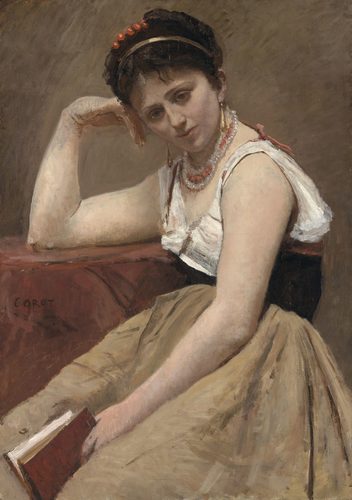
quiet studio figures
Lesser known in his lifetime, his figure paintings show solitary women reading, standing, or gazing quietly inward, painted with the same silvery restraint as his landscapes, and only rediscovered and prized decades later by younger admirers and collectors.
The life
Corot was born in Paris in 1796 to parents who ran a prosperous milliner's and drapery business. Groomed for trade, he instead persuaded his family, at twenty-six, to fund a painter's training and a modest yearly allowance — a support that freed him from ever needing to sell for survival. He studied under Achille-Etna Michallon and then Jean-Victor Bertin, both working in a tradition that prized direct outdoor oil sketching as preparation for finished studio landscapes.
Three extended stays in Italy, in 1825–28, 1834, and 1843, shaped his eye permanently; the small, sunlit studies he made there of Roman ruins and the Campagna are now considered among his finest work, though at the time they were private exercises, not exhibition pieces. He debuted at the Salon in 1827 and spent the following decades alternating between ambitious Salon paintings and looser open-air studies made across France.
By the 1850s his softer, silvery "souvenir" landscapes had found a wide public, and Corot became both famous and rich, buying property and supporting friends. He mentored younger artists, notably Berthe Morisot, and befriended the emerging Impressionists without ever formally joining their ranks. He died in Paris in February 1875, having never married, widely mourned as one of the most generous men in French art.
Timeline
- 1796Born in Paris to a shopkeeping family
- 1822Begins formal training under Michallon, then Bertin
- 1825First of three long painting trips to Italy
- 1827Makes his debut at the Paris Salon
- 1834Returns to Italy for a second extended stay
- 1843Makes a third and final trip to Italy
- 1855Wins wide recognition at the Exposition Universelle
- 1864Paints Souvenir de Mortefontaine, his best-known late work
- 1875Dies in Paris, mourned across the French art world
Most famous works
| Work | Date | Why it matters |
|---|---|---|
| The Bridge at Narni | 1826 | A small, direct Italian oil study prized today for a freshness his era saw only as a sketch. |
| Souvenir de Mortefontaine | 1864 | His most celebrated late landscape, a hazy, feathery lakeside scene recalled rather than observed. |
| Ville-d'Avray | 1860s | A series returning to a lake near his family's country house, epitomizing his silvery mature style. |
| Woman with a Pearl | c. 1868–70 | A quiet studio portrait echoing the Mona Lisa's pose, part of his lesser-known but influential figure work. |
| Chartres Cathedral | 1830 | A clear-eyed, architecturally precise view that shows his classical training at its most disciplined. |
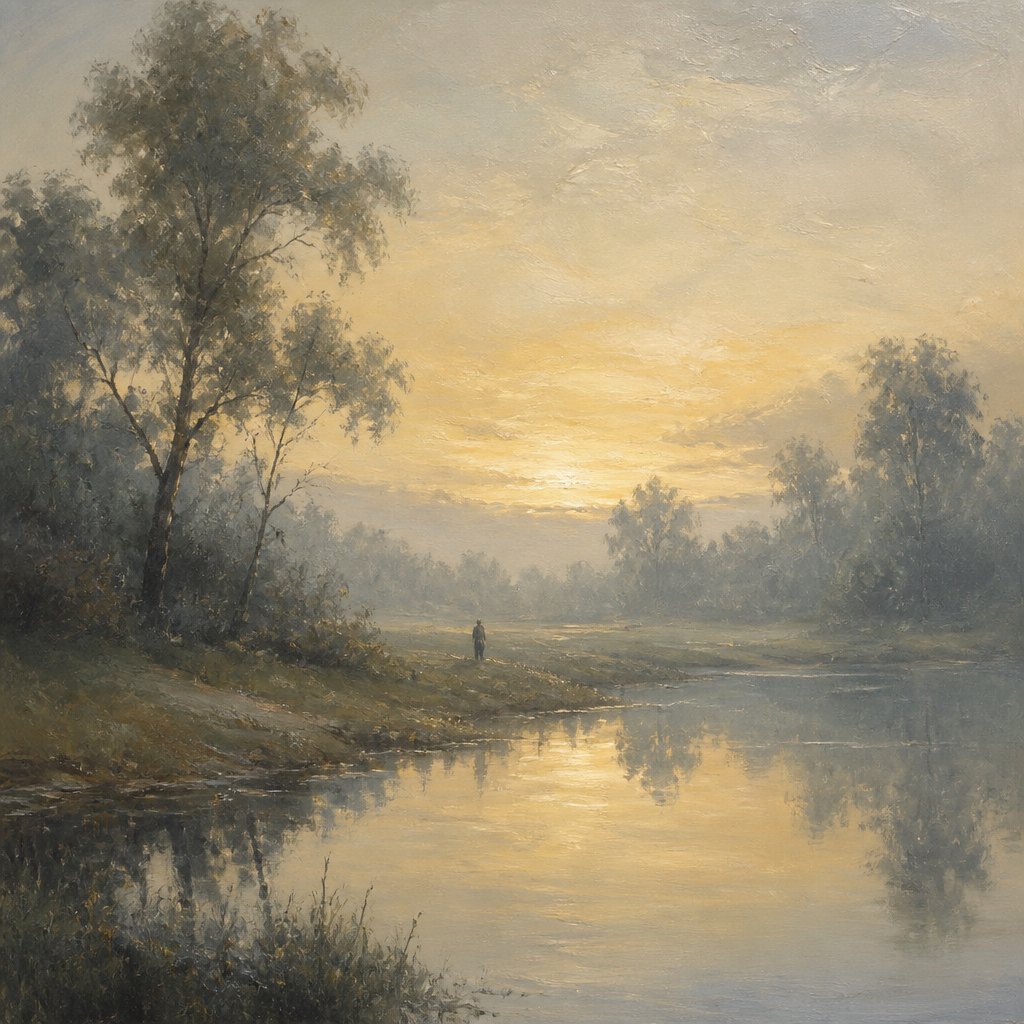 AI-generated
Create in the same spirit
Make Barbizon School art of your own
This AI interpretation echoes the aesthetic world Camille Corot worked in — it depicts no real artwork. Generate your own with the Barbizon School Art Style generator.
Open the Barbizon School Art Style generator →Legacy
Corot's silvery, atmospheric landscapes taught a generation of younger painters that a picture could be built from mood and memory rather than exact record. Camille Pissarro and Berthe Morisot studied directly under his influence; Claude Monet and Auguste Renoir both acknowledged a debt to his handling of light. His plein air Italian oil sketches, largely unseen in his own lifetime, are now recognized as some of the earliest steps toward Impressionism's outdoor practice. You feel him today whenever a landscape trades detail for atmosphere — in a soft grey morning, a tree caught mid-tremble, a horizon dissolving into haze rather than snapping into focus.
Frequently asked questions
What is Camille Corot famous for?
Corot is famous for silvery, atmospheric landscapes — especially his hazy "souvenir" scenes of lakes and feathery trees — and for plein air oil sketches from Italy that anticipated Impressionist practice.
Where can I see Corot's paintings?
Major holdings are at the Louvre and Musée d'Orsay in Paris, the Metropolitan Museum of Art in New York, and the National Gallery in London, among many other museums worldwide.
Did Corot influence the Impressionists?
Yes. He mentored Berthe Morisot directly, and painters including Pissarro, Monet, and Renoir studied and admired his handling of light, though Corot never joined the Impressionist exhibitions himself.
What movement did Corot belong to?
Corot worked alongside the Barbizon School and shared their commitment to direct study of nature, but his career bridges classical landscape tradition and the light-focused innovations that followed him.